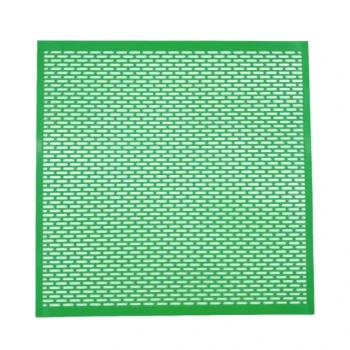
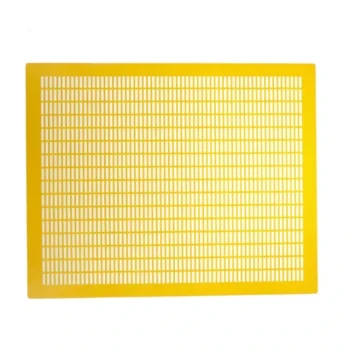
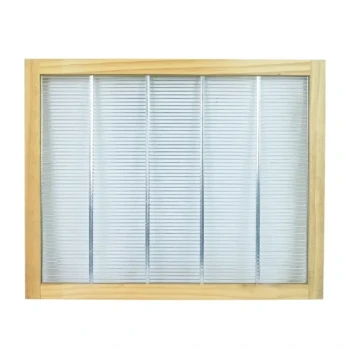
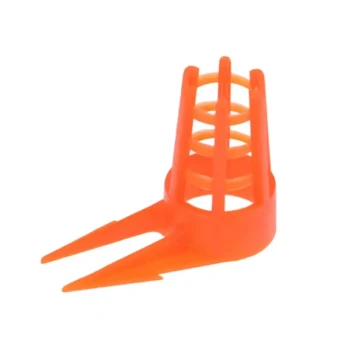
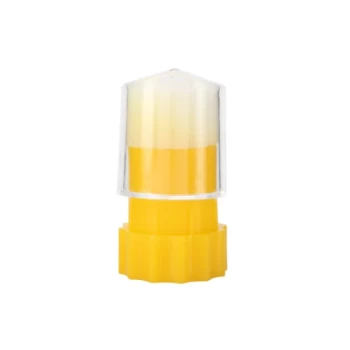
A queen excluder functions as a precise physical filter within the hive structure, acting as a critical control point for hive management. By utilizing a grid with strictly gauged gaps, it leverages the natural size difference between the larger queen bee and the smaller worker bees to create a selective barrier. This device allows workers to pass freely to store nectar while physically blocking the queen from entering specific upper sections of the hive.
Core Takeaway The queen excluder’s primary role is to strictly compartmentalize the hive, confining egg-laying to the lower brood chamber. This ensures that the upper honey supers remain free of larvae and organic residue, which is a non-negotiable requirement for harvesting high-grade, commercial-quality honey.
The Mechanics of Selective Exclusion
Precise Aperture Sizing
The excluder operates on a physical screening principle. It is not a solid wall, but a mesh or grid containing gaps of a specific metric.
These apertures are engineered to be large enough for worker bees to squeeze through but too narrow for the queen's larger abdomen. This size differential is the fundamental mechanism that makes the device effective.
Spatial Organization
By placing this barrier between the lower hive boxes (brood chambers) and the upper boxes (supers), you effectively zone the hive.
The queen is restricted to the bottom to lay eggs, while the workers traverse the barrier to fill the upper frames exclusively with honey.
Ensuring Commercial Grade Purity
Preventing Brood Contamination
The most critical function of the excluder is maintaining the purity of the harvest. Without this barrier, a queen will often move upward to lay eggs in the honey storage areas.
If this occurs, the honey frames become contaminated with larvae and cocoons. The excluder guarantees that the honey supers remain free of these organic residues and impurities.
Simplifying Processing
Honey harvested from frames that have never contained brood is significantly easier to process.
Because the comb is pure, the subsequent filtration and grading processes are simplified, resulting in a cleaner, higher-value final product.
Installation and Hive Management
Strategic Placement
The excluder is typically introduced when a honey super is added for hive expansion.
Before installation, the beekeeper must visually confirm the queen is in the lower brood box. The excluder is then placed directly on top of that box, followed by the honey super.
Encouraging Worker Movement
Workers may sometimes be reluctant to cross the barrier initially.
To encourage movement, a common technique involves moving a few frames of honey or sealed brood (ensuring no queen is present) from the lower chamber to the super above the excluder. This draws the nurse bees and foragers upward through the grid.
Understanding the Trade-offs
Management of Existing Brood
If you apply an excluder to a hive that already has brood in the upper supers, you cannot harvest immediately.
You must wait at least 24 days before extracting. This duration ensures that all worker brood (21-day cycle) and drone brood (24-day cycle) have hatched and vacated the cells.
Potential for Swarming
While the excluder helps organize the hive, restricting the queen too aggressively can lead to overcrowding in the brood chamber.
Suppressed movement can sometimes trigger swarm preparations if the lower box becomes honey-bound. Proper management requires monitoring the lower chamber to ensure the queen has ample space to lay.
Necessity in Large Setups
In hives utilizing multiple large brood bodies, an excluder may not always be mandatory.
In these spacious configurations, the queen often naturally remains in the lower sections, and the honey stored in the upper reaches remains relatively brood-free without a physical barrier.
Making the Right Choice for Your Goal
Whether or not to use a queen excluder depends on your specific objectives for the hive's output.
- If your primary focus is Commercial Purity: Use an excluder to guarantee honey is free of organic residue and to streamline the filtration process.
- If your primary focus is Colony Expansion: Consider delaying the use of an excluder until the honey flow is heavy, ensuring workers are not discouraged from moving up into the supers.
- If your primary focus is Low-Intervention Beekeeping: You may forego the excluder if using double brood boxes, accepting a small risk of brood in the honey for the sake of unrestricted bee movement.
Ultimately, the queen excluder is a tool for standardization, transforming a chaotic natural nest into a structured production unit capable of yielding clean, high-grade honey.
Summary Table:
| Feature | Function & Purpose | Key Benefit for Commercial Beekeeping |
|---|---|---|
| Aperture Design | Precise gaps (4.2mm - 4.3mm) | Blocks queen while allowing worker passage |
| Spatial Zoning | Confines queen to lower brood boxes | Keeps honey supers free of larvae and cocoons |
| Purity Control | Prevents organic residue in comb | Ensures high-grade, debris-free honey harvest |
| Processing | Standardizes honey frame content | Simplifies filtration and grading workflows |
| Management | Strategic placement during flow | Organizes hive structure for industrial efficiency |
Elevate Your Apiary’s Productivity with HONESTBEE
Maximize your honey purity and operational efficiency with professional-grade hive management solutions. As a premier partner for commercial apiaries and distributors, HONESTBEE provides a comprehensive wholesale catalog designed for scale.
Our value to your business includes:
- Precision Equipment: From high-quality queen excluders to specialized hive-making and honey-filling machinery.
- Complete Supply Chain: A full spectrum of beekeeping tools and essential industry consumables.
- Diverse Portfolio: Hardware, commercial-grade machinery, and unique honey-themed cultural merchandise.
Ready to streamline your production and secure high-volume supplies? Contact us today to discuss your wholesale needs and discover how our expertise can grow your beekeeping enterprise.
References
- Alemayehu Abebe, Alebachew Habtamu. Analysis of honey production systems in three agro-ecologies of Benishangul-Gumuz, Western Ethiopia. DOI: 10.5897/jaerd2014.0705
This article is also based on technical information from HonestBee Knowledge Base .
Related Products
- High Performance Plastic Queen Excluder for Beekeeping and Apiary Management
- Professional Plastic Queen Excluder for Modern Beekeeping
- Lightweight Durable Plastic Queen Excluder Scraper for Beekeeping
- Metal Queen Bee Excluder for Beekeeping
- Premium Wood Framed Metal Wire Queen Bee Excluder
People Also Ask
- What are the characteristics of a plastic queen excluder? Key Benefits for Cost-Effective Beekeeping
- What are the operational and cost advantages of using plastic queen excluders over metal or wire excluders in commercial hive management? Discover how they reduce labor, prevent wing damage, and lower total costs.
- What types of queen excluders are available for beekeepers? Choose the Right Tool for Your Hive
- Why are standardized hive frames and queen excluders essential for maintaining honey purity and quality? Scale Your Purity
- Do plastic queen excluders work? A Cost-Effective Solution for Modern Apiaries