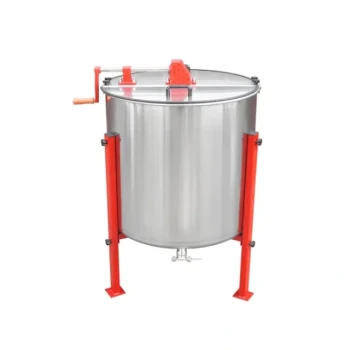
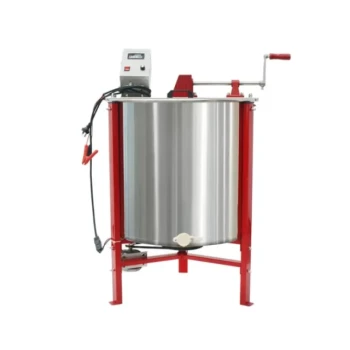
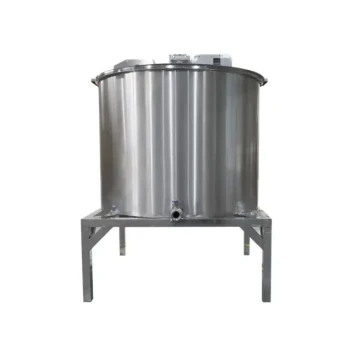
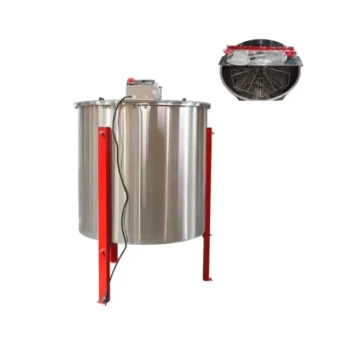
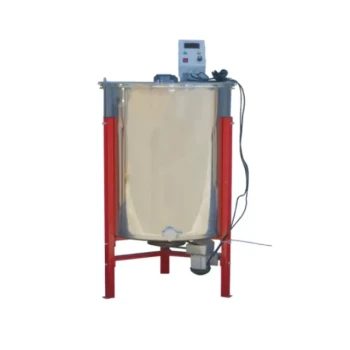
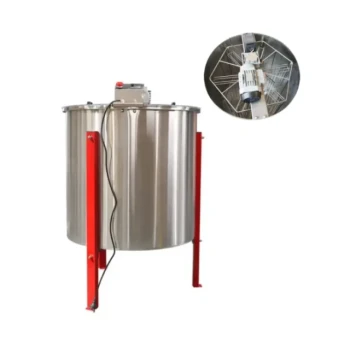
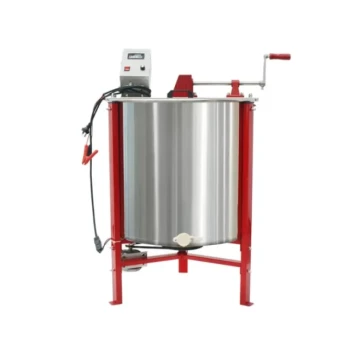
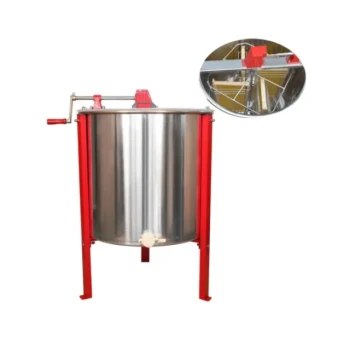
A radial honey extractor operates by positioning honeycomb frames vertically, arranged like the spokes of a wheel, and utilizing centrifugal force to fling liquid honey out of the wax cells. This specific orientation aligns the natural upward slope of the honeycomb cells with the spinning force, allowing honey to be expelled from both sides of the frame simultaneously without the need to flip the frames.
Core Takeaway: The radial extractor’s primary advantage is efficiency through simultaneous extraction. By orienting frames with the top bar facing the outer wall, it removes honey from both sides of the comb at once, significantly reducing labor and processing time compared to tangential models.
The Mechanics of Radial Extraction
Frame Orientation and Geometry
In a radial design, the frames are placed in the basket on end, facing inwards. They sit vertically, radiating out from the center axis like the spokes on a bicycle wheel.
Crucially, the bottom bars face the center of the cage, while the top bars face the outer wall of the drum. This utilizes the natural geometry of the honeycomb, where cells slope slightly upward.
Centrifugal Force and Simultaneous Extraction
When the central basket spins, it generates centrifugal force. Because of the "spoke" arrangement, this force acts on both sides of the comb at the exact same time.
The honey moves out of the uncapped cells, travels across the surface of the comb, and is flung against the inner walls of the extractor drum. This eliminates the manual step of pausing the machine to flip the frames, which is required in tangential extraction.
Collection and Drainage
Once the honey hits the inner walls, gravity takes over. The honey runs down the sides of the drum and pools at the bottom.
From the reservoir at the base, the honey is drained through a tap (honey gate) or removed via a pump for filtering and bottling.
Operational Workflow
The Importance of Variable Speed
The extraction process typically begins with a slow rotation. Starting at full speed immediately can damage the wax combs due to the weight of the honey.
As the honey begins to leave the cells and the frames become lighter, the speed is gradually increased. The primary reference notes that while smaller models can be manual, most radial extractors are motorized to handle this sustained, high-speed spinning efficiently.
Handling Different Frame Sizes
Radial extractors are highly efficient for medium and shallow frames. However, extracting honey from larger, deep frames can sometimes be physically difficult due to the distance the honey must travel.
To address this, some smaller radial extractors include screens or cages. These allow the operator to place large frames tangentially (flat side facing the wall) when necessary, effectively making the machine a hybrid device.
Understanding the Trade-offs
Mechanical Efficiency vs. Complexity
Radial extractors are generally mechanically simpler to operate because they do not require stopping to reverse frames. However, they often require a larger diameter drum to accommodate the frames radially, which increases the machine's footprint.
Frame Stress and Integrity
Because radial extractors rely on the slope of the cell to release honey, they often require higher rotational speeds than tangential units to get the comb completely dry.
If the operator increases the speed too quickly, the pressure can occasionally damage weak or unwired combs. However, because the force is applied along the length of the comb rather than pushing it sideways out of the frame, radial extraction is generally safer for preserving the comb structure for reuse.
Making the Right Choice for Your Goal
Whether a radial extractor is the correct tool depends on your volume and the specific equipment you manage.
- If your primary focus is high-volume efficiency: The radial extractor is the superior choice because it processes both sides of the comb simultaneously, drastically cutting down cycle times.
- If your primary focus is handling exclusively deep frames: You may encounter difficulty fully emptying deep cells radially; look for a model that includes screens for tangential adaptation or ensure the motor is powerful enough to generate the required force.
- If your primary focus is commercial scalability: A motorized radial extractor is the standard, as it automates the "slow-to-fast" speed progression and minimizes manual labor.
For most beekeepers expanding beyond a few hives, the radial extractor represents the transition from hobbyist experimentation to semi-professional efficiency.
Summary Table:
| Feature | Radial Honey Extractor Specification |
|---|---|
| Extraction Method | Centrifugal force applied to both sides simultaneously |
| Frame Orientation | Vertical, radiating like wheel spokes (top bar facing out) |
| Best For | Commercial scalability, medium/shallow frames, high volume |
| Key Advantage | No need to flip frames; significantly reduced labor time |
| Operational Tip | Start at slow speeds to preserve wax comb integrity |
| Collection | Gravity-fed drainage through a bottom honey gate |
Scale Your Honey Production with HONESTBEE
Transition from hobbyist to professional with high-performance extraction solutions. HONESTBEE specializes in catering to commercial apiaries and distributors, providing a comprehensive wholesale range of beekeeping machinery.
From motorized radial extractors to specialized honey-filling machines and durable hive-making hardware, we supply the full spectrum of equipment and industry consumables needed to run a successful operation.
Ready to upgrade your efficiency?
Contact HONESTBEE Today to discover how our professional-grade tools and cultural merchandise can add value to your business.
Related Products
- 24 Frame Honey Extractor Commercial Radial Honey Frame Extraction Machine
- Stainless Steel Manual 8 Frame Radial Honey Extractor Machine for Beehives
- 6 Frame Manual Stainless Steel Honey Extractor Beekeeping Equipment
- HONESTBEE 8 Frame Electric and Manual Three Use Honey Extractor
- Electric 4 Frame Tangential Honey Extractor
People Also Ask
- How does a radial honey extractor leverage the natural structure of a honeycomb? Optimize Your Apiary's Efficiency
- How do modern honey extraction machines improve harvest efficiency? Boost Your Yield with Radial Technology
- Why must the head of the honey comb be placed near the center axis? Protect Your Comb During Radial Extraction
- Why is the width of iron rings varied for radial honey extractor tilt? Optimize Your Harvest with Precise Engineering
- What are the operational differences between radial and tangential honey extractors? Maximize Your Harvest Efficiency