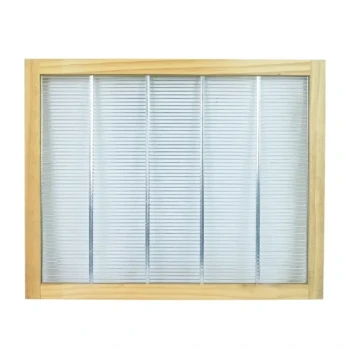
A wire grid with square inch markings serves as a precision overlay tool that transforms irregular biological patterns into quantifiable data. By placing this grid directly over a hive frame, beekeepers can segment scattered patches of capped brood into countable geometric units, applying a standard conversion factor of 25 cells per square inch to calculate total population.
The primary value of the grid is its ability to convert subjective visual estimates into objective scientific metrics. It enables the rigorous assessment of colony health and productivity by determining exact brood coverage and measuring the specific impact of environmental or nutritional changes.
Converting Irregularity into Data
The Challenge of Biological Patterns
Honeybees do not build or lay eggs in perfect geometric shapes. Capped brood areas are often irregular, scattered, or broken up by honey and pollen stores.
This makes simple visual estimation unreliable. Without a reference system, it is nearly impossible to accurately judge the surface area of reproductive activity.
The Grid as a Standardization Tool
The wire grid acts as a physical coordinate system. When placed over the frame, it imposes a rigid structure on the organic honeycomb.
This allows the observer to count specific square units rather than guessing the size of a blob. It turns a visual assessment into a counting task.
The Mathematics of Measurement
The system relies on a consistent mathematical baseline. The primary reference establishes that one square inch of grid area corresponds to approximately 25 worker cells.
By counting the number of "full" square inches occupied by capped brood and multiplying by 25, a precise cell count is generated.
Scientific Applications
Assessing Nutritional Interventions
Using this quantitative method allows for the scientific evaluation of supplements. Beekeepers can measure the exact expansion of brood area before and after introducing new nutrition.
This distinguishes between genuine colony growth and random seasonal fluctuation. It provides hard data on whether a specific supplement is driving colony development.
Comparing Treatment Efficacy
The grid is essential for measuring the recovery of a colony from disease. As noted in supporting methodologies, this approach allows for the calculation of infection reduction percentages.
By quantifying healthy versus infected cells, researchers can objectively compare different protocols, such as antibiotics versus essential oils, to see which yields better productivity recovery.
Understanding the Limitations
The Trade-off of Precision vs. Speed
While a wire grid offers high precision, it requires significantly more time than a visual "guesstimate." It requires physical manipulation of the frames and manual counting.
This method is best suited for scenarios where data accuracy is more critical than speed, such as research trials or critical health assessments.
The Assumption of Uniformity
The "25 cells per square inch" figure is a standard average. It assumes a relatively uniform comb structure.
Variations in comb drawing or high concentrations of drone brood (which are larger) can slightly alter the actual cell density, though the grid remains accurate for standard worker brood.
Applying This Measurement Strategy
If your primary focus is Scientific Research:
- Use the grid to generate exact cell counts to statistically prove the impact of nutritional supplements or environmental factors.
If your primary focus is Disease Management:
- Utilize the grid to track the precise percentage of infection reduction over time to determine if a treatment protocol is failing or succeeding.
If your primary focus is General Hive Management:
- Employ the grid periodically to benchmark seasonal growth, ensuring your colony is meeting standard developmental milestones.
By moving from observation to calculation, you turn hive management into an exact science.
Summary Table:
| Feature | Description | Benefit |
|---|---|---|
| Measurement Unit | 1 Square Inch Grid | Standardizes irregular biological shapes |
| Conversion Factor | 25 Worker Cells per Sq. Inch | Enables exact population calculations |
| Data Objective | Quantitative Metrics | Removes subjectivity from health assessments |
| Key Application | Research & Disease Tracking | Measures supplement efficacy and treatment recovery |
| Accuracy | High Precision | Provides hard data for scientific hive management |
Elevate Your Apiary Management with HONESTBEE
At HONESTBEE, we specialize in empowering commercial apiaries and distributors with the high-precision tools necessary for modern beekeeping. Whether you are conducting scientific research or managing large-scale honey production, our comprehensive wholesale portfolio offers everything from specialized hive-making and honey-filling machinery to essential industry consumables and premium beekeeping equipment.
Why partner with HONESTBEE?
- Professional Grade: We supply heavy-duty machinery designed for industrial efficiency.
- Complete Solutions: Access a full spectrum of tools, hardware, and honey-themed cultural merchandise.
- Wholesale Excellence: Tailored support for distributors looking to scale their product offerings.
Ready to transform your operation with industry-leading technology? Contact us today to explore our wholesale catalog and discover how HONESTBEE can drive your productivity forward.
References
- Ahmed Elhady. INFLUENCE OF SOME POLLEN SUBSTITUTES ON BROOD REARING OF HONEY BEE AND WORKERS LONGEVITY. DOI: 10.21608/jppp.2012.83764
This article is also based on technical information from HonestBee Knowledge Base .
Related Products
- HONESTBEE Professional Frame Wiring Board and Jig
- HONESTBEE Durable Frame Wiring Board with Integrated Tensioner
- Professional Large-Format Hive Number Set for Beekeeping
- Durable Plastic Hive Number Set for Beekeeping
- Modern Flat-Mount Hive Number Set for Beekeeping
People Also Ask
- How to wire a bee frame? A Step-by-Step Guide for Strong, Durable Honeycomb
- What is the final step in wiring a frame? Secure Lasting Tension for a Durable Hive
- What is minimalist bee frame wiring? Learn the Risks and Benefits for Beekeeping
- What tools and materials are required for wiring a beehive frame? Essential Equipment for Stronger Honeycomb
- What is the purpose of the frame wiring jig? Speed Up Bee Frame Wiring in Under 90 Seconds