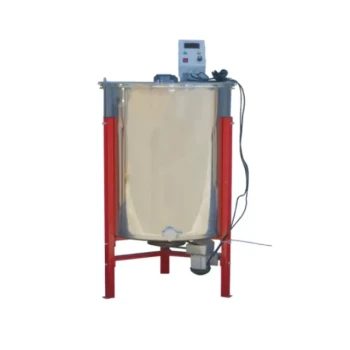
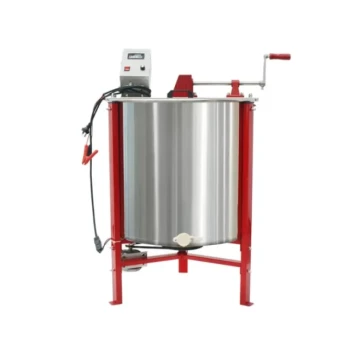
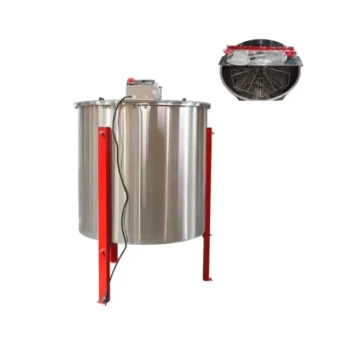
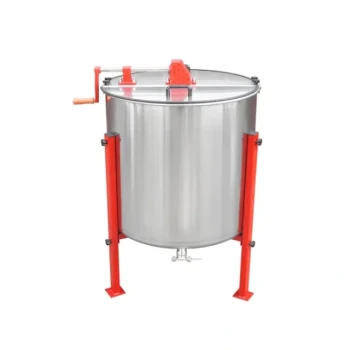
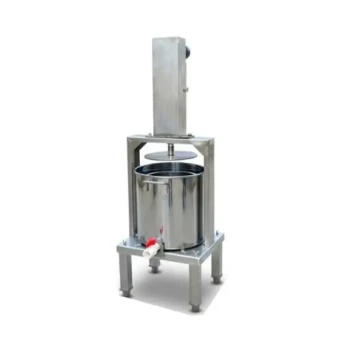
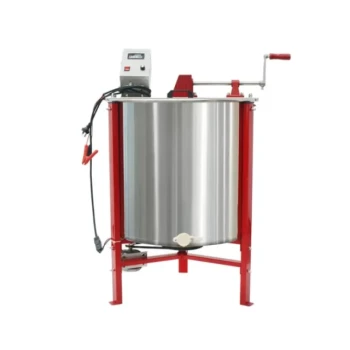
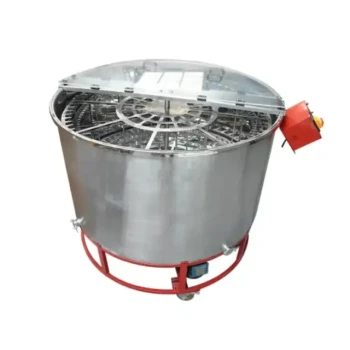
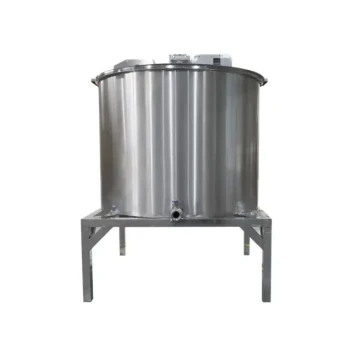
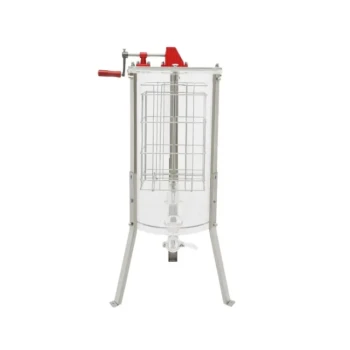
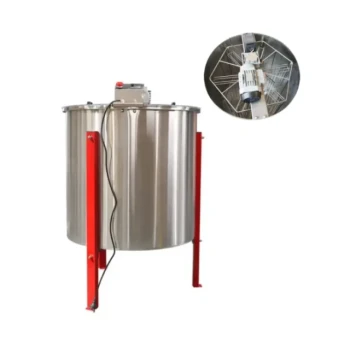
Centrifugal honey extractors protect hive comb by removing honey from reusable frames rather than crushing or pressing the wax. Their controlled rotational force separates liquid honey from the comb while preserving the beeswax foundation, allowing the emptied frames to return to the hive quickly. This reduces manual handling, shortens the production cycle, and helps beekeepers increase output without forcing colonies to rebuild comb after every harvest.
The central efficiency gain is comb reuse: centrifugal extraction turns filled frames into reusable production assets, saving colony energy and reducing the time, labor, and material required for the next honey flow.
How Centrifugal Extraction Preserves Hive Comb
It removes honey without destroying the comb
Traditional destructive harvesting can require honeycombs to be cut, crushed, or otherwise damaged. Centrifugal machinery instead places removable hive frames inside a rotating extractor.
As the basket spins, centrifugal force pulls honey from the cells while the wax comb and its foundation remain substantially intact. The machine separates the liquid from the solid comb without relying on pressing that could deform or break the structure.
It preserves the comb architecture
Honeycomb is not merely packaging for honey; it is a reusable production structure within the hive. When the comb remains intact, bees can continue using the existing cells for future storage.
This is particularly valuable for commercial apiaries using removable-frame systems such as Langstroth and Dadant hives. The frame can be extracted, returned, and placed back into the colony without requiring complete comb reconstruction.
It reduces damage from repeated handling
A suitable extractor supports the frames during rotation and reduces the need to manually scrape or crush honeycomb. Less physical manipulation helps protect the wax foundation and supports more consistent processing across larger batches.
For distributors and resellers, this makes frame compatibility, machine construction, operating controls, and after-sales support important purchasing considerations—not just nominal extraction capacity.
Why Comb Reuse Improves Harvesting Efficiency
Bees spend less energy rebuilding wax
Producing new wax requires substantial colony resources. If the comb is destroyed during harvest, bees must redirect energy and stored food toward rebuilding cells rather than toward honey production and colony development.
Returning intact frames allows the colony to resume using existing comb. This reduces the biological recovery burden and helps preserve more productive energy within the hive.
The next production cycle starts sooner
Empty, intact frames can be returned to the hive for immediate reuse. Beekeepers do not need to wait for bees to construct an equivalent wax structure before the colony can refill the cells.
The result is a shorter preparation period between harvests and a more continuous production cycle, especially when managing many colonies or repeated extraction schedules.
It increases usable honey yield over time
The efficiency benefit is cumulative. Each preserved frame can support multiple production cycles instead of becoming a one-time harvesting material.
For commercial operations, this can improve long-term bulk yield, reduce comb replacement requirements, and make labor and equipment investment more productive.
It reduces manual labor and processing loss
Mechanized rotation extracts honey more quickly and consistently than manual crushing or pressing. This reduces the labor required per batch and minimizes the material loss associated with damaged comb.
The process also supports a cleaner liquid-solid separation, helping beekeepers handle honey efficiently before filtration, settling, or packaging.
What Determines Real-World Performance
Correct frame and extractor compatibility
The extractor must match the hive frames being used. A machine that does not properly accommodate Langstroth, Dadant, or another frame format can cause poor support, uneven loading, or comb damage.
Before purchasing, distributors and beekeepers should confirm frame dimensions, basket configuration, capacity, and whether the machine supports the intended operating method.
Balanced loading is essential
Frames should be loaded evenly so the rotating basket remains balanced. Uneven loading can create vibration, increase mechanical stress, and reduce extraction consistency.
Clear operating instructions and responsive technical support are therefore part of the equipment’s practical value, particularly for first-time users or high-volume buyers.
Controlled operation protects delicate wax
Rotation must be appropriate for the condition and strength of the comb. Excessive or poorly managed force can damage weak, newly built, or improperly supported comb even though centrifugal extraction is generally gentler than destructive methods.
A reliable machine should therefore combine effective rotation with stable frame support, robust construction, and usable controls.
Understanding the Trade-offs
Centrifugal extraction requires removable frames
The method depends on removable frame hives. It is not directly suited to harvesting systems in which combs are fixed permanently inside the hive unless those combs can first be transferred into compatible frames.
This makes hive-system compatibility a basic requirement rather than an optional feature.
Equipment requires upfront investment
A centrifugal extractor costs more initially than simple manual crushing tools. The investment includes not only the machine but also installation, cleaning, maintenance, and operator training.
The business case becomes stronger when the equipment is used regularly, across multiple colonies, or as part of commercial processing and wholesale supply.
Preserving comb does not eliminate all damage risks
The comb must still be handled correctly before, during, and after extraction. Weak wax, poor frame loading, unbalanced rotation, and unsuitable operating conditions can reduce the preservation benefit.
The machine protects comb integrity most effectively when paired with sound beekeeping practices and a properly specified extractor.
Capacity should match the operation
A small extractor may be economical for a hobbyist but inefficient for a commercial apiary. Conversely, buying excessive capacity can increase capital cost without improving utilization.
Distributors should assess the customer’s colony count, harvest frequency, frame type, labor availability, and expected growth before recommending a model.
Why This Matters for B2B Sourcing
Product selection should go beyond machine specifications
Buyers need more than a stated capacity or rotation speed. They should evaluate frame compatibility, construction quality, operational stability, cleaning requirements, spare-parts availability, and service responsiveness.
A supplier with a full-spectrum portfolio can help coordinate extractors with related harvesting, filtration, storage, and handling equipment.
Reliable fulfillment affects harvesting schedules
Honey harvesting is time-sensitive. Delayed delivery, incomplete orders, or unavailable replacement parts can interrupt the production cycle and reduce the value of comb-preserving equipment.
For wholesalers, resellers, and commercial beekeepers, rapid response, efficient order fulfillment, and dependable delivery are operational advantages, not merely purchasing conveniences.
Technical support protects the expected return
Correct setup and use directly influence comb preservation, extraction efficiency, and equipment life. Dedicated customer service and professional guidance can help reduce avoidable operating errors.
This is especially important when supplying different markets with varied hive systems, user experience levels, and production scales.
How to Apply This to Your Project
Select the equipment according to the production system, not simply the lowest purchase price.
- If your primary focus is comb preservation: Choose a frame-compatible centrifugal extractor with stable support and controlled operation, then match it with careful loading and handling practices.
- If your primary focus is higher honey output: Prioritize suitable batch capacity, efficient rotation, and a workflow that allows emptied frames to return to the hive quickly.
- If your primary focus is commercial distribution: Work with a supplier offering a broad product portfolio, reliable technical expertise, responsive service, and fast, complete order fulfillment.
- If your primary focus is long-term operating value: Compare the equipment’s upfront cost with reduced comb replacement, lower manual labor, shorter production cycles, and improved repeat-harvest potential.
The right centrifugal extractor protects a valuable biological asset—the hive’s existing comb—while converting faster, cleaner extraction into more efficient and repeatable honey production.
Summary Table:
| Aspect | Centrifugal Extraction | Destructive Methods |
|---|---|---|
| Comb integrity | Preserved, reusable | Destroyed, must be rebuilt |
| Honey separation | By centrifugal force | By crushing or pressing |
| Time to next harvest | Faster (frames immediately reusable) | Slower (bees rebuild comb) |
| Labor required | Lower (mechanized) | Higher (manual) |
| Long-term yield | Higher (multiple cycles per comb) | Lower (comb replaced frequently) |
| Suitable for | Removable-frame hives (Langstroth, Dadant) | Fixed comb may require special handling |
Optimize your honey harvest with HONESTBEE's premium centrifugal extractors. Our equipment ensures comb integrity, boosts efficiency, and supports your entire apiary operation. With a full spectrum of beekeeping tools and rapid delivery, we're your trusted partner for sustainable growth. Contact us today to discuss your needs and discover how we can enhance your productivity.
Related Products
- electric honey extractor honey centrifuge 3 frame honey extractor stainless steel honey frame extractor
- Manual Hand Crank 4 Frame Honey Extractor Centrifuge for Beekeeping
- Professional 4 Frame Self Reversing Electric Honey Extractor for Beekeeping
- 24 Frame Honey Extractor Commercial Radial Honey Frame Extraction Machine
- Stainless Steel Manual 8 Frame Radial Honey Extractor Machine for Beehives
People Also Ask
- What are the characteristics of electric honey extractors? Boost Your Apiary Efficiency with Automated Technology
- What are the disadvantages of using an electric honey extractor? Weighing Cost, Power, and Comb Safety
- What are the advantages of an electric honey extractor? Boost Efficiency and Scale Your Honey Production
- What are the technical advantages of electric honey extractors? Maximize Yield and Protect Your Bee Colony
- How does an electric honey extractor affect the quality of honey? Preserve Flavor & Purity with Precision Extraction