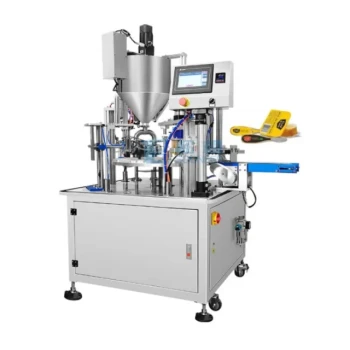
Professional honey filling equipment secures organic integrity by executing precise, automated filling within sterile environments. This isolation prevents environmental contaminants from compromising the product, while accurate dosage and sealing mechanisms actively preserve the honey's natural antioxidant activity and nutritional composition.
By eliminating manual handling and strictly controlling environmental exposure, industrial filling machinery transforms raw organic honey into a standardized commercial product without sacrificing its biological value or purity.
The Mechanics of Purity Preservation
Eliminating Secondary Contamination
The most critical threat to organic honey during processing is secondary contamination caused by human contact.
Automated equipment replaces manual scooping and pouring with mechanized operations. This ensures the product remains additive-free and avoids exposure to bacteria or foreign substances that often accompany manual packaging.
The Role of Enclosed Systems
High-end machinery utilizes fully enclosed filling systems to isolate the honey from the surrounding facility air.
This protects the liquid from airborne pollutants and dust. It ensures that no non-organic substances inadvertently mix with the product during the transition from storage tank to bottle.
Filtration and Impurity Removal
Before filling, the equipment often integrates multi-stage filtration systems.
This process removes physical impurities, such as wax particles or debris, without stripping the honey of its essential properties. It guarantees a texture that meets commercial standards while adhering to organic production policies.
Stabilizing Biological Integrity
Preserving Nutritional Value
Organic honey is prized for its enzymes, glucose, fructose, and antioxidant activity.
Professional equipment minimizes exposure to extreme heat and prolonged processing times. By maintaining strict control over the flow and environment, the machinery prevents the degradation of these heat-sensitive nutritional components.
Managing Moisture and Fermentation
Excess moisture is the primary cause of honey fermentation and spoilage.
Advanced processing tools stabilize moisture content through precision temperature-controlled concentration. This protects the honey from fermenting in the bottle, ensuring it retains its natural flavor and prevents the development of off-tastes.
Protection from Oxidation
Exposure to air and moisture can alter the honey's natural color and accelerate spoilage.
Sealing processes and food-grade storage tanks minimize the honey's contact with oxygen. This helps secure higher market prices by maintaining the visual appeal and chemical purity required by high-end distributors.
Achieving Commercial Consistency
Precision Dosage Control
For organic producers scaling up, consistency is a requirement for retail distribution.
Quantitative control systems ensure every unit contains the exact same net weight. This standardization is vital for meeting legal labeling requirements and ensuring economic sustainability.
Operational Efficiency
Automated systems feature anti-drip designs and handle varying viscosities effectively.
This prevents waste and keeps the packaging line hygienic. It allows producers to maintain high speeds without the messy residue that typically plagues manual honey bottling operations.
Understanding the Trade-offs
Maintenance and Sterility Requirements
While these machines prevent contamination, they introduce a new requirement: rigorous equipment hygiene.
The complex internal piping and valves of enclosed systems must be cleaned extensively. If the cleaning protocol fails, the equipment itself can become a source of contamination, negating the benefits of automation.
Balancing Processing with "Raw" Status
There is a fine line between cleaning honey and over-processing it.
Excessive filtration or heating—even if intended to stabilize the product—can strip honey of pollen and enzymes. Producers must carefully calibrate equipment to ensure they meet "organic" standards without inadvertently creating a sterile but nutrient-void syrup.
Making the Right Choice for Your Goal
To select the right equipment configuration, identify your primary market objective:
- If your primary focus is Strict Organic Certification: Prioritize fully enclosed systems with high traceability features to prove zero contamination to certifying bodies.
- If your primary focus is High-End Retail Aesthetics: Prioritize machinery with anti-drip nozzles and filtration capable of removing visible impurities without heating the honey.
- If your primary focus is Shelf-Life Stability: Prioritize equipment with moisture control capabilities to prevent fermentation during long-term storage.
True professional equipment does not just package honey; it acts as a guardian of the product's natural state against the variables of the industrial environment.
Summary Table:
| Quality Pillar | Equipment Mechanism | Benefit to Organic Honey |
|---|---|---|
| Purity | Fully enclosed systems | Prevents secondary contamination and airborne pollutants. |
| Nutrition | Precision temperature control | Preserves heat-sensitive enzymes and antioxidant activity. |
| Stability | Moisture concentration & sealing | Prevents fermentation and oxidation for longer shelf life. |
| Consistency | Quantitative dosage control | Ensures precise net weights and reduces product waste. |
| Efficiency | Anti-drip nozzles | Maintains a hygienic packaging line with high-speed output. |
Elevate Your Honey Processing with HONESTBEE
At HONESTBEE, we understand that maintaining the biological integrity of organic honey is paramount for commercial apiaries and global distributors. Our professional-grade beekeeping machinery—from automated honey-filling machines to specialized concentration tools—is designed to eliminate contamination while preserving natural nutritional value.
Whether you are looking to scale your production or supply high-end retail markets, we provide the full spectrum of equipment and beekeeping consumables tailored to your operational needs. Partner with the industry experts to secure your product's purity.
Contact HONESTBEE Today for a Professional Consultation
References
- I Dobre, G. Cotor. The principles and the regulation of organic beekeeping – Conditions for ensuring the organic honey on the community market. DOI: 10.1016/j.jbiotec.2016.05.235
This article is also based on technical information from HonestBee Knowledge Base .
Related Products
- Precision Durable Efficient HONESTBEE Rotary Honey Filling Machine
- Small Honey Filling Machine Sachet Packing Equipment Single Nozzle
- Double Nozzle Small Honey Filling Machine Honey Sachet Packing Packaging Equipment
- Economy Small Honey Filling Machine Honey Bottle Filler Packaging Machine
- Automatic Honey Filling and Filtering Machine for Beekeeping Bottle Filling
People Also Ask
- How do high-precision honey filling machines ensure quality? Optimize Your Commercial Production with HONESTBEE
- What are the common types of bottling machines used for honey? Choosing the Right Solution for Your Apiary
- How do honey filling and processing machines aid native bee product conservation? Boost Value with HONESTBEE Technology
- What is a key feature of the new generation of the honey filling machine? The Advanced Electronic Control Unit
- How do honey filling machines work? Achieve Precision & Speed for Your Apiary