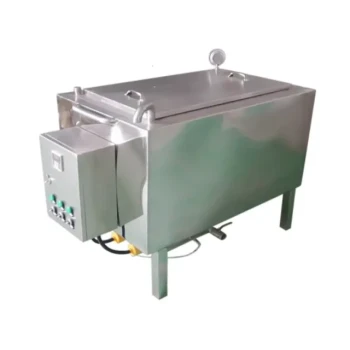
The heating process for a wax melting vat serves as a clarifying process by leveraging gravity and controlled cooling to separate contaminants from the liquid wax. When the insulated vat is heated to 190°F and then turned off, the lack of active agitation allows suspended impurities to sink, effectively filtering the material.
The clarifying effect is largely a result of the slow cooling process rather than the heating itself; by allowing the wax to sit undisturbed overnight, heavier dirt particles settle to the bottom, leaving the upper layers of wax cleaner and lighter in color.
The Mechanics of Passive Clarification
The Thermal Cycle
The process begins by bringing the insulated melting vat to a specific temperature of 190°F. This ensures the wax is fully liquefied and sufficiently fluid to allow particulates to move.
The Settling Phase
Once the target temperature is reached, the heat is turned off to initiate an overnight cooling phase. Because the vat is insulated, the wax cools slowly, preventing immediate solidification.
Gravitational Separation
During this undisturbed period, suspended dirt and impurities naturally drift downward. Gravity pulls these heavier particles out of the suspension, clearing the main body of the wax.
Visual Confirmation
The success of this process is often immediately visible the following morning. The wax typically appears lighter in color because the dark, suspended particulates have been removed from the mix.
Maintenance and Residue Management
Handling the Sediment
The impurities do not vanish; they accumulate as a fine "slum" or dirty wax layer at the very bottom of the vat. This layer must be managed to prevent it from remixing with the clean wax.
The Solidification Technique
To permanently remove these contaminants, you should drain the wax and allow it to harden into cakes. The dirty residue will settle on the underside of the solidified cake, where it can be scraped off and discarded.
Periodic Deep Cleaning
In addition to scraping the wax cakes, the vat itself requires attention. It is recommended to perform a deep clean every 2-3 months to physically remove the accumulated sludge from the bottom of the tank.
Understanding the Trade-offs
Production Downtime
This clarifying method requires the vat to remain static overnight. This means you cannot continuously process wax 24/7 if you wish to utilize this settling feature.
Manual Labor Required
While the separation is passive, the removal of the waste is manual. You must commit to the periodic schedule of draining, scraping cakes, and cleaning the vat floor to maintain efficiency.
How to Apply This to Your Project
To ensure high-quality wax production, balance your daily operations with periodic maintenance:
- If your primary focus is product clarity: Establish a daily routine of heating to 190°F and allowing the vat to cool undisturbed overnight to settle suspended dirt.
- If your primary focus is equipment longevity: Schedule a complete drain and deep clean of the vat's bottom every 2-3 months to remove the "slum" layer.
By treating your heating cycle as a purification step, you passively enhance the quality of your raw material with every batch.
Summary Table:
| Process Phase | Action Taken | Resulting Effect |
|---|---|---|
| Heating | Heat insulated vat to 190°F | Liquefies wax to allow particulate movement |
| Settling | Turn off heat & sit undisturbed | Slow cooling allows gravity to pull impurities down |
| Clarification | Overnight passive cooling | Heavier dirt settles; upper wax becomes lighter/cleaner |
| Maintenance | Scrape cake bottom / Deep clean | Removes accumulated 'slum' and prevents re-contamination |
Elevate Your Wax Production with HONESTBEE
At HONESTBEE, we specialize in empowering commercial apiaries and beekeeping distributors with the professional tools needed for high-purity results. Whether you are looking for advanced insulated wax melting vats, honey-filling machines, or specialized hive-making equipment, our comprehensive wholesale portfolio is designed to maximize your efficiency and product quality.
Why partner with HONESTBEE?
- Expert Equipment: From industrial machinery to essential consumables, we supply the full spectrum of beekeeping hardware.
- Quality Assurance: Our tools are engineered to support delicate processes like passive clarification and thermal management.
- Wholesale Support: Tailored solutions for large-scale operations and distributors worldwide.
Ready to upgrade your apiary’s processing capabilities? Contact us today to explore our wholesale offerings!
Related Products
- Professional Stainless Steel Wax Melter for Beekeeping and Crafts
- Electric Commercial Beeswax Melter for Factory Use
- Steam Beeswax Melter Wax Warmer for Wax Processing
- Beeswax Melter for Candle Making Honey Bee Wax Melter
- Solar Beeswax Melter Easy Solar Wax Melter for Beeswax
People Also Ask
- What are the benefits of using a professional wax melter? Achieve Consistent, Scalable, and Safe Production
- What are the two main types of wax melters available? A Guide to Direct vs. Indirect Heat
- What are the types of wax melters available? Choose the Right Heating Method for Your Project
- What is the fundamental operating principle of a wax melter? Master the Thermal Phase Change for Pure Beeswax
- What do you use a wax melter for? From Home Fragrance to Professional Beekeeping