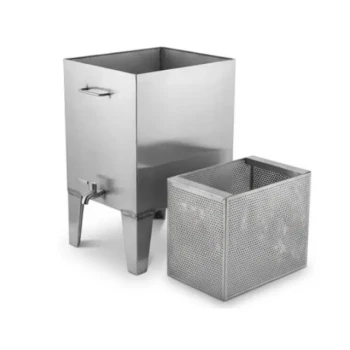
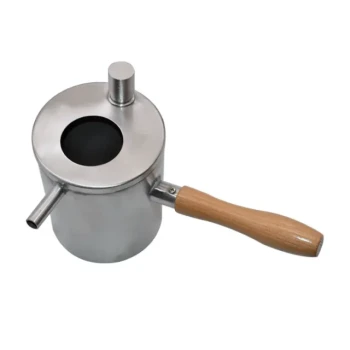
The water bath method cleans beeswax by melting it directly in water, utilizing density differences to separate the wax from debris. You simply heat uncleaned wax and water together in a dedicated pot; as the mixture cools, the clean wax floats to the top and hardens into a block, while heavy impurities and honey residue settle into the dirty water below.
The core principle of this method is gravity separation. Because beeswax is less dense than water, it naturally rises to the surface, leaving water-soluble contaminants and heavy particulates trapped in the water or settled at the bottom of the container.
The Step-by-Step Process
preparing Your Equipment
Select a large pot that you are willing to dedicate solely to wax processing, as beeswax is incredibly difficult to remove from cookware.
Add a few cups of water to the pot. The water acts as a buffer to prevent the wax from burning and provides the medium for separation.
The Melting Phase
Place your uncleaned beeswax pieces or cappings directly into the water.
Turn the heat to a low or low-medium setting. It is critical that you ensure the water does not boil, as high temperatures can damage the wax or cause a boil-over.
Stir the mixture occasionally to assist the melting process. Continue this until every piece of wax has liquefied.
Separation and Cooling
Once the wax is completely melted, remove the pot from the heat source immediately.
Allow the pot to sit undisturbed until it cools entirely. During this time, the wax will rise to the surface and solidify into a firm cake (block).
Processing the Cleaned Wax
Retrieving the Wax Block
After the pot has cooled completely, you will find a solid block of wax floating on top of cloudy, dirty water.
Remove the wax block. You can now discard the dirty water, which will contain the honey residue and loose debris that separated from the wax.
Addressing the "Dirty Bottom"
Be aware that the cleaning process is rarely perfect after a single round.
When you inspect the underside of your solidified wax block, you will likely see a layer of gray sludge or debris that was trapped as the wax hardened.
You must scrape this dirty layer off the bottom of the block to reveal the clean yellow wax underneath.
Understanding the Trade-offs
The Need for Reprocessing
While the water bath method is excellent for an initial bulk clean, it is often just the first stage of a two-stage process.
For high-quality applications like candle making, the resulting block may require a second round of melting and filtering to remove fine particulates that gravity did not catch.
Safety and Mess
This method is safer than melting wax directly over a flame, but it still carries risks.
Never leave melting wax unattended, and ensure the water never boils to prevent dangerous splatters.
Making the Right Choice for Your Goal
Depending on your end-use for the beeswax, consider how you apply this method:
- If your primary focus is bulk processing raw comb: Use the standard water bath method described above to separate the majority of sludge and honey from the wax.
- If your primary focus is high-purity cosmetic or candle wax: Treat the water bath as a "pre-clean" and plan to remelt the resulting block, passing it through a filter for a final polish.
Mastering the water bath method gives you a reliable, low-tech foundation for reclaiming usable wax from raw hive scrapings.
Summary Table:
| Step | Action | Key Outcome |
|---|---|---|
| 1. Preparation | Add water & wax to a dedicated pot | Prevents burning & enables separation |
| 2. Melting | Heat on low-medium; do not boil | Liquefies wax without heat damage |
| 3. Separation | Allow to cool completely | Wax rises to top; debris sinks into water |
| 4. Finishing | Scrape debris from block bottom | Removes remaining sludge for a clean finish |
Elevate Your Wax Processing with HONESTBEE
Are you looking to scale your beeswax production? HONESTBEE specializes in supporting commercial apiaries and distributors with high-performance beekeeping machinery and tools. From industrial-grade wax melting equipment to honey-filling machines and essential consumables, we provide the full spectrum of hardware needed to turn raw hive materials into premium products.
Partner with HONESTBEE today to optimize your operation—Contact us now to explore our wholesale solutions!
Related Products
- Beeswax Machine Press Embosser Wax Foundation Mold Printer Bee Hive Equipment Making Sheet
- Beeswax Foundation Sheets Beehive Foundation for Wholesale
- Colorful Silicone Beeswax Foundation Mold Mould for Beekeeping
- Economy Manual Beeswax Embossing Mill Wax Foundation Machine Roller
- Electric Beeswax Flat Sheet Machine with Operating Tray for Wax Processing
People Also Ask
- What equipment is needed to make beeswax foundation? A Guide to DIY Wax Sheet Production
- What miscellaneous equipment is needed for making foundation? A Guide to the Essential Tools
- What miscellaneous equipment is useful when making beeswax foundation? Essential Support Tools for Beekeepers
- What specific equipment is required for making beeswax foundation? Essential Tools for High-Quality Production
- What is the recommended temperature for melting beeswax to make foundation sheets? Master the 70°C-80°C Ideal Range