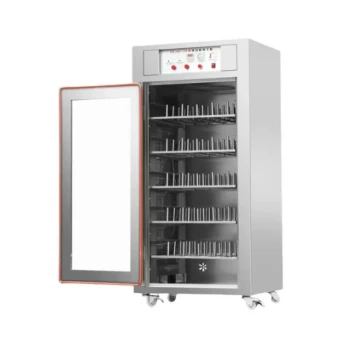
The collaboration between the evaporator and condenser in a heat pump system functions as a continuous energy recycling loop. The evaporator cools the air to remove moisture, while the condenser immediately re-purposes the captured heat to warm that dry air back up. This process creates a cycle of dehumidification and reheating that drastically reduces the need for external energy sources.
Core Takeaway Unlike traditional dryers that vent hot air effectively throwing energy away—a heat pump system captures "latent heat" during the dehumidification process. The system transfers this recovered energy from the evaporator to the condenser to maintain optimal drying temperatures (specifically around 38.4°C) with minimal electrical input.
The Mechanics of Heat Recovery
The Evaporator: Moisture Extraction
The process begins when moist air from the drying chamber enters the evaporator.
The evaporator actively cools this air below its dew point. This causes the moisture held within the air to condense into liquid water, which is then discharged from the system.
The Condenser: Energy Re-utilization
Once the air is cool and dry, it passes to the condenser.
Instead of using a heating element powered by new electricity, the condenser utilizes the latent heat recovered from the refrigerant during the evaporation phase. It transfers this captured energy back into the air stream.
The Thermal Cycle
The air leaves the condenser as "dry, hot air" ready to re-enter the drying chamber.
Because the heat is moved rather than generated, the system creates a highly efficient closed loop. This prevents the significant energy loss associated with open-loop systems that simply exhaust hot, humid air.
Why This Suits Bee Pollen
Precise Temperature Control
Bee pollen is a heat-sensitive product that requires careful handling to preserve its nutritional value.
The heat pump mechanism allows the system to maintain a specific, moderate temperature, cited in technical setups as 38.4 degrees Celsius. This aligns with general best practices for pollen, which typically recommend temperatures between 35-40 degrees Celsius.
Consistent Dehydration
By separating moisture removal (evaporator) from heating (condenser), the system ensures the air entering the chamber is consistently dry.
This allows for effective drying even at lower temperatures. It prevents the "case hardening" or nutrient loss that often occurs when using high heat to force moisture evaporation.
Understanding the Trade-offs
System Complexity
While energy-efficient, a heat pump system is mechanically more complex than a simple electric heater.
It relies on a refrigerant loop, compressors, and balanced airflow. If the components are not perfectly matched, the efficiency of the heat transfer drops, potentially extending drying times.
Capital Cost vs. Operational Cost
The collaboration between evaporator and condenser reduces ongoing energy bills significantly.
However, the initial investment for this machinery is typically higher than standard resistance-based dryers. The return on investment depends on the volume of pollen processed and the frequency of use.
Making the Right Choice for Your Goal
To maximize the benefits of this collaborative thermal cycle, consider your specific production needs:
- If your primary focus is Nutrient Preservation: Ensure your system settings strictly adhere to the 35–40°C range (optimally 38.4°C) to prevent thermal degradation of the pollen.
- If your primary focus is Energy Efficiency: Monitor the discharge from the evaporator; a steady stream of condensate indicates the heat recovery loop is functioning at peak efficiency.
By decoupling moisture removal from heat generation, you achieve a drying process that is gentle on the product and aggressive on energy waste.
Summary Table:
| Component | Role in the Heat Pump Cycle | Impact on Bee Pollen |
|---|---|---|
| Evaporator | Cools air below dew point to extract moisture. | Ensures deep dehydration without high-heat damage. |
| Condenser | Recycles captured latent heat to reheat dry air. | Maintains stable, gentle drying temperatures (approx. 38.4°C). |
| Refrigerant Loop | Transfers energy between components. | Replaces energy-intensive electrical heating elements. |
| Closed Loop | Prevents heat loss by recirculating dry air. | Drastically reduces operational costs for large-scale production. |
Optimize Your Pollen Production with HONESTBEE
Are you looking to scale your apiary operations or upgrade your distribution inventory with professional-grade technology? At HONESTBEE, we specialize in serving commercial apiaries and distributors by providing the industry's most reliable beekeeping tools and machinery.
From high-efficiency heat pump drying systems that preserve the delicate nutrients of bee pollen to advanced hive-making and honey-filling machines, our comprehensive wholesale portfolio is designed to enhance your efficiency and product quality. Partner with us to access specialized hardware, essential consumables, and expert support tailored to the beekeeping industry.
Ready to upgrade your efficiency? Contact us today to discuss your wholesale equipment needs!
References
- Nguyen Hay, Vo Tan Phuong. Novel Solution for High Efficiency Bee Pollen Heat Pump Dryer. DOI: 10.31080/asmi.2020.03.0687
This article is also based on technical information from HonestBee Knowledge Base .
Related Products
- 0.5T Capacity Honey Dehumidifier Dryer with Vacuum Heating and Thickening Filtering Machine
- HONESTBEE Professional Cabinet Bottle Dryer
People Also Ask
- What is the primary function of professional dehumidification equipment in honey processing? Stability & Quality
- How to dry up honey? The Safe Guide to Stabilizing Honey and Preventing Fermentation
- What is the process for using a dehumidifier to lower honey's moisture content? Expert Drying Techniques
- How to decrease moisture in honey? Prevent Fermentation and Ensure Long-Term Quality
- How to remove humidity from honey? Protect Your Harvest from Fermentation