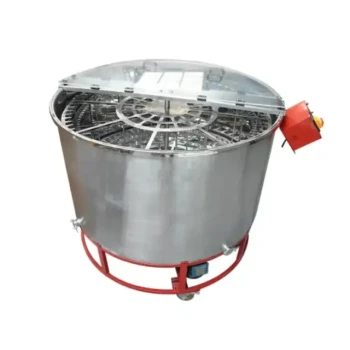
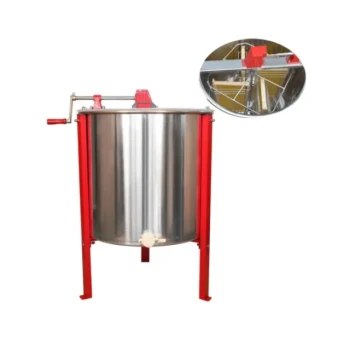
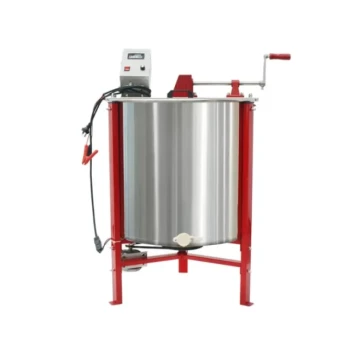
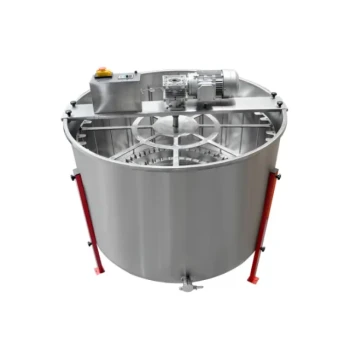
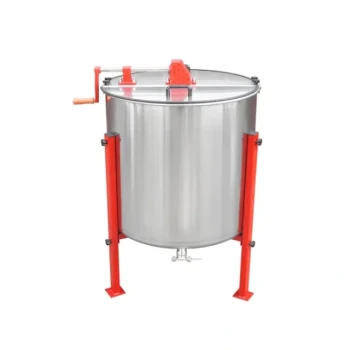
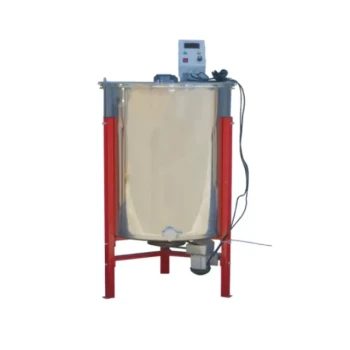
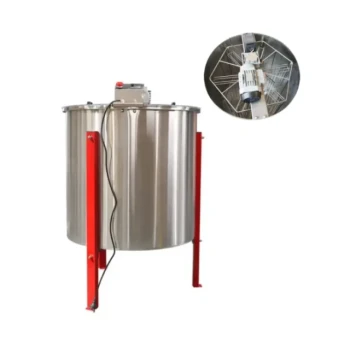
Automated honey extractors fundamentally transform the harvesting workflow by utilizing high-speed centrifugal force to separate honey from hive frames in large batches. This mechanical approach improves extraction efficiency by up to 50% while significantly reducing the heavy labor costs associated with manual harvesting.
The Core Efficiency Principle While speed is the obvious benefit, the true value of automation lies in preservation. By extracting honey without destroying the honeycomb, you allow bees to reuse the wax infrastructure, drastically reducing their energy expenditure and shortening the time required for the next harvest cycle.
The Mechanics of Throughput
High-Volume Batch Processing
Manual harvesting is often a bottleneck, limited by how fast a human can handle individual frames. Automated extractors eliminate this constraint by processing multiple frames simultaneously.
Depending on the capacity of the machine, you can spin between 2 and 30 frames at once. This allows for continuous, high-volume processing that scales with the size of the apiary.
Centrifugal Force vs. Pressing
Traditional manual methods often rely on squeezing or pressing, which is slow and messy. Automated machines utilize high-speed rotation to generate precise centrifugal force.
This force rapidly ejects honey from the comb. It maximizes the extraction rate, ensuring very little usable product is left behind in the wax.
Biological Efficiency and Hive Health
Preserving Honeycomb Structure
The most critical advantage of centrifugal automation is that it keeps the honeycomb structure intact. Manual squeezing destroys the comb, forcing the apiarist to melt it down or discard it.
Reducing Bee Energy Expenditure
When the structure is preserved, the empty frames can be returned directly to the hive. This creates a biological efficiency loop.
Bees do not need to expend energy or time secreting new wax to rebuild the nest. Instead, they can immediately focus their energy on foraging and nectar production, effectively increasing the annual yield per hive.
Product Quality and Hygiene
Minimizing Contamination
Manual handling introduces opportunities for environmental pollutants and debris to enter the honey. Automated, enclosed extractors significantly reduce human contact with the product.
This mechanical process achieves high-efficiency liquid-solid separation. The result is better clarity and a reduction in the impurities often found in pressed honey.
Ensuring Maturity and Value
Mechanical extraction is highly effective at separating mature honey from the comb. This prevents the accidental mixing of high-moisture, immature honey into the final batch.
By maintaining distinct batches of mature honey, you ensure a higher grade of product. This directly correlates to increased market value and shelf stability.
Understanding the Trade-offs
Upfront Capital Investment
While efficient, these machines represent a "significant investment" compared to manual tools. They are built as long-term assets for apiaries that have reached a volume where labor costs outweigh equipment costs.
Maintenance Complexity
Moving from manual to automated systems introduces mechanical and electrical components. To ensure the machine lasts for many years of service, operators must commit to a regimen of technical maintenance that simple manual tools do not require.
Optimizing Your Harvest Strategy
Choosing the right extraction method depends on your current bottlenecks and production goals.
- If your primary focus is Commercial Scale: Prioritize automation to leverage the 50% increase in processing speed and the reduction in manual labor costs.
- If your primary focus is Production Speed: Use centrifugal extraction to preserve combs, allowing bees to skip the rebuilding phase and shorten the production cycle.
- If your primary focus is Product Purity: Adopt mechanical extraction to eliminate handling contaminants and ensure high liquid clarity.
Automated extraction is not just a tool for speed; it is a strategic asset that synchronizes mechanical processing with the biological needs of the hive.
Summary Table:
| Feature | Manual Harvesting | Automated Extraction |
|---|---|---|
| Processing Speed | Slow, frame-by-frame | High-speed batch (up to 30+ frames) |
| Comb Preservation | Often destroyed/pressed | Kept intact for reuse |
| Labor Intensity | High manual effort | Minimal mechanical oversight |
| Product Purity | Higher risk of debris | Enclosed, hygienic processing |
| Bee Energy Loss | High (must rebuild wax) | Low (immediate nectar storage) |
Maximize Your Apiary's Potential with HONESTBEE
Transitioning to automated systems is the key to scaling your honey production and reducing operational overhead. At HONESTBEE, we specialize in supporting commercial apiaries and distributors with high-performance beekeeping machinery and essential industry consumables.
Our value to you includes:
- Industrial-Grade Equipment: From high-capacity honey-filling machines to specialized hive-making hardware.
- Full Spectrum Supply: A comprehensive wholesale offering of professional tools and honey-themed cultural merchandise.
- Commercial Scalability: Solutions designed specifically for high-volume producers looking to optimize every harvest cycle.
Ready to upgrade your harvesting workflow? Contact us today to explore our wholesale catalog and expert solutions!
References
- Marella Sai Manoj, Amit Umesh Paschapur. Current Scenario of Beekeeping and Honey Production in India. DOI: 10.55446/hexa.2023.591
This article is also based on technical information from HonestBee Knowledge Base .
Related Products
- HONESTBEE 72 Frame Industrial Electric Honey Extractor for Beekeeping
- Commercial Electric 12 Frame Honey Extractor Spinner Motorized Honey Extractor
- 32 Frame Commercial Electric Honey Extractor for Beekeeping and Honey Production
- Stainless Steel Manual 8 Frame Radial Honey Extractor Machine for Beehives
- HONESTBEE 4 Frame Manual Self Reversing Honey Extractor for Beekeeping
People Also Ask
- What is the importance of balancing honeycomb frames within a honey extractor? Ensure Stability and Protect Machinery
- How is honey separated from the frames after they are uncapped? Efficient Extraction Methods for High Yields
- What are the main benefits of using a honey extractor? Maximize Yields and Protect Your Honeycomb
- What are the recommended methods for removing honey from the honeycomb? Top Extraction Techniques for Maximum Efficiency
- How do manual honey extractors compare to electric honey extractors? Choosing the Right Tool for Your Apiary Growth