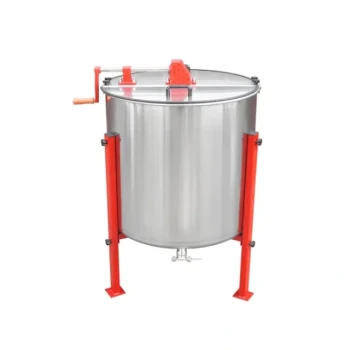
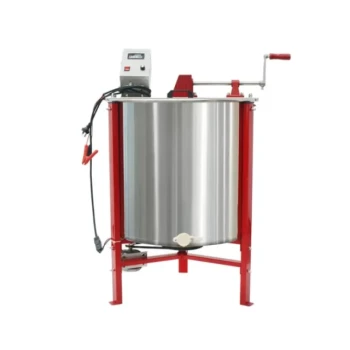
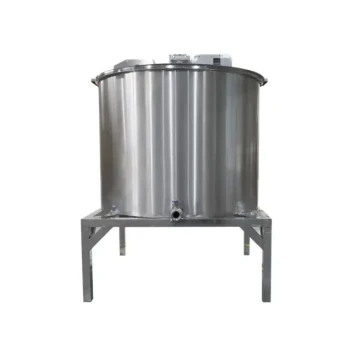
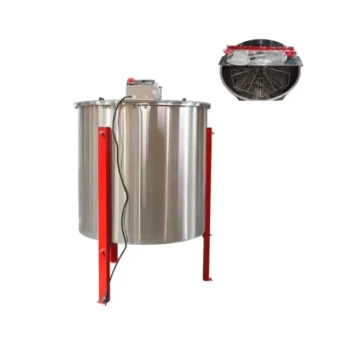
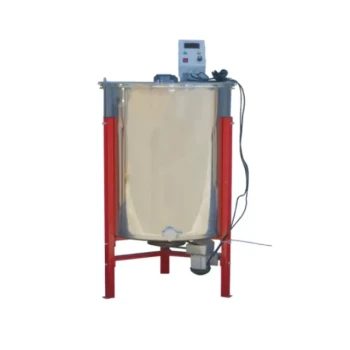
Radial honey extractors provide a distinct advantage in yield assessment by utilizing centrifugal force to ensure nearly complete honey removal from the comb. Unlike traditional crushing or squeezing methods, this equipment delivers high-precision data by standardizing the extraction process, ensuring that the measured yield reflects the actual production of the colony without the variables introduced by incomplete manual extraction.
Core Takeaway For accurate yield assessment, the radial extractor’s primary value is the elimination of variable waste. By removing honey completely via centrifugal force without destroying the comb, it provides high-precision quantitative evidence while preserving the hive's infrastructure for immediate reuse.
Maximizing Data Precision
Achieving Complete Extraction
To assess yield accurately, you must measure all the honey produced, not just what is easily accessible. A radial extractor uses high-speed centrifugal force to pull honey from the cells.
This ensures the data collected for each colony or group is based on complete extraction. This eliminates the inconsistencies found in gravity-draining or manual squeezing, providing a reliable baseline for analysis.
Eliminating Contaminants from Weight Data
Traditional methods like crushing often mix wax, pollen, and even larvae into the honey. This requires extensive filtering which can alter the final weight and volume measurements.
Radial extraction occurs in a closed chamber, preventing honey from contacting wax residues or impurities. This yields a pure product immediately, ensuring that your yield data represents pure honey mass, not a mixture of honey and hive debris.
Operational Efficiency and Scalability
Simultaneous Multi-Frame Processing
For large-scale assessment, speed is critical. Radial electric extractors can process 20 to 60 frames simultaneously on both sides.
This eliminates the need to manually flip frames during extraction, a common bottleneck in tangential extraction. This capability drastically reduces the processing cycle, allowing for the rapid assessment of large professional apiaries.
Preserving Chemical Integrity
Mechanical extraction reduces the time honey is exposed to the environment. This minimizes oxidation risks and preserves natural floral aromas.
When assessing yield quality—not just quantity—this speed ensures the sample maintains the natural flavor and color profile inherent to the specific colony’s harvest.
The Biological Advantage: Comb Preservation
Non-Destructive Harvesting
Traditional pressing destroys the wax comb. Radial extractors remove liquids without damaging the physical structure of the wax combs.
This is crucial for long-term yield assessment. Because the structural integrity is maintained, the frames can be returned to the hive immediately.
Enhancing Future Yields
When bees receive intact combs, they do not need to expend energy secreting new wax. They can immediately focus on foraging and nectar storage.
This significantly increases overall production efficiency for subsequent cycles. It removes the variable of "comb rebuilding time" from future yield assessments, allowing for cleaner data comparisons over time.
Understanding the Trade-offs
Equipment Complexity and Cost
While radial extractors offer superior precision, they represent a larger investment than manual tools. They require a reliable electric drive system and often a power source, limiting their portability compared to simple crush-and-strain tools.
Maintenance Requirements
The mechanical nature of these devices introduces maintenance variables. The speed control systems and moving parts require regular cleaning and calibration to ensure the "precise speed control" remains accurate over time.
Making the Right Choice for Your Goal
To select the right extraction method for your specific needs, consider your primary objective:
- If your primary focus is Scientific Data Accuracy: Prioritize a radial extractor to ensure complete extraction, which provides the high-precision quantitative evidence required for statistical analysis.
- If your primary focus is Commercial Efficiency: Leverage the radial extractor’s ability to handle 20–60 frames simultaneously, minimizing labor costs and maximizing throughput.
The radial extractor transforms honey harvesting from a manual chore into a precise, non-destructive data collection process.
Summary Table:
| Feature | Radial Honey Extractor | Traditional Crushing/Squeezing |
|---|---|---|
| Extraction Method | High-speed centrifugal force | Manual pressure or gravity |
| Yield Precision | High (nearly 100% extraction) | Variable (residual honey left in wax) |
| Comb Integrity | Preserved (ready for immediate reuse) | Destroyed (must be rebuilt by bees) |
| Honey Purity | High (minimal wax/debris contact) | Low (mixes with wax, pollen, and larvae) |
| Scalability | Processes 20–60 frames simultaneously | Labor-intensive; small batches only |
Scale Your Honey Production with HONESTBEE
Ready to transform your commercial apiary with high-precision equipment? HONESTBEE provides a comprehensive wholesale portfolio designed for professional beekeepers and distributors. From advanced radial extractors and honey-filling machines to specialized hive-making hardware and essential industry consumables, we offer the tools you need to maximize yield and efficiency.
Whether you are looking for large-scale machinery or unique honey-themed cultural merchandise, HONESTBEE is your one-stop partner for quality and reliability.
Contact our wholesale experts today to receive a customized quote and see how our specialized equipment can streamline your business!
References
- Jesús Humberto Reyna-Fuentes, Francisco Reyes-Zepeda. Comparative Evaluation of Organic and Commercial Treatments Against Varroa destructor in Apis mellifera: Implications for Honey Yield in Northeastern Mexico. DOI: 10.3390/pathogens14101051
This article is also based on technical information from HonestBee Knowledge Base .
Related Products
- 24 Frame Honey Extractor Commercial Radial Honey Frame Extraction Machine
- Stainless Steel Manual 8 Frame Radial Honey Extractor Machine for Beehives
- 6 Frame Manual Stainless Steel Honey Extractor Beekeeping Equipment
- HONESTBEE 8 Frame Electric and Manual Three Use Honey Extractor
- Electric 4 Frame Tangential Honey Extractor
People Also Ask
- How does a radial honey extractor leverage the natural structure of a honeycomb? Optimize Your Apiary's Efficiency
- How do modern honey extraction machines improve harvest efficiency? Boost Your Yield with Radial Technology
- Why must the head of the honey comb be placed near the center axis? Protect Your Comb During Radial Extraction
- Why is the width of iron rings varied for radial honey extractor tilt? Optimize Your Harvest with Precise Engineering
- What are the operational differences between radial and tangential honey extractors? Maximize Your Harvest Efficiency