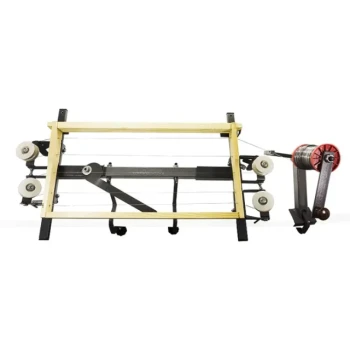
The critical priorities when assembling beehive frames are ensuring structural rigidity to support heavy loads and accurately estimating the labor time required for construction. Because a single deep frame can weigh approximately 8 lbs when full of honey, the assembly process is not merely about putting pieces together, but about engineering a durable component that will not fail inside the hive.
The most significant challenge in frame assembly is ensuring the unit can withstand the stress of a full honey load. You must prioritize building perfectly square, securely nailed corners over speed, as mechanical failure inside the hive can be catastrophic.
Engineering for Strength and Durability
The Reality of Hive Loads
You must treat a beehive frame as a load-bearing structure rather than simple carpentry. A standard deep frame filled with honey can weigh roughly 8 lbs.
This weight places significant stress on the top bar and the side joints. If the frame is weak, it may separate when you attempt to lift it for inspection or extraction.
Achieving Geometric Stability
Rigidity is paramount. The frame must be assembled so that all corners are perfectly square.
If a frame is not square, it may not fit correctly into the hive body. Furthermore, a warped or non-square frame compromises the structural integrity needed to support heavy combs.
Secure Fastening Requirements
To achieve the necessary strength, you cannot skimp on hardware. A properly assembled frame often requires up to eight nails to be secure.
Every nail serves to lock the joints together against the downward pull of gravity.
The Resource Investment
Calculating the Time Cost
While unassembled frames are a standard industry option, you must account for the time required for assembly.
Driving eight nails per frame is labor-intensive. If you are assembling dozens or hundreds of frames, this translates into hours of repetitive work that must be factored into your operational planning.
Understanding the Trade-offs
Cost Savings vs. Labor
The primary appeal of unassembled frames is often the lower financial cost compared to pre-assembled options.
However, this financial saving comes at the direct expense of your time. You are essentially trading currency for "sweat equity."
Customization vs. Convenience
Building the frames yourself allows for customization that pre-bought frames do not offer. You have full control over the assembly quality and the specific techniques used.
Conversely, buying pre-assembled frames guarantees a standard product but removes your ability to reinforce specific joints or adjust the construction to your preference.
Making the Right Choice for Your Apiary
If you are deciding between buying unassembled frames or pre-assembled ones, consider your resources:
- If your primary focus is maximum durability: Assemble them yourself to ensure every corner is square and every joint uses the maximum number of nails for strength.
- If your primary focus is budget efficiency: Choose unassembled frames to lower your upfront capital expenditure.
- If your primary focus is time management: Avoid unassembled frames, as the labor required to drive eight nails per unit may outweigh the cost savings.
Ultimately, a well-assembled frame is an investment in the long-term safety and stability of your honey harvest.
Summary Table:
| Factor | Key Consideration | Priority Level |
|---|---|---|
| Structural Strength | Must support ~8 lbs of honey load without failure | Critical |
| Geometric Stability | Ensuring frames are perfectly square for hive fit | High |
| Fastening | Use up to 8 nails per frame for joint security | High |
| Labor Input | Significant time required for manual assembly/nailing | Medium |
| Cost Analysis | Lower upfront cost vs. high "sweat equity" investment | Variable |
Scaling Your Apiary Operations with HONESTBEE
At HONESTBEE, we understand that for commercial apiaries and distributors, efficiency is just as vital as durability. Whether you prefer the hands-on quality control of unassembled frames or require the immediate readiness of pre-assembled equipment, we provide the professional-grade solutions you need.
Our value to your business:
- Comprehensive Wholesale Range: From precision-cut wooden components to advanced hive-making and honey-filling machinery.
- Industry Expertise: We supply everything from essential consumables to specialized hardware designed to withstand heavy commercial loads.
- Tailored Solutions: Supporting your growth with reliable tools that ensure the long-term stability of your honey harvest.
Ready to optimize your production and equipment sourcing? Contact us today to discuss our wholesale offerings and how we can support your beekeeping success!
Related Products
- HONESTBEE Wired and Assembled Wooden Bee Frames Foundation for a Thriving Hive
- Assembled Wooden Bee Frames with Plastic Foundation for Durability and Convenience by HONESTBEE
- Mini Desktop Bee Hive Frame Forming Making Machine
- Wooden Bee Hive Frames for Beekeeping and Wholesale
- Assembled Wooden Bee Frames with Beeswax Foundation Ready to Use by HONESTBEE
People Also Ask
- What role does replacing foundation and frames play in controlling American Foulbrood (AFB)? A Key to Hive Sanitation
- What is the role of frames and foundation in a bee hive? Build a Stable and Productive Apiary with Modern Design
- What is the difference between frames and foundation in a bee hive? A Guide to Hive Structure and Comb Building
- What is the purpose of frames and foundations in a beehive? Achieve a Healthy, Manageable Hive
- How do wooden and plastic hive frames compare in terms of durability? Wood vs. Plastic Longevity & Repairability