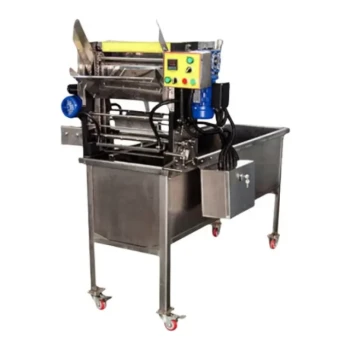
Automated honey filling machinery represents the definitive technological standard for modern commercial honey processing, shifting production from manual variability to industrial precision. These systems provide a closed, sterile environment that ensures exact metering control, drastically reduces contamination risks, and enables the consistent standardization required to enter premium global markets.
The core value of automated filling lies in its ability to establish a "closed-loop" production process. This simultaneously secures food safety by eliminating human contact and guarantees the precise volumetric consistency necessary for regulatory compliance and commercial scalability.
Elevating Hygiene and Product Safety
Eliminating Secondary Contamination
The primary technical advantage of this machinery is the creation of a closed production environment. By automating the transfer of honey from storage to packaging, the system removes the variables associated with manual handling.
This isolation significantly reduces the risk of secondary contamination, ensuring that pathogens or impurities are not introduced during the final packaging phase.
Protecting Against Environmental Spoilage
Beyond human contact, automated systems provide a defense against environmental factors. The sealed operation minimizes contact between the honey and the ambient air.
This prevents oxidation and moisture absorption, two factors that can degrade honey quality. Furthermore, sterile operating environments reduce the ingress of airborne molds and yeasts, acting as a hardware defense against fermentation.
Precision and Market Standardization
Exact Metering and Volumetric Control
Automated machinery utilizes high-precision sensors to control fill volume. This ensures that every unit meets strict net weight regulations and minimizes product giveaway (overfilling).
For producers, this consistency is critical. It transforms raw bulk product into standardized retail units (such as 0.33kg or 0.5kg jars) with reliable physical characteristics.
Meeting Premium Market Requirements
To enter high-value or export markets, products must meet rigorous specification standards. Automated filling ensures the high degree of packaging standardization these markets demand.
This uniformity increases consumer confidence and allows producers to command higher price premiums compared to bulk wholesale trade.
Operational Efficiency and Scalability
enhancing Throughput and Speed
Automated operations significantly increase the speed of packaging compared to manual methods. This allows producers to manage large-volume orders efficiently, a necessity for scaling operations.
High-throughput machinery serves as the technological foundation for transitioning from small-scale traditional methods to large-scale commercial production.
Reducing Labor Costs
By integrating filling and packaging lines, producers can lower their reliance on manual labor. This reduction in labor costs directly enhances competitive advantage.
In global markets where honey prices fluctuate, this operational efficiency protects margins and ensures long-term viability.
Understanding the Trade-offs
Managing Viscosity and Heat Sensitivity
While automation improves speed, honey is a technically difficult fluid due to its high viscosity and heat sensitivity. Machinery must be specifically calibrated to handle these physical properties without degrading the product.
If the equipment is not industrial-grade or properly configured for viscosity, it may struggle with flow rates or require excessive heating, which can damage the honey's quality.
Sanitation Complexity
While these machines prevent contamination during operation, they introduce a requirement for rigorous maintenance and cleaning protocols.
The complex internal channels of automated fillers must be thoroughly sanitized to prevent residue buildup. Failure to maintain the machine's internal hygiene negates the safety benefits of the closed system.
Making the Right Choice for Your Goal
To maximize the value of automated filling machinery, align the technology with your specific business objective:
- If your primary focus is Premium Market Entry: Prioritize systems with advanced sealed environments and sterile operations to guarantee the low yeast counts and oxidation protection required for export standards.
- If your primary focus is Commercial Scaling: Focus on equipment with high-speed volumetric metering and integrated packaging capabilities to maximize throughput and minimize unit labor costs.
Automated filling is not just a tool for speed; it is the essential infrastructure for guaranteeing the safety, consistency, and profitability of a modern honey brand.
Summary Table:
| Technical Feature | Primary Advantage | Impact on Business |
|---|---|---|
| Closed Environment | Eliminates secondary contamination | Ensures food safety & export compliance |
| Precision Sensors | Exact volumetric metering | Minimizes product giveaway & ensures net weight |
| High-Speed Throughput | Increased production speed | Enables large-scale commercial scaling |
| Automated Transfer | Reduced manual handling | Lowers labor costs & improves consistency |
| Sealed Operation | Prevents oxidation & moisture | Preserves honey quality & prevents fermentation |
Scale Your Honey Production with HONESTBEE Precision
Transitioning from manual variability to industrial precision is the key to capturing premium markets. HONESTBEE empowers commercial apiaries and global distributors with the cutting-edge machinery needed to succeed.
Our comprehensive wholesale range includes:
- Advanced Honey-Filling Machines: Engineered for high viscosity and sterile operation.
- Industrial Hive-Making Equipment: Professional-grade hardware for infrastructure.
- Processing Consumables: A full spectrum of essentials for honey-themed brands.
Whether you are looking to lower labor costs or meet rigorous export standards, HONESTBEE provides the tools and technical expertise to enhance your efficiency. Contact us today to upgrade your production line!
References
- Agnieszka Borowska. Zmiany w produkcji i handlu zagranicznym miodem w Polsce na tle krajów Unii Europejskiej i świata. DOI: 10.22630/prs.2022.22.4.13
This article is also based on technical information from HonestBee Knowledge Base .
Related Products
- Fully Automatic Honey Filling Packaging Machine for Processing Line
- Automatic Honey Filling and Filtering Machine for Beekeeping Bottle Filling
- Precision Durable Efficient HONESTBEE Rotary Honey Filling Machine
- Precision Automated Packaging Turntable Honey Spoon Filling Sealing Packing Machine
- Semi Automatic Small Honey Bottle Filling Machine Honey Filler
People Also Ask
- Why are fully automatic honey filling and packaging lines essential? Boost Your Honey's Market Value and Quality
- What is a fully-automatic honey filler? Streamline Your Production with High-Precision Automation
- How do automated honey filling and packaging machines affect profitability? Boost Margins with HONESTBEE Technology
- How do automated honey filling and packaging machines contribute to the market value of honey products? Maximize Your ROI
- How do industrial-grade automated honey filling and packaging machines mitigate the risk of physical contamination?