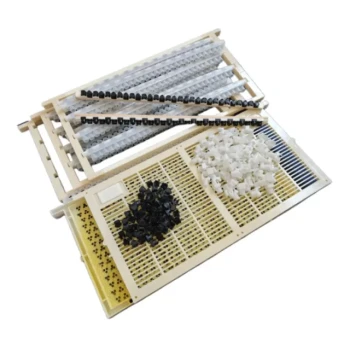
To maximize Royal Jelly yield, grafting tools require high-precision engineering and specific tactile properties. Technically, these instruments must feature a fine tip capable of transferring larvae less than 24 hours old without causing physical injury or dehydration. The tool’s design must facilitate a delicate touch, as the survival of the larva is the single most critical factor in the production process.
The Core Reality: The quality of your grafting tool is a direct predictor of your Royal Jelly yield. If the tool causes even microscopic damage during transfer, the bees will reject the larva, resulting in an empty queen cell and zero production for that unit.
The Mechanics of Precision Transfer
Fine Tip Geometry
The primary technical requirement is a fine tip design. The tool must be slender enough to navigate standard honeycomb cells without touching the walls or crushing the contents.
This geometry allows the operator to scoop underneath the larva suspended in royal jelly. A bulky tool will displace too much jelly or damage the comb, making the transfer impossible.
Tactile Feedback Sensitivity
A superior grafting tool acts as an extension of the operator's hand. It must provide delicate tactile feedback.
Because the larvae are extremely fragile, the operator must be able to feel the slight resistance of the cell floor. This sensitivity prevents the application of excessive pressure that would crush the larva.
Preserving Larval Integrity
Handling Extremely Young Larvae
The window for grafting is narrow. Tools must be specifically calibrated to handle larvae less than 24 hours old.
At this stage, the larvae are at their most vulnerable. The tool must support the larva's body fully during the move from the comb to the artificial queen cup to ensure high acceptance rates.
Preventing Dehydration
The design of the tool must minimize the time the larva is exposed to air. Risk of dehydration is a major technical failure point.
Efficient tools facilitate a rapid transfer. Any delay or difficulty in dislodging the larva from the tool increases the chance of the larva drying out, which leads to rejection by the colony.
Material Safety and Purity Standards
Chemical Neutrality
For high-quality production, particularly organic operations, the material of the tool matters. It must be free from synthetic chemicals or harmful coatings.
Zero-Residue Requirements
Tools must not leach substances into the hive environment. Organic principles strictly prohibit materials that leave residues, ensuring the organic integrity of the final product is safeguarded from the source.
Understanding the Trade-offs
Mechanical Damage vs. Commercial Value
While speed is often desired in production, the wrong tool forces a trade-off between volume and quality. Tools that are not sufficiently precise may damage the jelly's composition during the later stages of larval removal.
Minimizing mechanical damage to both the larva (during grafting) and the jelly (during harvesting) is essential. If the jelly structure is compromised or contaminated by tool debris, its commercial value drops significantly.
Durability vs. Delicacy
There is often a tension between the durability of a tool and its required delicacy. An overly rigid tool may last longer but lacks the flexibility needed to scoop a larva without injury. Conversely, highly flexible tools require more frequent replacement but offer the gentle touch necessary for maximum yield.
Making the Right Choice for Your Goal
To select the appropriate grafting equipment, assess your production priorities:
- If your primary focus is Maximum Yield: Prioritize tools with high-precision tips and superior tactile feedback to ensure the survival of <24-hour-old larvae.
- If your primary focus is Organic Certification: Verify that all tool materials are chemically inert and free from synthetic coatings to prevent residue contamination.
Ultimately, the correct tool is one that renders the transfer process invisible to the bees, ensuring immediate acceptance and optimal secretion of Royal Jelly.
Summary Table:
| Technical Feature | Requirement | Impact on Production |
|---|---|---|
| Tip Geometry | Ultra-fine and slender | Prevents larval injury and comb damage |
| Tactile Feedback | High sensitivity | Enables delicate scooping without crushing larvae |
| Larval Age Compatibility | Suitable for <24-hour-old larvae | Ensures maximum colony acceptance rates |
| Transfer Speed | Rapid, non-stick surface | Minimizes dehydration risk for fragile larvae |
| Material Safety | Chemically inert / No coatings | Maintains organic integrity and product purity |
Maximize Your Royal Jelly Yield with HONESTBEE Precision Equipment
At HONESTBEE, we understand that in commercial royal jelly production, the smallest technical detail determines your success. As a premier provider for commercial apiaries and global distributors, we supply the professional-grade grafting tools and high-precision machinery you need to ensure larval survival and product purity.
From specialized hive-making and honey-filling machines to a comprehensive range of industry consumables, our portfolio is designed to scale your operations efficiently. Partner with HONESTBEE to access wholesale expertise and premium beekeeping hardware.
Contact our specialists today to upgrade your apiary equipment.
References
- Ratna Iffany Faradilla Besari, Lilik Eka Radiati. Benguk Tempeh Flour (<i>Mucuna pruriens</i> L.): Royal Jelly Production of <i>Apis mellifera</i> in the Dearth Period. DOI: 10.1051/bioconf/202519100030
This article is also based on technical information from HonestBee Knowledge Base .
Related Products
- Plastic Chinese Queen Grafting Tool for Bee Queen Rearing
- No Grafting Queen Rearing Kit: System for Royal Jelly Production and Queen Rearing
- Stainless Steel Beekeeping Queen Grafting Tool for Honey Bee Rearing
- Stainless Steel Queen Grafting Tool for Beekeeping and Bee Queen Grafting
- Plastic Beekeeping Honey Bee Larvae Grafting Tools for Queen Rearing and Chinese Grafting
People Also Ask
- Why is it necessary for migratory beekeeping enterprises to utilize professional queen bee rearing tools? Boost Resilience
- What specialized tools and frame configurations are needed for larval grafting during queen rearing, and how are queen cells properly spaced? Master the essentials for efficient queen production
- What are the benefits of using a queen grafting tool for queen rearing? Master Precision for Superior Bee Genetics
- What is grafting in queen rearing? Take Control of Your Apiary's Genetics
- What are the steps involved in using a queen grafting tool? A Guide to Successful Queen Rearing