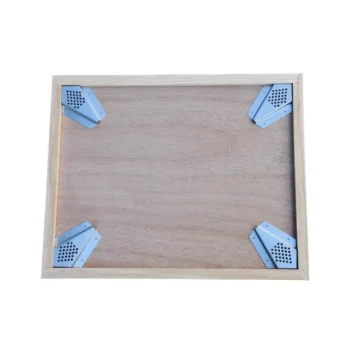
The essential design of wooden micro-cages for honeybee toxicology relies on a hybrid structure: a solid wooden body for thermal regulation paired with plastic mesh sides for ventilation and visibility. This configuration is critical for maintaining individual honeybees in a state that mimics their natural environment while allowing for the rigorous observation required in toxicology protocols.
Minimizing environmental stress is paramount to obtaining valid toxicological data. The wooden micro-cage addresses this by balancing the bee's need for a hive-like thermal buffer with the researcher's need for constant, non-intrusive monitoring.
The Role of Material Selection
Thermal Insulation
The choice of wood as the primary structural material is not accidental. Wood offers superior thermal insulation compared to synthetic alternatives like clear plastic or metal.
This insulation helps stabilize the internal temperature of the cage. It prevents rapid fluctuations that could stress the bee and skew toxicology results.
Mimicking the Natural Hive
Beyond temperature control, the wooden structure serves to mimic the natural hive environment.
By providing a tactile and olfactory environment that resembles a colony, the cage reduces the "captivity stress" placed on the individual bee. This ensures that observed mortality or behavioral changes are attributable to the toxin being tested, not the housing conditions.
Balancing Containment and Observation
Plastic Mesh Sides
To offset the opacity of the wood, these cages utilize plastic mesh sides.
This mesh must be fine enough to act as a secure physical restraint, preventing escape. However, it must also be open enough to allow for clear visual inspection.
Non-Intrusive Monitoring
A critical requirement in toxicology is checking the status of the subject without introducing new variables.
The mesh design allows researchers to monitor the honeybee's health and survival without opening the cage. This prevents physical disturbance and maintains the stability of the micro-environment during the study.
Environmental Control Factors
Ensuring Air Exchange
Toxicology studies often take place within controlled environmental chambers or incubators.
The mesh sides ensure sufficient air exchange between the cage interior and the controlled chamber. This ventilation prevents humidity buildup and ensures the bee receives the specific atmospheric conditions set by the study protocol.
Understanding the Trade-offs
Insulation vs. Ventilation
The primary design challenge of the micro-cage is the tension between the wood (insulation) and the mesh (ventilation).
While the mesh is essential for air and light, it acts as a thermal leak. The design relies on the wooden components to compensate for this heat loss.
Visibility vs. Comfort
While a fully transparent cage would offer the best visibility, it fails to provide the comforting "enclosure" of a hive.
The wooden micro-cage compromises on total visibility to prioritize the biological comfort of the bee. This trade-off is necessary to maintain a baseline of health in the control group.
Making the Right Choice for Your Goal
When selecting or fabricating cages for your study, consider your primary data requirements:
- If your primary focus is behavioral accuracy: Prioritize high-quality wood construction to minimize stress and simulate natural hive conditions.
- If your primary focus is high-frequency monitoring: Ensure the plastic mesh surface area is maximized relative to the wood without compromising structural integrity.
- If your primary focus is environmental consistency: Verify that the mesh density permits adequate airflow for the specific humidity and temperature of your incubator.
The ideal micro-cage is not just a container; it is a tool that isolates the variable of toxicity by standardizing the variable of environment.
Summary Table:
| Feature | Material | Primary Function | Research Benefit |
|---|---|---|---|
| Structural Body | Wood | Thermal insulation & hive mimicry | Reduces captivity stress and stabilizes data |
| Containment Sides | Plastic Mesh | Ventilation & secure restraint | Allows clear air exchange and prevents escape |
| Visual Access | Transparent Mesh | Non-intrusive monitoring | Observation without disturbing the micro-environment |
| Tactile Environment | Natural Grain | Mimics natural hive conditions | Ensures mortality results are toxin-specific |
Elevate Your Beekeeping Operations with HONESTBEE
At HONESTBEE, we specialize in empowering commercial apiaries and distributors with premium-grade equipment designed for biological accuracy. Whether you require high-precision wooden housing for research or large-scale honey-filling machinery and specialized beekeeping tools, we provide the full spectrum of industry essentials.
Our value to you:
- Comprehensive Wholesale Range: From specialized hardware to hive-making machines.
- Expertly Designed Tools: Equipment that respects honeybee biology to ensure better results.
- Global Distribution Support: Tailored solutions for distributors and large-scale commercial setups.
Ready to upgrade your research or production capacity? Contact us today to explore our wholesale catalog and see how HONESTBEE can support your growth.
References
- Kaarel Pent, Reet Karise. Overlapping exposure effects of pathogen and dimethoate on honeybee (Apis mellifera Linnaeus) metabolic rate and longevity. DOI: 10.3389/fphys.2023.1198070
This article is also based on technical information from HonestBee Knowledge Base .
Related Products
- HONESTBEE 4-Way Metal Corner Wooden Bee Escape Board
- Assembled Wooden Bee Frames with Beeswax Foundation Ready to Use by HONESTBEE
- Assembled Wooden Bee Frames with Plastic Foundation for Durability and Convenience by HONESTBEE
- Wood and Mesh Push-In Queen Cage
- Premium Wood and Steel Push In Queen Cage
People Also Ask
- How do bee escape boards compare with solar fume boards when clearing bees from honey supers? Speed vs. Simplicity for Commercial Apiaries
- How do bee escape boards and fume boards assist in honey harvesting? Optimize Your Harvest with Low-Stress Tools
- What types of bee escape boards are available? Clear Your Supers Fast and Stress-Free
- How is a bee escape board used to clear a hive body for honey harvesting? Optimize Your Chemical-Free Harvest
- What are the advantages of using a bee escape board? Ensure a Chemical-Free and Sting-Free Honey Harvest