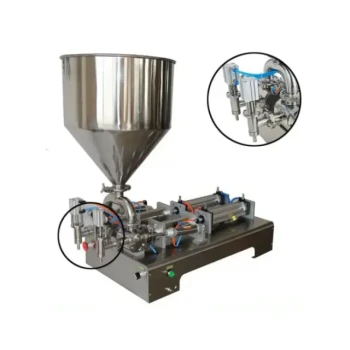
Automated honey-filling machines function as the technological backbone for transforming raw honey into a retail-ready commercial product. They provide high-precision volumetric control within a hygienic, closed packaging environment, ensuring that every unit meets strict weight specifications and food safety standards. By replacing manual handling, these systems significantly reduce product loss while enhancing the visual uniformity and market competitiveness of the final inventory.
Core Takeaway By mechanizing the packaging process, automated filling machines bridge the gap between bulk agricultural production and professional retail standards. They are essential for guaranteeing the consistency, hygiene, and shelf stability required to sell honey as a high-value branded commodity rather than a raw ingredient.
Achieving Commercial Standardization
Precision Volumetric Control
In a commercial setting, inconsistency is a liability. Automated machines utilize advanced metering controls to ensure that every jar contains the exact amount of product.
This adherence to accurate weight specifications is critical for meeting legal labeling requirements. It prevents the financial loss of overfilling and the consumer trust issues associated with underfilling.
Transitioning from Commodity to Brand
Automation facilitates the shift from selling a bulk agricultural product to marketing a branded commodity.
By ensuring uniform packaging across all units, producers can establish a professional brand identity. This consistency is a prerequisite for entering formal retail channels, such as supermarkets and international export markets.
Ensuring Product Integrity and Safety
The Closed Packaging Environment
Honey is susceptible to contamination during the potting process. Automated machines operate in a closed, hygienic environment that minimizes human contact with the product.
This isolation significantly reduces the risk of secondary contamination from external impurities or manual handling errors. It ensures that the purity of the natural honey is maintained from the tank to the sealed jar.
Extending Shelf Life
Proper sealing is as vital as the filling itself. These machines employ specialized sealing mechanisms that prevent oxidation and fermentation.
By creating a reliable barrier against air and moisture, automation preserves the honey’s quality over time. This extended shelf life allows products to withstand the logistics of storage and transport without degrading.
Enhancing Market Competitiveness
Improving Visual Quality
Consumer perception is often driven by shelf appeal. Automated filling ensures consistent fill lines across every bottle, creating a visually uniform product display.
This "shelf-ready" appearance signals professionalism and quality control to the consumer. It directly enhances the product's competitiveness against synthetic alternatives or imported competitors.
Maximizing Efficiency and Yield
Manual filling is labor-intensive and prone to spillage. Mechanization increases the speed of packaging while drastically minimizing product loss.
This efficiency reduces the cost per unit, allowing commercial producers to scale operations effectively. It transforms the back-end processing of honey into a streamlined, high-output operation.
Understanding the Trade-offs
Operational Rigidity
While automation offers speed and precision, it introduces a level of rigidity to the production line. Shifting between different bottle shapes or honey varieties may require machine calibration, unlike the immediate adaptability of manual labor.
Maintenance and Purity
The shift to automation moves the burden from manual labor to machine maintenance. To maintain the "closed environment" benefits, the equipment requires rigorous cleaning protocols to prevent cross-contamination between batches, particularly with different floral varieties.
Making the Right Choice for Your Goal
To determine how this technology fits your commercialization strategy, consider your immediate business objectives:
- If your primary focus is Market Expansion: Prioritize automation to meet the standardized packaging and hygiene certifications required by supermarkets and export regulators.
- If your primary focus is Brand Credibility: Use the machine’s precision to guarantee uniform fill levels and weight accuracy, establishing trust with high-end consumers.
- If your primary focus is Operational Efficiency: Leverage the technology to minimize honey loss and labor costs, maximizing the yield from your bulk supply.
Ultimately, automated filling is not just about speed; it is the mechanism that secures the safety, consistency, and professional status of your honey in a competitive marketplace.
Summary Table:
| Feature | Commercial Function | Impact on Business |
|---|---|---|
| Volumetric Control | High-precision dosing | Legal compliance & waste reduction |
| Closed Environment | Hygienic packaging | Food safety & contamination prevention |
| Sealing Mechanisms | Airtight protection | Extended shelf life & fermentation prevention |
| Visual Uniformity | Consistent fill lines | Enhanced brand trust & shelf appeal |
| High-Speed Output | Streamlined processing | Scalability & lower cost per unit |
Elevate Your Honey Brand with HONESTBEE
Transition from bulk production to a premium retail brand with HONESTBEE’s professional honey-processing solutions. As a dedicated partner to commercial apiaries and distributors, we provide more than just equipment—we provide the tools for growth.
Our comprehensive wholesale portfolio includes:
- Automated Honey-Filling & Packaging Machines
- Specialized Hive-Making Equipment
- Full-Spectrum Beekeeping Tools & Consumables
- Honey-Themed Cultural Merchandise
Contact HONESTBEE today to streamline your operations, ensure product integrity, and maximize your market competitiveness with our industry-leading machinery and hardware.
References
- William F. Tchuenbou, Marc K. Kouam. Health, Socio- Technical, and Economic Constraints of Beekeeping in Bamboutos, Western Highlands of Cameroon. DOI: 10.55529/ijaap.51.1.13
This article is also based on technical information from HonestBee Knowledge Base .
Related Products
- Precision Durable Efficient HONESTBEE Rotary Honey Filling Machine
- Semi Automatic Small Honey Bottle Filling Machine Honey Filler
- Fully Automatic Honey Filling Packaging Machine for Processing Line
- Commercial Rotary Honey Filling Machine for Production
- Economy Small Honey Filling Machine Honey Bottle Filler Packaging Machine
People Also Ask
- How do honey filling and processing machines aid native bee product conservation? Boost Value with HONESTBEE Technology
- How do high-precision honey filling machines ensure quality? Optimize Your Commercial Production with HONESTBEE
- How do honey filling machines work? Achieve Precision & Speed for Your Apiary
- What is a key feature of the new generation of the honey filling machine? The Advanced Electronic Control Unit
- What are the common types of bottling machines used for honey? Choosing the Right Solution for Your Apiary