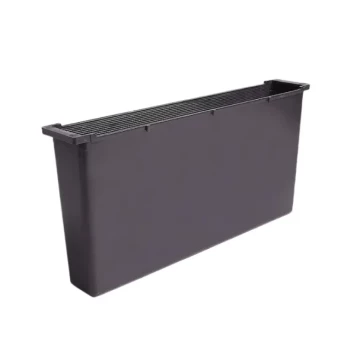
A prevalent dimensional mismatch exists in standard Langstroth deep hive configurations, specifically concerning the relationship between box depth and frame depth. While standard deep hive bodies typically measure 9 5/8 inches deep, they are frequently fitted with frames that are only 9 1/8 inches deep. This specific combination creates a cumulative 1/2-inch vertical gap between stacked hive boxes, which violates the fundamental principle of proper bee space.
The resulting 1/2-inch gap is significantly larger than the ideal bee space required for efficient hive management. Because this void exceeds the bees' tolerance for open space, they will instinctively fill it with unwanted comb, fusing the two boxes together.
The Mechanics of the Dimensional Flaw
The Standard Measurements
In the most common deep hive setup, the external box (the super) is constructed with a depth of 9 5/8 inches. Inside this box, beekeepers insert standard deep frames, which are manufactured to a depth of 9 1/8 inches.
Calculating the Gap
When you place the frames into the box, the difference in depth leaves significant headroom or bottom space. When you stack one deep box on top of another, the space between the top of the lower frames and the bottom of the upper frames totals 1/2 inch.
Violation of Bee Space
Langstroth hives rely on "bee space"—a precise gap (usually between 1/4 and 3/8 inch) that bees leave open for movement. The 1/2-inch gap created by this design flaw exceeds this critical threshold.
Consequences for Hive Management
Creation of Burr Comb
When bees encounter a gap larger than the ideal bee space, they do not leave it empty. Instead, they view it as a structural void that must be filled. They will build burr comb (unwanted wax bridges) in this 1/2-inch space.
Connecting the Boxes
This burr comb effectively bridges the gap between the lower frames and the frames in the box above. Consequently, the two hive bodies become physically connected by wax structures rather than remaining distinct, modular units.
Understanding the Trade-offs
Standardization vs. Precision
The primary reason this flaw persists is manufacturing standardization; these dimensions are the "default" for many suppliers. The trade-off is that while these components are widely available and interchangeable, they lack the biological precision required to prevent extra work for the beekeeper.
Operational Friction
Accepting this standard design means accepting higher maintenance during inspections. When you lift the top box, you will likely tear open the burr comb bridging the gap. This can agitate the bees, potentially kill bees caught in the comb, and require constant scraping of frame tops and bottoms to maintain a clean workspace.
Making the Right Choice for Your Goal
To manage this design flaw effectively, you must decide whether to modify your equipment or adapt your management style.
- If your primary focus is Equipment Accuracy: You may need to trim the hive bodies slightly (reducing the 9 5/8" depth) to achieve the correct bee space and eliminate the excess gap.
- If your primary focus is Standard Maintenance: Be prepared to routinely scrape burr comb from the top and bottom bars of your frames during every inspection to prevent the boxes from fusing together.
Success in beekeeping requires understanding that "standard" equipment does not always align perfectly with the biological instincts of the colony.
Summary Table:
| Component | Standard Dimension | Resulting Gap | Biological Bee Space | Impact |
|---|---|---|---|---|
| Deep Hive Body | 9 5/8 inches | -- | -- | Structural Frame |
| Deep Frame | 9 1/8 inches | -- | -- | Internal Support |
| Vertical Gap | -- | 1/2 inch | 1/4 to 3/8 inch | Burr Comb Creation |
| Management | -- | -- | -- | Fused boxes & extra cleaning |
Optimize Your Apiary Operations with HONESTBEE
Don't let design flaws hinder your productivity. HONESTBEE provides commercial apiaries and distributors with high-precision beekeeping equipment designed to respect biological bee space and minimize maintenance friction.
Our comprehensive wholesale catalog includes:
- Precision-Engineered Hive Hardware: Durable boxes and frames that ensure a perfect fit.
- Advanced Machinery: Industrial hive-making and honey-filling machines for high-volume producers.
- Quality Consumables: A full spectrum of essential tools and honey-themed merchandise.
Ready to upgrade your equipment or stock your distribution line? Contact us today to discuss your wholesale needs and see how our expertise can drive your business success.
Related Products
- Langstroth Honey Bee Box Hive Boxes for Different Depths
- Long Langstroth Style Horizontal Top Bar Hive for Wholesale
- Solid Bottom Board Australian Pine Wood Langstroth Bottom Board for Wholesale
- High-Performance Langstroth Bee Hives for Global Professional Beekeeping
- Australian Langstroth Beehive Boxes for Beekeeping Wholesales
People Also Ask
- What role do standardized Langstroth boxes play in commercial apiary management and honey bee research? | HONESTBEE Guide
- What are the primary advantages of using standardized Langstroth boxes? Scale Your Commercial Beekeeping Operation
- What are the differences between the three standard depths of Langstroth boxes? Choose the Best Size for Your Apiary
- What features of Langstroth hive boxes contribute to expandability and honey yield? Maximize Your Apiary Production
- What are the typical uses for the different box sizes in a Langstroth hive? Master Hive Management & Efficiency