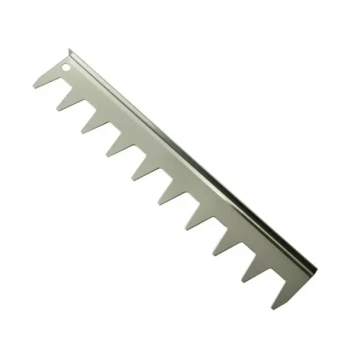
The primary reason to use 9 frames in a 10-frame brood box is to create essential working space for hive inspections. In a standard 10-frame setup, bees use propolis (a resinous glue) to seal gaps, often fusing the outer frames to the box wall. Reducing the count to 9 provides the "wiggle room" necessary to break this seal and remove the first frame without damaging the comb or crushing the bees.
The goal is to trade a small amount of potential comb area for significant operational safety. By increasing the spacing between frames or the wall, you prevent the accidental "rolling" of bees during removal, protecting both the colony structure and the queen.
The Mechanics of Hive Management
Overcoming Propolis Lock
Bees naturally fill crevices with propolis. In a tight 10-frame configuration, this buildup can cement the frames into the box, making the initial lift nearly impossible without violence to the equipment.
By using 9 frames, you create lateral space. This allows you to slide the first frame sideways into the gap to break the propolis seal before lifting it vertically, ensuring the comb remains intact.
Preventing "Rolling" Injuries
When frames are packed too tightly, pulling a frame straight up causes the bees on the side of that frame to rub against the bees on the adjacent frame.
This friction, known as rolling, can injure or kill worker bees. More critically, if the queen happens to be on that frame, rolling her can result in her injury or death, putting the entire colony at risk.
Utilizing Follower Boards
The extra space created by removing a frame can be utilized for follower boards (dummy boards) placed on the outer edges of the box.
These boards serve as physical buffers. In summer, they provide a space for bees to cluster away from the brood nest to prevent overheating; in winter, they act as insulation against the cold.
Understanding the Trade-offs
Thermal Efficiency in Winter
While 9 frames offer superior management during the active season, empty air space can be detrimental during colder months.
Bees rely on density to maintain the warmth of the brood nest. The supplementary data suggests that during cooler weather, it is often better to return to a full 10-frame density (or use insulated follower boards) to help the colony conserve heat efficiently.
The Necessity of Even Spacing
If you run 9 frames without follower boards, you cannot simply leave a large gap at one end.
To prevent the bees from building irregular "burr comb" in the wide gaps, the 9 frames must be spaced out evenly. Consistent gaps ensure the bees draw out the comb correctly for brood rearing rather than filling the void with unusable wax structures.
Making the Right Choice for Your Colony
Deciding between 9 and 10 frames depends on your local climate and your comfort level with hive manipulations.
- If your primary focus is ease of inspection: Run 9 frames to minimize propolis locking and reduce the risk of rolling the queen during lifts.
- If your primary focus is winter survival: Ensure the box is densely packed with 10 frames or insulated follower boards to maximize thermal retention.
Ultimately, the best configuration balances the bees' need for climate control with the beekeeper's need for non-destructive access.
Summary Table:
| Feature | 10-Frame Configuration | 9-Frame Configuration |
|---|---|---|
| Primary Benefit | Maximum comb area & thermal retention | Ease of manipulation & bee safety |
| Inspection Ease | Low; frames often stuck with propolis | High; extra space allows lateral movement |
| Risk of 'Rolling' | High risk of crushing bees/queen | Low; reduced friction during frame lifting |
| Winter Utility | Excellent heat conservation | Requires follower boards for insulation |
| Comb Structure | Standard bee space | Requires even spacing to prevent burr comb |
Scale Your Beekeeping Business with HONESTBEE
For commercial apiaries and professional distributors, efficiency and equipment reliability are the cornerstones of success. At HONESTBEE, we understand the technical nuances of hive management, which is why we offer a comprehensive wholesale portfolio designed to optimize your operations. From precision-engineered hive-making and honey-filling machinery to a full spectrum of professional beekeeping tools and essential consumables, we provide the hardware you need to thrive.
Whether you are looking to stock high-quality woodenware for your retail network or seeking automated solutions to increase your honey production, our team is ready to deliver global-standard expertise and competitive wholesale pricing.
Ready to elevate your inventory or upgrade your production line?
Contact us today to explore our full catalog and wholesale offers.
Related Products
- Stainless Steel 9 Frame Hive Spacer Durable Precise for Commercial Beekeeping
- Langstroth Honey Bee Box Hive Boxes for Different Depths
- Australian Langstroth Beehive Boxes for Beekeeping Wholesales
- Portable Bee Mating Hive Boxes Mini Mating Nucs 8 Frames for Queen Rearing
- Assembled Wooden Bee Frames with Plastic Foundation for Durability and Convenience by HONESTBEE
People Also Ask
- What is the function of Langstroth frames in comb foundation construction? Optimize Your Apiary's Structural Integrity
- What are the specific dimensions for the wooden parts of Langstroth beehive frames? Precision Guide for All Sizes
- How are Langstroth beehive frames assembled? A Step-by-Step Guide for a Durable Hive
- What is the purpose of Langstroth beehive frames in beekeeping? Key to Professional Hive Management & Scaling
- What is the purpose of Langstroth beehive frames? Unlock the Key to Modern Beekeeping