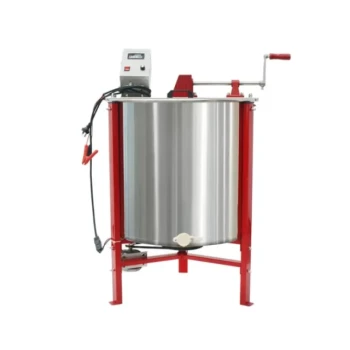
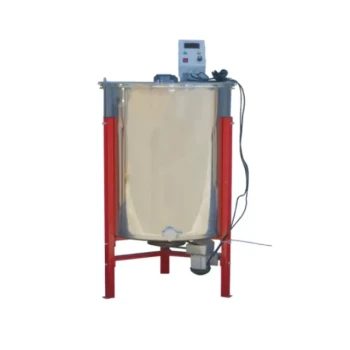
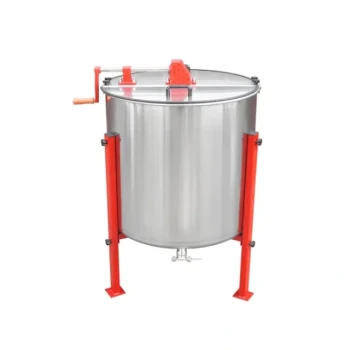
The primary function of an industrial mechanical stirrer is to drive the efficient mass transfer of bioactive compounds from raw propolis into a solvent, typically 70% ethanol. By providing continuous, high-intensity agitation over an extended period—often lasting up to one week—the stirrer ensures that propolis resin particles remain in constant suspension and contact with the liquid. This mechanical intervention breaks down physical barriers within the matrix, allowing active ingredients like polyphenols and flavonoids to diffuse thoroughly for a maximum yield.
Mechanical stirring transforms extraction from a passive soaking process into a dynamic, high-efficiency operation. By generating kinetic energy and shear force, it disrupts saturated boundary layers around propolis particles to accelerate dissolution without the need for damaging heat.
Mechanisms of Enhanced Extraction
Breaking Physical Barriers
Raw propolis is a complex matrix of resin and wax. A mechanical stirrer applies shear force to the mixture, which physically disrupts the structure of these particles. This allows the solvent to penetrate deeper into the solid material, accessing internal reserves of resin that static soaking would miss.
Disrupting the Boundary Layer
When a solid sits in a liquid, a "boundary layer" of saturated solvent forms immediately around the particle, halting further extraction. Mechanical stirring creates forced convection, which constantly strips away this saturated layer. This exposes the particle to fresh, unsaturated solvent, maintaining a high concentration gradient that drives rapid diffusion.
Maintaining Suspension
Without agitation, crushed propolis particles will settle, reducing the surface area exposed to the solvent. The stirrer provides continuous kinetic energy to keep the solid material suspended. This ensures that every particle remains fully immersed and subjected to the solvent's extracting power throughout the entire process cycle.
Optimizing Chemical Composition
Maximizing Bioactive Yield
The ultimate goal of the stirrer is to facilitate the complete dissolution of specific active substances, such as flavonoids, polyphenols, and ferutinin. By ensuring thorough contact between the solvent and the propolis matrix, the equipment maximizes the concentration of these valuable chemical components in the final extract.
Preventing Local Saturation
In a static environment, the solvent directly surrounding a propolis chunk becomes saturated quickly, stopping the process locally. Continuous agitation facilitates uniform distribution of dissolved compounds throughout the tank. This prevents local saturation pockets and ensures the chemical composition of the extract is representative of the entire batch.
Preserving Heat-Sensitive Ingredients
Mechanical stirring acts as a substitute for heat in accelerating extraction. By relying on physical motion rather than thermal energy, the process can occur at room temperature (cold maceration). This protects heat-sensitive active ingredients from thermal degradation, preserving the biological potency of the final product.
Understanding the Trade-offs
Process Duration
While efficient, mechanical stirring in this context is not instantaneous. The primary reference notes that this process is designed for extended periods, such as one week. It requires patience to allow the mechanical action to fully leach the compounds from the dense resinous matrix.
Energy Consumption
Unlike passive soaking, this method requires a continuous power supply to maintain agitation for days at a time. Operators must account for the energy costs associated with running industrial-grade motors for long-duration extraction cycles.
Making the Right Choice for Your Goal
To optimize your extraction protocol, align your equipment usage with your specific objectives:
- If your primary focus is Extraction Yield: Ensure the stirrer runs continuously to prevent particle settling and to break the saturated boundary layers that inhibit diffusion.
- If your primary focus is Ingredient Potency: Utilize the mechanical energy of the stirrer to drive extraction at room temperature, strictly avoiding heat to protect sensitive flavonoids.
- If your primary focus is Product Consistency: Rely on the agitation to maintain a uniform concentration throughout the tank, preventing stratification of the extract.
The mechanical stirrer is the engine of efficiency in propolis processing, turning a simple solvent mixture into a potent, bioactive extract through consistent kinetic force.
Summary Table:
| Feature | Mechanism | Benefit to Propolis Extraction |
|---|---|---|
| Shear Force | Physical disruption of resinous matrix | Penetrates wax barriers to access internal compounds |
| Forced Convection | Disruption of the boundary layer | Maintains high concentration gradient for faster diffusion |
| Kinetic Energy | Continuous particle suspension | Maximizes surface area contact between solvent and solid |
| Cold Maceration | Agitation vs. thermal energy | Protects heat-sensitive flavonoids and polyphenols |
Elevate Your Propolis Production Efficiency with HONESTBEE
Maximize your extract potency and process consistency with professional-grade equipment. HONESTBEE specializes in supporting commercial apiaries and distributors by providing a comprehensive range of beekeeping tools, advanced machinery, and essential consumables.
Whether you need specialized extraction hardware, high-precision honey-filling machines, or durable hive-making equipment, our wholesale solutions are designed to scale your business and ensure superior product quality.
Ready to optimize your facility? Contact us today to explore our full machinery portfolio and see how our expertise can drive your success.
References
- Hassan Laaroussi, Badiâa Lyoussi. Unraveling the chemical composition, antioxidant, α-amylase and α-glucosidase inhibition of Moroccan propolis. DOI: 10.1016/j.fbio.2021.101160
This article is also based on technical information from HonestBee Knowledge Base .
Related Products
- HONESTBEE 72 Frame Industrial Electric Honey Extractor for Beekeeping
- Modern Stainless Steel Honey Dipper Stirrer
- Double Wall Honey Heating Stirring Homogenizer Mixing Machine with Various Capacity
- Professional Plastic Honey Dipper for Easy Honey Drizzling
- 8-Frame Electric Self-Reversing Honey Extractor Spinner for Commercial Honey Extraction Equipment
People Also Ask
- What is the importance of balancing honeycomb frames within a honey extractor? Ensure Stability and Protect Machinery
- How is honey separated from the frames after they are uncapped? Efficient Extraction Methods for High Yields
- What are the main benefits of using a honey extractor? Maximize Yields and Protect Your Honeycomb
- What are the recommended methods for removing honey from the honeycomb? Top Extraction Techniques for Maximum Efficiency
- How do manual honey extractors compare to electric honey extractors? Choosing the Right Tool for Your Apiary Growth