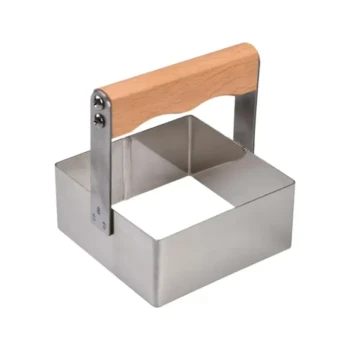
The primary function of breaking old honeycomb into approximately 9 cm² pieces is to drastically increase the specific surface area of the raw material. This physical alteration allows heat to penetrate the wax structure more rapidly and uniformly. By optimizing the surface area, you accelerate the melting process and improve the efficiency of releasing wax from the absorbent silk cocoons found in old brood combs.
Breaking honeycomb into uniform 9 cm² fragments strikes a critical balance: it exposes enough surface area to speed up thermal transfer and wax release, yet keeps the pieces large enough to prevent the microscopic fragmentation of impurities.
The Mechanics of Heat Transfer
Increasing Specific Surface Area
The efficiency of the recycling process is directly tied to the surface area exposed to the heat source.
By breaking the comb into smaller chunks, you increase the specific surface area significantly compared to processing whole frames. This maximizes the material's contact with heat, facilitating faster energy transfer.
Accelerating the Melting Rate
Heat penetration in solid blocks of wax and cocoon can be slow and uneven.
The 9 cm² size allows thermal energy to reach the core of each piece quickly. This results in a rapid, uniform melt that reduces the overall energy required to liquefy the batch.
Improving Wax Recovery
Releasing Wax from Silk Cocoons
Old honeycombs contain layers of silk cocoons spun by developing bee larvae, which act like sponges that trap wax.
Rapid and uniform heating is essential to separate the liquid wax from these fibrous impurities. Efficient heat penetration ensures the wax liquefies and drains away from the cocoons before it can be re-absorbed or trapped during cooling.
Understanding the Trade-offs
Why Size Matters: The 9 cm² Standard
You might assume that grinding the comb into even smaller powder would be more efficient, but this is a common pitfall.
There is a specific reason for the 9 cm² benchmark. It represents an optimal balance between thermal efficiency and impurity management.
The Risk of Excessive Fragmentation
If the pieces are broken down too small, you risk pulverizing the non-wax impurities.
Excessive fragmentation creates fine particulates that are difficult to filter out. By maintaining a 9 cm² size, you prevent the mixing of fine contaminants into the wax, ensuring the final product remains pure.
Optimizing Your Rendering Process
By controlling the physical dimensions of your input material, you can manipulate the efficiency of your output.
- If your primary focus is processing speed: Ensure consistent fragmentation to roughly 9 cm² to maximize heat transfer and minimize the duration of the melt cycle.
- If your primary focus is product quality: Be careful not to over-crush or pulverize the comb, as this will complicate the separation of impurities and lower the grade of your wax.
Precise preparation of your raw material is the single most effective way to ensure high yields and clean filtration.
Summary Table:
| Factor | 9 cm² Optimization Benefit |
|---|---|
| Specific Surface Area | Drastically increased for rapid heat penetration |
| Melting Rate | Faster, more uniform melting reducing energy costs |
| Wax Recovery | Maximizes release of wax trapped in silk cocoons |
| Impurity Control | Prevents fragmentation of fine debris for cleaner filtration |
| Process Efficiency | Optimal balance between thermal speed and final wax quality |
Scale Your Beeswax Production with HONESTBEE
Maximize your recycling efficiency and product quality with industry-leading equipment from HONESTBEE. We specialize in supporting commercial apiaries and distributors by providing a comprehensive range of professional beekeeping tools, high-capacity wax-processing machinery, and honey-filling systems.
Whether you are upgrading your facility with specialized hardware or sourcing essential consumables, our portfolio is designed to enhance your operational yield. Contact us today to discover how our wholesale solutions and expert machinery can streamline your beekeeping business.
References
- Gleydson Luiz de Oliveira Neto, Rodrigo Diniz Silveira. Alternative wax recovery from Apis mellifera: Different combs size effect. DOI: 10.33448/rsd-v10i8.17313
This article is also based on technical information from HonestBee Knowledge Base .
Related Products
- Stainless Steel Jack Type Honey Comb Press Machine Wax and Honey Separator
- Electric Honey Press Machine for Squeezing Honey Comb Press Equipment
- Heavy Duty Stainless Steel Honeycomb Cutter
- Professional Wide Blade Honey Scraper for Beekeeping and Honey Processing
- Fully Automatic Honey Filling Packaging Machine for Processing Line
People Also Ask
- Can you heat honey to separate from wax? A Guide to Preserving Honey Quality
- How do you separate honey from wax at home? A Simple Guide to Zero-Waste Harvesting
- How do you separate honey from wax cappings? Choose the Best Method for Your Harvest
- How do I separate honey from wax? A Two-Stage Process for Maximum Yield
- What temperature does wax separate from honey? Achieve Clean, Efficient Honey Rendering