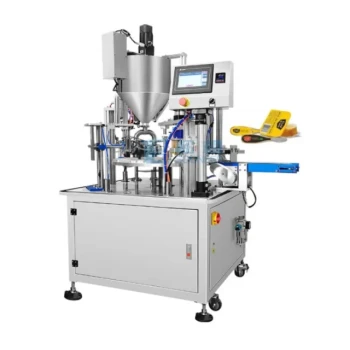
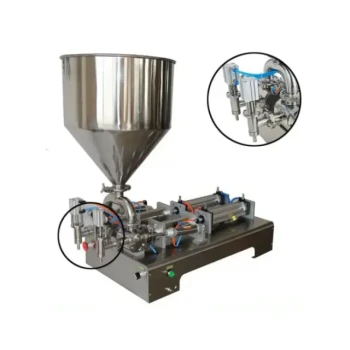
The hopper serves as the critical staging reservoir within the filling system, holding the honey immediately prior to dispensing. While its basic mechanical function is storage, its technical purpose is to condition the honey by applying controlled heat to lower viscosity, ensuring the product flows efficiently through the machine's metering system.
Core Takeaway: The hopper is less about storage and more about thermal conditioning. It bridges the gap between bulk storage and the final package by heating the honey just enough to facilitate movement without damaging its delicate chemical composition.
The Role of Viscosity Management
Overcoming Fluid Resistance
Honey is naturally viscous and resistant to flow at room temperature. The hopper is typically equipped with a heating element or a water-jacketed system.
By raising the temperature of the honey within this reservoir, the machine lowers the fluid's dynamic viscosity. This allows the internal pistons or pumps to draw the product in and push it out with minimal resistance.
Ensuring Consistent Fills
Consistency in filling volume relies on a consistent flow rate. If the honey in the hopper varies in temperature, its thickness changes, leading to fluctuations in how much product is dispensed.
The hopper acts as a buffer that normalizes the state of the honey. This ensures that the first jar and the hundredth jar receive product of the exact same density and flow characteristics.
Balancing Heat and Quality
The "Delicate Nature" Constraint
As noted in the primary technical documentation, honey is a delicate product. Excessive heat can degrade its quality, destroy beneficial enzymes, and alter the flavor profile.
The hopper is designed to provide gentle, regulated heat rather than rapid boiling. It maintains the honey at the minimum temperature required for flow, rather than heating it for sterilization or cooking purposes.
Precision Temperature Regulation
Modern hoppers utilize sensors to monitor the product continuously. This regulation is crucial for speed.
If the honey is too cold, the machine must slow down to force the thick liquid through the nozzles. If the temperature is regulated correctly in the hopper, the filling cycle can run at maximum speed without straining the mechanical components.
Understanding the Trade-offs
Thermal Lag vs. Volume
A larger hopper allows for longer continuous operation without refilling, but it introduces thermal lag. It takes longer to bring a large volume of honey up to the correct processing temperature.
Conversely, a smaller hopper heats up quickly but requires more frequent refilling from bulk storage. This can interrupt production flow if the bulk transfer system is not automated.
Complexity vs. Maintenance
Heated hoppers introduce additional complexity to the machine. They require heating elements, thermostats, and often water jackets (double-walled construction).
While necessary for honey, this increases the maintenance burden compared to standard hoppers used for free-flowing liquids like water. You must regularly inspect seals and heating elements to prevent uneven heating or leaks.
Making the Right Choice for Your Goal
When evaluating the hopper system on a honey filling machine, consider your production constraints:
- If your primary focus is Production Speed: Prioritize a hopper with a high-efficiency heating jacket and agitation capability to ensure uniform viscosity, allowing for faster cycle times.
- If your primary focus is Product Integrity (Raw/Organic): Prioritize a hopper with high-precision digital temperature controls to ensure the product never exceeds the threshold where enzyme damage occurs.
Ultimately, a well-engineered hopper transforms honey from a difficult, sticky substance into a manageable fluid, protecting both your machinery and the quality of your final product.
Summary Table:
| Feature | Primary Function | Benefit to Production |
|---|---|---|
| Thermal Conditioning | Lowers honey viscosity via controlled heating | Ensures smooth flow and reduces mechanical strain |
| Staging Reservoir | Acts as a buffer between bulk storage and nozzles | Enables continuous operation and consistent fill volumes |
| Precision Sensors | Monitors and regulates honey temperature | Protects delicate enzymes and maintains flavor profiles |
| Water-Jacket Design | Provides gentle, even heat distribution | Prevents localized overheating and product degradation |
Elevate Your Honey Processing with HONESTBEE Solutions
Maximize your apiary's efficiency and product integrity with HONESTBEE’s professional-grade beekeeping machinery. As a leading partner for commercial apiaries and distributors, we provide a complete spectrum of wholesale solutions—from high-precision honey-filling machines with advanced heated hoppers to specialized hive-making hardware and essential industry consumables.
Our equipment is engineered to handle the unique challenges of honey viscosity, ensuring your brand delivers consistent quality every time. Whether you are scaling up production or diversifying your honey-themed cultural merchandise, HONESTBEE has the tools you need to succeed.
Ready to streamline your operations? Contact our experts today to find the perfect machinery for your business.
Related Products
- Precision Durable Efficient HONESTBEE Rotary Honey Filling Machine
- Precision Automated Packaging Turntable Honey Spoon Filling Sealing Packing Machine
- Economy Small Honey Filling Machine Honey Bottle Filler Packaging Machine
- Commercial Rotary Honey Filling Machine for Production
- Fully Automatic Honey Filling Packaging Machine for Processing Line
People Also Ask
- What quality control role does professional honey filling equipment perform? Ensure Consistency and Product Stability
- How do honey filling machines work? Achieve Precision & Speed for Your Apiary
- How do honey filling and processing machines aid native bee product conservation? Boost Value with HONESTBEE Technology
- What are the common types of bottling machines used for honey? Choosing the Right Solution for Your Apiary
- What is a key feature of the new generation of the honey filling machine? The Advanced Electronic Control Unit