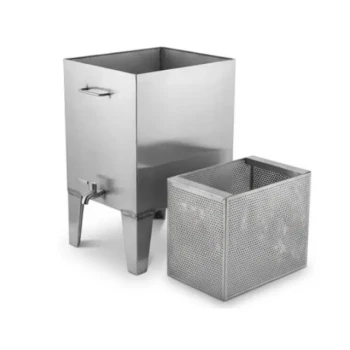
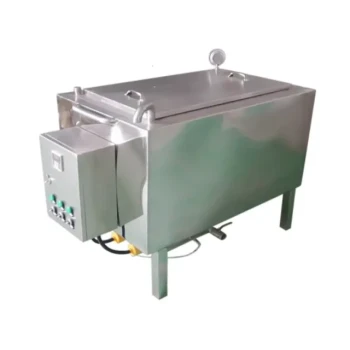
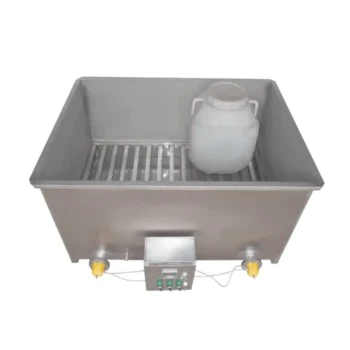
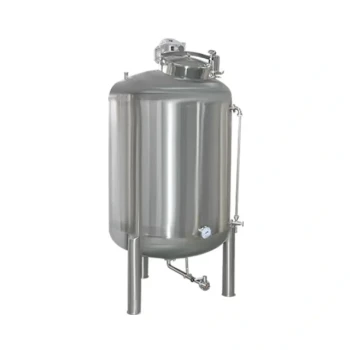
The melting tank acts as the foundational processing unit in the production of beeswax foundation sheets. Its primary function is to transform raw beeswax blocks into a liquid state by maintaining a constant temperature of approximately 65°C, which is essential for subsequent purification and continuous manufacturing.
The tank does more than simply melt wax; it creates a stable, liquid material flow that enables the filtration of impurities and ensures the downstream casting and rolling machinery operates without interruption.
The Role of Thermal Preparation
Achieving the Optimal Liquid State
The primary objective of the melting tank is the phase conversion of beeswax. By heating solid blocks to a steady 65°C, the system ensures the wax achieves the necessary fluidity.
This specific temperature is critical because it liquefies the wax sufficiently for processing without subjecting it to excessive heat immediately.
Facilitating Filtration and Purification
Raw beeswax blocks often contain debris or non-wax contaminants that are trapped in the solid state.
Once the tank converts the blocks to liquid, these impurities are released and can be effectively filtered out. This purification step is impossible to perform while the material is solid.
Ensuring Continuous Production Flow
Modern beeswax foundation production relies on a continuous casting and rolling process.
The melting tank acts as a buffer, providing a consistent supply of liquid raw material. This prevents gaps in the production line that could lead to uneven sheet thickness or machine stoppages.
Critical Considerations in Thermal Processing
The Risk of Localized Overheating
While the primary goal is melting, the quality of the heating system is paramount. Poorly designed tanks can cause localized overheating, which damages the chemical structure of the wax.
Advanced systems often employ indirect heating methods (such as water jackets or Bain-Marie principles) to maintain fluidity without scorching the material.
Melting vs. Sterilization
It is vital to distinguish between melting for processing and heating for sterilization.
While the melting tank operates at ~65°C to facilitate flow, industrial sterilization to kill pathogens requires significantly higher temperatures (between 120°C and 140°C). Operators must not assume that the standard melting process automatically sterilizes the wax.
Making the Right Choice for Your Production Line
The melting tank is the gatekeeper of your product quality. Selecting the right setup depends on your specific manufacturing priorities.
- If your primary focus is Production Efficiency: Prioritize a tank with high thermal capacity that can maintain a steady flow to match the speed of your continuous casting and rolling equipment.
- If your primary focus is Material Purity: Ensure the tank is integrated with a robust filtration system that takes advantage of the liquid state at 65°C to remove maximum particulate matter.
Ultimately, the melting tank transforms a raw, variable input into a consistent, process-ready liquid, determining the quality of the final foundation sheet.
Summary Table:
| Feature | Primary Function | Technical Requirement |
|---|---|---|
| Phase Conversion | Transforms solid blocks to liquid | Steady 65°C constant temperature |
| Purification | Facilitates debris & impurity filtration | Fluid state release of contaminants |
| Process Flow | Acts as a production buffer | Continuous supply to casting machinery |
| Quality Control | Prevents localized overheating | Indirect heating (water jacket) system |
| Pathogen Safety | Preparation for sterilization | Distinction between melting and 120°C+ sterilization |
Elevate Your Apiary Operations with HONESTBEE Professional Equipment
Are you looking to scale your beeswax processing or upgrade your commercial production line? HONESTBEE specializes in supporting commercial apiaries and distributors with high-performance solutions. From advanced melting tanks and honey-filling machines to complete beeswax foundation production lines, we provide the heavy-duty machinery and essential consumables your business needs to thrive.
Why partner with HONESTBEE?
- Comprehensive Wholesale Catalog: One-stop sourcing for all beekeeping tools and hardware.
- Industrial Precision: Equipment designed for continuous, high-efficiency manufacturing.
- Global Support: Tailored solutions for large-scale distributors and professional beekeepers.
Ready to enhance your production capacity and material purity? Contact our expert team today to discuss how our specialized machinery can optimize your workflow.
References
- Cristiano Ziegler, Ademar Michels. DESENVOLVIMENTO DE UM EQUIPAMENTO PARA A PRODUÇÃO DE CERA ALVEOLADA. DOI: 10.15628/holos.2016.3742
This article is also based on technical information from HonestBee Knowledge Base .
Related Products
- Solar Beeswax Melter Easy Solar Wax Melter for Beeswax
- Steam Beeswax Melter Wax Warmer for Wax Processing
- Beeswax Melter for Candle Making Honey Bee Wax Melter
- Electric Commercial Beeswax Melter for Factory Use
- Professional Stainless Steel Wax Melter for Beekeeping and Crafts
People Also Ask
- How does a solar melter work to process beeswax? The Eco-Friendly Way to Pure Wax
- What is a solar wax melter and how does it work? Harness the Sun for Pure Beeswax
- What are the benefits of using a solar wax melter? Harness the Sun for Pure, Cost-Effective Beeswax
- What is the purpose of a solar wax melter in beekeeping? Sustainable Wax Processing for Modern Apiaries
- How does a solar-powered frame wax melter work? Harness the Sun for Sustainable Beekeeping