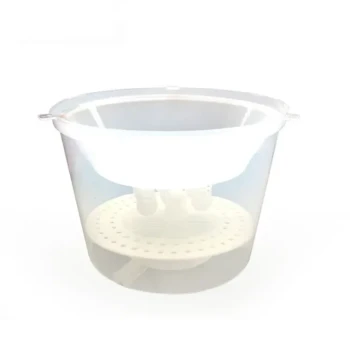
The mechanical function of an internal pollen catcher relies on precision-engineered grid apertures designed to create moderate physical friction against worker bees. As bees navigate these grids to enter or exit the hive, the contact physically dislodges Varroa mites attached to their bodies, causing the parasites to fall into a separated collection box.
By substituting chemical treatments with mechanical interference, this method effectively targets mites on adult bees during early spring while ensuring honey and beeswax remain free of toxic residues.
The Mechanics of Detachment
Precision-Engineered Apertures
The core mechanism involves a grid containing specific grid apertures. These openings are not random; they are sized precisely to allow the bee to pass while maximizing the surface area that comes into contact with the bee's body.
Friction as a Physical Filter
As the worker bee pushes through the aperture, the device creates moderate mechanical friction. This physical "rubbing" action acts as a filter, interfering with the mite's grip on the host.
Separation and Collection
Once the friction breaks the mite's hold, gravity takes over. The detached mites fall away from the bee and are captured in a collection box, preventing them from re-attaching or re-entering the colony.
Strategic Timing and Impact
Targeting Phoretic Mites
This mechanical intervention is most potent during early spring. At this stage, Varroa mites are primarily active on the bodies of adult bees (the phoretic stage), making them vulnerable to physical dislodgment.
Eliminating Chemical Residue
Because the mechanism is purely physical, it offers a distinct advantage over miticides. It allows for population control without introducing chemical residues into the hive's honey stores or beeswax structure.
Understanding the Trade-offs
Limited to Adult Bees
The mechanical action only works on mites currently attached to adult bees. It does not affect mites reproducing inside capped brood cells, which limits its standalone effectiveness once the brood rearing season is in full swing.
Entrance Resistance
While the friction is described as "moderate," the grid creates a physical barrier. This inevitably adds a level of resistance to hive traffic, which requires the colony to expend energy navigating the entrance and exit.
Making the Right Choice for Your Goal
To determine if this mechanical control fits your Integrated Pest Management (IPM) strategy, consider your specific objectives:
- If your primary focus is Organic Certification: This tool provides a physical reduction method that eliminates the risk of chemical contamination in your hive products.
- If your primary focus is Early Season Control: Implement this device in the spring to lower the initial mite load before the colony's brood production accelerates.
Effective Varroa management requires understanding not just how to kill the mite, but how to preserve the integrity of the hive products.
Summary Table:
| Feature | Mechanical Function & Impact |
|---|---|
| Core Mechanism | Precision-engineered grid apertures creating physical friction |
| Action Type | Physical dislodgment of phoretic mites from adult bees |
| Primary Benefit | Chemical-free pest control; prevents honey and wax contamination |
| Ideal Timing | Early Spring (pre-brood expansion) |
| Target Stage | Phoretic mites on adult bees |
| Collection | Separated collection box prevents re-attachment |
Maximize Your Colony Health with HONESTBEE
At HONESTBEE, we understand that commercial apiaries and distributors require professional-grade solutions to maintain hive productivity and product purity. As a comprehensive wholesale provider, we supply the full spectrum of beekeeping tools—from specialized hive-making machinery and honey-filling equipment to mechanical Varroa management solutions like internal pollen catchers.
Whether you are scaling your operation or sourcing premium consumables for distribution, our expertise ensures you get high-performance hardware that eliminates chemical risks. Contact us today to discover how our wholesale portfolio can streamline your honey production and enhance your beekeeping efficiency!
References
- В.К. Пестис, A. N. Krichevtsova. Modern technologies for conducting beekeeping in the Republic of Belarus on the background of varroatous invasion. DOI: 10.29235/1817-7204-2022-60-1-59-68
This article is also based on technical information from HonestBee Knowledge Base .
Related Products
- Plastic Bee Pollen Trap Strips Comb Catcher Collector
- Removable Plastic Pollen Trap With Ventilated Tray for Bees Pollen Collector
- 30 cm Plastic Entrance Hole Bee Pollen Trap and Collector
- Stainless Steel Pollen Shovel with Wooden Handle
- Heavy-Duty Ergonomic Grip Galvanized Pollen Shovel
People Also Ask
- For what reasons do beekeepers collect bee pollen? Boost Hive Health and Unlock New Revenue Streams
- What are the design principles and advantages of pollen traps in the collection of bee pollen? Boost Your Apiary Yield
- What are the ideal weather conditions for installing a bee pollen trap? Ensure Colony Safety with Expert Timing
- Why is frequent harvesting of bee pollen from traps necessary for quality control? Ensure Freshness and Prevent Mold.
- What are the primary functions of a standard pollen trap in research? Maximize Data Accuracy in Bee Nutrition Studies