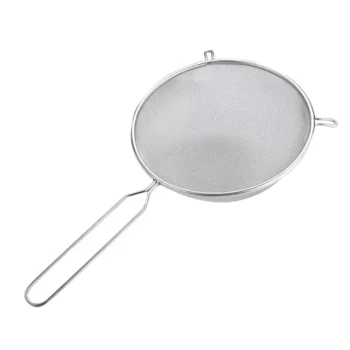
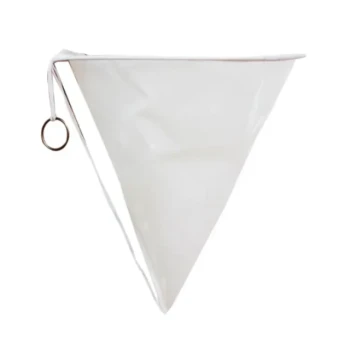
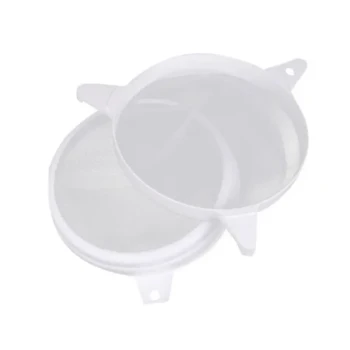
In the context of honey filtration, a 1/4 inch hole is equivalent to approximately 6,350 microns.
This represents an extremely coarse level of filtration, generally categorized as a mechanical strainer rather than a true filter. At this size (more than 6,000 microns), the mesh allows virtually all fine particulates to pass through, capturing only the largest debris such as dead bees, large wax cappings, or wood chips.
Core Takeaway A 1/4 inch opening creates a "macro" strainer, not a microscopic filter. Because the opening is over 250 times larger than the average pollen grain, using this size mesh guarantees that your honey remains 100% pollen-rich and "raw," removing only the largest visible contaminants.
The Scale of Filtration in Beekeeping
The Micron Measurement
To understand the behavior of your equipment, you must understand the unit of measure. A micron is one-millionth of a meter.
While standard honey filters are often measured in the hundreds of microns (e.g., 200, 400, or 600), a 1/4 inch opening sits at a massive 6,350 microns. This places it in a completely different category of equipment functionality.
The Pollen Comparison
The primary reference point for honey purity is often the pollen grain. The average pollen grain is merely 25 microns in diameter.
Passing honey through a 1/4 inch (6,350 micron) hole is mechanically similar to throwing a marble through a garage door. The mesh exerts absolutely no restrictive force on the pollen, ensuring it remains suspended in the final product.
Practical Implications for Honey Quality
Straining vs. Filtering
It is critical to distinguish between straining and filtering. A 1/4 inch mesh is a strainer.
Its sole purpose is to remove foreign objects introduced during the extraction process. It does not clarify the honey or alter its nutritional profile in any way.
Flow Rate and Temperature
Because the openings are so large, 1/4 inch mesh offers excellent flow rates. It creates almost no back pressure.
This is particularly useful when working with cold honey or thick, thixotropic varieties (like heather honey) that would clog finer filters immediately.
Understanding the Trade-offs
Clarity vs. Nutrition
The primary trade-off with a 1/4 inch strainer is visual clarity. Because it lets fine wax particles and debris through, the resulting honey may appear cloudy or opaque.
However, this "impurity" is often desired by consumers seeking raw honey, as it proves the product has not been ultra-filtered or stripped of its natural components.
Crystallization Risks
Fine particles act as nucleation sites for sugar crystals. By using a coarse 6,000+ micron mesh, you allow small bits of wax and propolis to remain in the honey.
While this preserves authenticity, it significantly accelerates the rate of crystallization. Honey strained through a 1/4 inch mesh will solidify much faster than honey filtered through a 200-micron cloth.
Making the Right Choice for Your Goal
When selecting your filtration equipment, your choice depends entirely on the final product you intend to bottle.
- If your primary focus is Authentic "Raw" Honey: Use the 1/4 inch mesh (approx. 6,350 microns) to ensure maximum retention of pollen, propolis, and natural enzymes.
- If your primary focus is Shelf Stability and Clarity: Avoid the 1/4 inch mesh in favor of a much finer filter (200 to 600 microns) to remove the particulates that cause cloudiness and rapid crystallization.
Ultimately, a 1/4 inch mesh is the gold standard for beekeepers who prioritize nutritional integrity over cosmetic perfection.
Summary Table:
| Feature | 1/4 Inch Strainer (6,350 Microns) | Standard Honey Filter (200-600 Microns) |
|---|---|---|
| Primary Function | Macro-straining (bees, wax chunks) | Clarification (fine debris) |
| Pollen Retention | 100% (No removal) | Partial to high removal |
| Flow Rate | Exceptionally high, even for cold honey | Moderate to slow |
| Honey Clarity | Cloudy/Natural | Clear/Bright |
| Crystallization | Rapid (more nucleation sites) | Slower (particulates removed) |
| Best For | Authentic raw & unfiltered honey | Commercial shelf-stable honey |
Elevate Your Honey Processing with HONESTBEE
Whether you are producing authentic raw honey or high-clarity commercial batches, HONESTBEE provides the professional-grade equipment you need to succeed. As a leading partner for commercial apiaries and distributors, we offer a comprehensive wholesale selection of beekeeping tools, specialized honey-filling machines, and high-performance filtration hardware.
From hive-making machinery to essential industry consumables, our portfolio is designed to maximize your efficiency and product quality. Contact us today to discover how our tailored equipment solutions can scale your beekeeping operations and enhance your market value.
Related Products
- Electric Double Wall Honey Filtering Machine Purifier Equipment for Honey Processing Plant
- Professional Stainless Steel Honey Filtering Machine with Water Bath Heating for Beekeeping
- 0.5T Capacity Honey Dehumidifier Dryer with Vacuum Heating and Thickening Filtering Machine
- Honey Concentrating and Filtering Dehumidifier Machine 2T Capacity for Honey
- Professional Stainless Steel Honey Filter with Support Handle
People Also Ask
- What types of equipment are used in honey filtering? Build an Efficient System for Pure, Marketable Honey
- What is the process of filtering honey? A Guide to Clean, Pure, and Market-Ready Honey
- What is the overall importance of using the right equipment in honey filtering? Boost Quality & Marketability
- What is a potential concern associated with filtering honey? Balancing Clarity and Pollen Preservation
- What are the benefits of drying honey filtering equipment after use? Protect Your Honey Quality & Equipment Investment