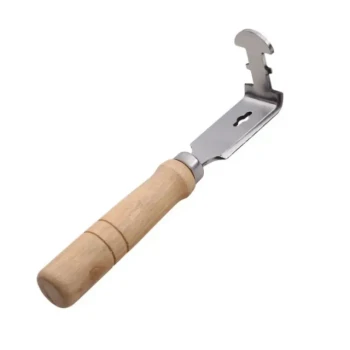
The primary function of a laboratory grinder in propolis pretreatment is to mechanically reduce frozen raw material into fine particles, thereby drastically increasing its specific surface area. This physical transformation disrupts the dense matrix of the propolis, facilitating deep solvent penetration and ensuring the efficient release of bioactive substances during the subsequent extraction phase.
Raw propolis acts as a physical barrier, often trapping valuable compounds behind layers of wax and resin. Grinding is the critical mechanical step that shatters this encapsulation, transforming a viscous block into a porous powder that allows extraction solvents to reach and dissolve the active ingredients.
The Mechanics of Pretreatment Efficiency
Maximizing Specific Surface Area
The core objective of the grinding process is the exponential increase of the material's specific surface area. By reducing the particle size, you expose significantly more of the raw material's surface to the extraction medium.
This increased exposure is the fundamental driver of extraction speed. It removes the physical bottleneck, allowing chemical reactions between the solute and solvent to occur more rapidly and completely.
Facilitating Deep Solvent Penetration
Raw propolis is naturally dense and resistant to saturation. Grinding breaks down this resistance, creating pathways for the solvent to enter the core of the material.
The primary reference notes that this step allows the solvent to permeate the propolis matrix thoroughly. Without this penetration, the solvent would merely wash the exterior of the block, leaving internal bioactives untouched.
Disrupting Physical Encapsulation
As noted in the supplementary data, propolis contains resins and waxes that form a physical encapsulation structure. This structure essentially "locks in" active ingredients like flavonoids and polyphenols.
Mechanical force disrupts these waxy seals. By breaking this physical encapsulation, the grinder ensures that the solvent can physically contact and dissolve the target compounds that were previously inaccessible.
Critical Processing Conditions
The Necessity of Freezing
The primary reference specifies that the grinder processes frozen raw propolis. This is a non-negotiable requirement due to the material's natural state.
At room temperature, propolis is sticky and viscous. Freezing hardens the material, allowing it to be shattered into a powder rather than gumming up the mechanical components of the grinder.
Achieving Particle Uniformity
Beyond simple reduction, the goal is to create a uniform powder. Irregular chunks lead to inconsistent extraction rates, where small particles over-extract and large chunks under-extract.
A laboratory grinder ensures a consistent particle distribution. This stability is essential for scientific accuracy, particularly when precise weighing or consistent release rates are required for sensitivity tests.
Understanding the Trade-offs
Thermal Degradation Risks
Mechanical grinding generates heat through friction. Because propolis is heat-sensitive, there is a risk that the grinding process itself could degrade the very bioactive compounds you are trying to extract.
If the equipment is not properly cooled or if the grinding duration is too long, the friction heat can cause the propolis to melt or chemically alter. This negates the benefits of the pretreatment phase.
Equipment Maintenance and Clogging
Because propolis returns to a sticky state as it warms, it presents significant challenges for equipment maintenance.
If the temperature control fails even slightly, the fine powder can re-agglomerate. This causes severe clogging in the grinding chamber and screens, potentially halting production and requiring labor-intensive cleaning.
Making the Right Choice for Your Goal
To maximize the efficacy of your propolis extraction, tailor your grinding approach to your specific outcome:
- If your primary focus is maximum bioactive recovery: Ensure the propolis is frozen completely solid before grinding to achieve the finest possible particle size, exposing the maximum surface area for flavonoid extraction.
- If your primary focus is process consistency: Prioritize grinding equipment with integrated cooling features to prevent the powder from melting and re-agglomerating, ensuring a uniform particle distribution for every batch.
The quality of your final extract is directly determined by the surface area available to your solvent; without effective grinding, even the strongest solvent cannot access the full spectrum of active compounds.
Summary Table:
| Feature | Function in Propolis Pretreatment | Impact on Extraction |
|---|---|---|
| Particle Size Reduction | Increases specific surface area | Faster and more complete solute-solvent interaction |
| Matrix Disruption | Breaks through waxy resins and encapsulation | Ensures solvent reaches internal flavonoids/polyphenols |
| Mechanical Action | Transforms viscous blocks into porous powder | Eliminates physical bottlenecks in the extraction process |
| Temperature Control | Utilizes frozen raw material | Prevents gumming and protects heat-sensitive compounds |
| Particle Uniformity | Ensures consistent distribution | Provides scientific accuracy and stable release rates |
Maximize Your Propolis Yield with HONESTBEE Professional Solutions
High-quality propolis extraction begins with precision pretreatment. HONESTBEE specializes in supporting commercial apiaries and distributors with the robust machinery and tools needed to scale production. From advanced laboratory grinders and honey-filling machines to specialized hive-making equipment, we provide the full spectrum of hardware and industry consumables you need to succeed.
Ready to enhance your processing efficiency? Contact our expert team today to explore our comprehensive wholesale offerings and find out how our specialized beekeeping tools can add value to your business.
References
- Hatice Kalkan Yı̇ldırım. Assessment of Propolis Treated by Different Extraction Methods. DOI: 10.1590/1678-4324-2022210251
This article is also based on technical information from HonestBee Knowledge Base .
Related Products
- Heavy Duty Stainless Steel Frame Cleaner with Plastic Handle
- 8 Frame and 10 Frame Propolis Trap Collector Screen for Propolis Collection
- Professional Stainless Steel Frame Cleaner with Ergonomic Wood Handle
People Also Ask
- What tools are used for cleaning frames? A Beekeeper's Simple 4-Tool Guide
- What are the physical characteristics of the frame cleaning tool? Durable Wood Design for Effective Hive Maintenance
- What is the purpose of the frame cleaning tool? A Precision Tool for Efficient Frame Maintenance
- In what specific situation is the frame cleaning tool particularly useful? Master Cut Comb Maintenance
- What is the function of the frame cleaning tool in beekeeping? Streamline Your Apiary Hygiene and Maintenance