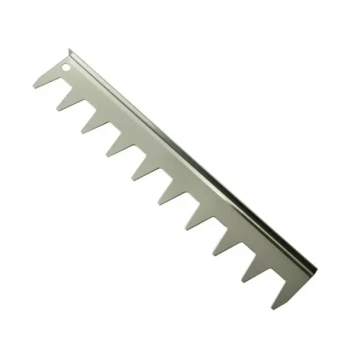
Standardizing beehive frame counts is the primary method for establishing a controlled experimental baseline. By using a fixed specification, such as a nine-frame setup, beekeepers and researchers ensure that the initial strength and population of every colony are identical. This uniformity allows for the accurate measurement of how external factors—like floral density, temperature, and wind speed—affect foraging efficiency without the "noise" of varying colony sizes.
Standardizing hive internal volume and frame counts transforms complex biological systems into predictable, measurable units. This eliminates hardware-driven variables, allowing for precise data on colony productivity and environmental impact.
Eliminating Biological Variables
Ensuring Initial Population Consistency
Using a standardized number of frames ensures that every experimental group starts with the same adult bee population and brood area. This baseline is critical because a larger colony will naturally forage more than a smaller one, regardless of its efficiency or the quality of the surrounding environment.
Isolating External Environmental Factors
When internal hive space and resources are equalized, any observed change in foraging behavior can be attributed to external variables. Researchers can then objectively analyze how factors like humidity, wind speed, and floral phenology influence the dynamics of nectar and pollen collection.
Quantifying Population Dynamics
Standardized frames serve as a physical benchmark for counting adult bees, typically calculated at a ratio of approximately 3,000 bees per fully covered frame. This allows technicians to track population fluctuations over 21-day worker development cycles with high mathematical precision.
Quantitative Benchmarking for Commercial Scale
Precise Resource Assessment
In a professional setting, standardized frames allow for the subdivision of hive space into tenths or percentages. This level of granularity is essential for quantifying brood area, honey reserves, and pollen stores across thousands of units in a commercial operation.
Tracking Foraging Energy Consumption
Standardized hive layouts facilitate the calculation of the physical distance between the hive and floral sources. By keeping hive structures identical, beekeepers can more accurately estimate the energy consumption of foragers relative to the total honey yield.
Data-Driven Management Decisions
Consistent hive specifications provide the data necessary for informed management, such as when to begin supplemental feeding or swarm control. This professional expertise ensures that distributors and wholesalers can offer products backed by rigorous performance metrics.
The Role of Standardization in Supply Chain Efficiency
Professional Industry Expertise
For distributors and B2B resellers, standardized hardware represents deep industry expertise and a commitment to reliability. Selling equipment that adheres to recognized specifications, such as the nine-frame standard, ensures that end-users can replicate successful foraging results.
Rapid Response and Order Fulfillment
Standardization simplifies the supply chain, allowing for ultra-fast delivery and efficient order fulfillment. Because parts are interchangeable and specifications are fixed, distributors can maintain a comprehensive full-spectrum portfolio without the complexity of custom dimensions.
One-Stop Sourcing Capabilities
By focusing on standardized specifications, trading partners can offer one-stop sourcing for frames, foundations, and hive bodies. This compatibility reduces lead times and ensures that commercial beekeepers can scale their operations rapidly without facing hardware mismatches.
Understanding the Trade-offs
Limitations of Rigid Specifications
While standardization is essential for data integrity, it can sometimes ignore the biological needs of a colony in extreme climates. A fixed nine-frame setup may provide too much space for a weak colony in cold weather or too little space for a high-performance queen during a peak nectar flow.
Potential for Growth Constraints
In high-yield environments, a standardized frame count may act as a physical bottleneck for colony expansion. Professionals must balance the need for standardized data with the flexibility to add supers or expand volume when the biological population exceeds the established benchmark.
How to Apply This to Your Project
Making the Right Choice for Your Goal
Standardization is a tool for precision; its application depends on your specific commercial or research objectives.
- If your primary focus is research and data accuracy: Implement a strict nine-frame protocol to isolate environmental variables and ensure repeatable results across all experimental groups.
- If your primary focus is commercial scalability: Utilize standardized frame specifications to streamline your inventory and ensure that all hardware is interchangeable across different apiary sites.
- If your primary focus is maximizing individual colony yield: Use standardized frames as a baseline, but remain prepared to adjust hive volume based on real-time population assessments and local floral cycles.
Standardization is the foundation of a professional apicultural operation, turning biological uncertainty into actionable commercial data.
Summary Table:
| Key Benefit | Description | Commercial Impact |
|---|---|---|
| Baseline Consistency | Ensures identical starting colony strength and adult bee population. | Provides reliable benchmarking for large-scale operations. |
| Variable Isolation | Eliminates internal hardware differences to focus on external floral/weather factors. | Enables precise data collection on environmental productivity. |
| Resource Assessment | Allows subdivision of hive space into measurable units (tenths/percentages). | Facilitates data-driven decisions for feeding and swarm control. |
| Supply Chain Speed | Uses interchangeable, recognized industry specifications (e.g., 9-frame). | Ensures ultra-fast delivery and efficient order fulfillment. |
Scale Your Apiary Business with HONESTBEE
At HONESTBEE, we understand that standardization is the engine of profitability for distributors and B2B resellers. We offer a comprehensive wholesale portfolio designed to meet the rigorous demands of commercial beekeeping.
Why Partner with Us?
- One-Stop Sourcing: From specialized hive-making and honey-filling machinery to a full spectrum of beekeeping tools and consumables.
- Premium Trading Services: Benefit from our deep industry expertise, OEM/ODM support, and certifications that protect your profit margins.
- Unmatched Reliability: Experience ultra-fast delivery and a rapid-response service model tailored to high-volume distributors.
Ready to enhance your product offering with high-performance, standardized hardware? Contact us today to explore our full-spectrum wholesale solutions and drive your business forward!
References
- Fazlah Wahid, Braj Kishor Prasad Singh. Foraging Dynamics of Western Honey Bee <i>APIs Mellifera</i> L. On Litchi. DOI: 10.55446/ije.2024.1390
This article is also based on technical information from HonestBee Knowledge Base .
Related Products
- Stainless Steel 9 Frame Hive Spacer Durable Precise for Commercial Beekeeping
- Wooden Bee Hive Frames for Beekeeping and Wholesale
- Assembled Wooden Bee Frames with Plastic Foundation for Durability and Convenience by HONESTBEE
- Plastic Bee Frame Beekeeping Hive Frames for Wholesale
- HONESTBEE Wired and Assembled Wooden Bee Frames Foundation for a Thriving Hive
People Also Ask
- What is the function of Langstroth frames in comb foundation construction? Optimize Your Apiary's Structural Integrity
- What are the specific dimensions for the wooden parts of Langstroth beehive frames? Precision Guide for All Sizes
- How are Langstroth beehive frames assembled? A Step-by-Step Guide for a Durable Hive
- What is the purpose of Langstroth beehive frames in beekeeping? Key to Professional Hive Management & Scaling
- What is the purpose of Langstroth beehive frames? Unlock the Key to Modern Beekeeping