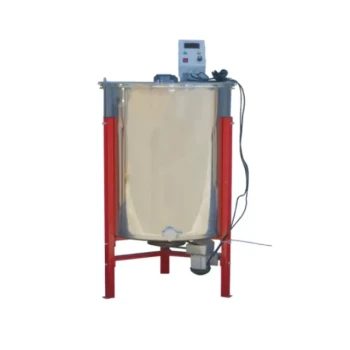
The primary purpose of the laboratory centrifuge in honey analysis is to prepare the sample for optical measurement by strictly separating solid particles from the liquid solution. By utilizing high-speed centrifugal force, the device forces unreacted substrates and precipitates to the bottom of the tube. This process results in a transparent supernatant—a clear liquid layer—that is free of physical debris.
Core Takeaway: The centrifuge acts as a critical filtration step that guarantees optical clarity. Without this separation, suspended particles would scatter light within the spectrophotometer, leading to inaccurate absorbance readings and invalid Diastase Number (DN) calculations.
The Mechanics of Sample Preparation
Removing Reaction Byproducts
During the enzymatic reaction phase of honey testing, not all substrates are consumed. The solution often contains unreacted substrate particles or newly formed precipitates that cloud the mixture.
Creating the Supernatant
The centrifuge rapidly spins the sample to isolate these solids. This creates a distinct separation: a solid pellet at the bottom and a clear, transparent supernatant on top.
Ensuring Optical Clarity
The liquid portion (supernatant) is the only part of the sample analyzed by the spectrophotometer. This liquid must be completely free of turbidity to ensure that the light passes through without obstruction.
Enabling Accurate Enzyme Analysis
Facilitating Colorimetric Analysis
Honey enzyme activity is measured using optical colorimetric analysis. This method relies on light absorption to quantify chemical presence; any suspended solid acts as an obstruction that falsifies the measurement.
Protecting the Diastase Number (DN)
The ultimate goal is to measure the activity of diastase, an enzyme highly sensitive to heat and storage time. Accurate spectrophotometer readings are required to calculate the Diastase Number (DN), which serves as the key indicator of honey quality and thermal history.
Preventing Data Interference
If the separation step is skipped or performed poorly, particles remain suspended. These particles interfere with the spectrophotometer's sensors, generating "noise" that disguises the true enzymatic activity levels.
Common Pitfalls in Workflow Integration
Incomplete Separation
If the centrifugation speed or duration is insufficient, the supernatant will remain slightly turbid. Even microscopic particles can scatter light, leading to artificially high absorbance readings that do not reflect true enzyme activity.
False Quality Indicators
Inaccurate readings caused by poor centrifugation can lead to incorrect conclusions about the honey's history. A sample might appear to have a different DN than reality, potentially masking improper heating or excessive storage degradation.
Ensuring Analytical Precision
To ensure valid results in honey enzyme detection, structure your workflow around the following priorities:
- If your primary focus is Data Accuracy: Ensure the centrifugation cycle is long enough to produce a supernatant that is visually indistinguishable from water or clear reagents.
- If your primary focus is Quality Control: Verify that the separation is complete before transferring the liquid to the spectrophotometer to prevent equipment contamination and false readings.
The centrifuge effectively translates a chemically complex reaction into a physically clear sample, creating the baseline condition required for scientific measurement.
Summary Table:
| Process Phase | Function of Centrifuge | Impact on Accuracy |
|---|---|---|
| Sample Preparation | Removes unreacted substrates and physical debris | Eliminates light-scattering particles |
| Phase Separation | Isolates solid pellet from liquid supernatant | Creates the transparent layer needed for analysis |
| Optical Measurement | Enables clear light path in spectrophotometer | Prevents false absorbance and DN calculation errors |
| Quality Control | Validates sample purity before testing | Detects thermal history and storage degradation |
Elevate Your Honey Quality Analysis with HONESTBEE
Precise data is the backbone of a successful beekeeping operation. At HONESTBEE, we specialize in empowering commercial apiaries and distributors with the professional-grade tools needed to maintain global quality standards. From high-precision laboratory centrifuges for enzyme detection to industrial honey-filling machines and hive-making equipment, we provide a comprehensive wholesale catalog of machinery and essential consumables.
Whether you are scaling your honey production or looking for specialized cultural merchandise to expand your brand, our team is ready to deliver the hardware and expertise you need.
Ready to optimize your workflow? Contact us today to explore our full spectrum of beekeeping solutions!
References
- Erwan Erwan, Muhammad Muhsinin. The Honey Quality of Apis mellifera with Extrafloral Nectar in Lombok West Nusa Tenggara Indonesia. DOI: 10.29303/jossed.v1i1.482
This article is also based on technical information from HonestBee Knowledge Base .
Related Products
- Manual Hand Crank 4 Frame Honey Extractor Centrifuge for Beekeeping
- electric honey extractor honey centrifuge 3 frame honey extractor stainless steel honey frame extractor
- Professional 4 Frame Self Reversing Electric Honey Extractor for Beekeeping
- Honey Concentrating and Filtering Dehumidifier Machine 2T Capacity for Honey
- Precision Honey Refractometer Instrument for Quality Assessment
People Also Ask
- What are some tips for achieving efficient honey extraction with a centrifuge extractor? Maximize Your Yield & Efficiency
- What is the proper procedure for maintaining a centrifuge honey extractor? Expert Tips for Longevity and Hygiene
- What are the advantages of using a centrifuge honey extractor? Maximize Yields and Protect Your Honeycombs
- Which type of honey extractor is generally more durable? Focus on Material & Build Quality for Longevity
- What is a manual honey extractor? The Essential Guide to Cost-Effective Beekeeping for Beginners