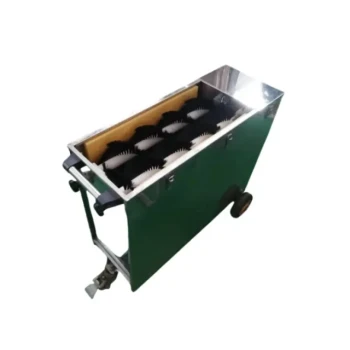
Industrial-grade insect foggers function as a rapid delivery mechanism for Oxalic Acid (OA) by using heat to atomize acid that has been dissolved in ethanol. While beekeepers often turn to them for their speed and cost-effectiveness, their primary limitation is a critical lack of dosing precision. This inconsistency frequently results in an insufficient drug load, rendering the treatment largely ineffective at lowering Varroa mite infestation rates compared to specialized equipment.
While foggers offer a fast and inexpensive method for applying Oxalic Acid, they lack the precision required for effective pest control. The inability to deliver a consistent, sufficient dose often fails to significantly lower mite counts, making specialized vaporizers a more reliable choice for colony health.
The Mechanics of Industrial Foggers
How the Process Works
These devices operate by creating a thermal fog. You dissolve Oxalic Acid in ethanol, and the machine uses heat to atomize this solution into a fine mist.
The Appeal of the System
The primary role of the fogger in this context is speed and economy. It allows for the treatment of multiple hives in a very short period without the higher price tag associated with specialized vaporizers.
The Critical Flaw: Dosing Precision
Inconsistent Drug Loads
The defining limitation of industrial foggers is their inability to control the actual amount of active ingredient delivered.
A single burst from a fogger often fails to carry a sufficient "drug load" of Oxalic Acid. The ratio of carrier (ethanol) to active agent (OA) combined with the variable output of the nozzle leads to significant under-dosing.
Failure in Varroa Control
Because the dosing is imprecise and often too low, the therapeutic threshold required to kill mites is missed.
Consequently, using a fogger often results in negligible reductions in infestation rates. The mites survive the treatment, leaving the colony vulnerable despite the beekeeper's efforts.
Understanding the Trade-offs
Specialized vs. General Equipment
Industrial foggers are general-purpose tools adapted for beekeeping, whereas specialized vaporizers are engineered specifically for sublimation.
Specialized vaporizers are designed to deliver a precise, measured dose of OA directly. Foggers sacrifice this precision for the sake of rapid application.
The Cost of Convenience
The trade-off is clear: you gain speed but lose efficacy.
While you may save time during the application process, the long-term health of the hive is compromised because the treatment fails to manage the mite population effectively.
Making the Right Choice for Your Apiary
To select the right tool, you must prioritize your goals regarding hive management and pest control efficacy.
- If your primary focus is rapid application at a low cost: Be aware that while a fogger is fast, it likely provides an insufficient dose that will not effectively reduce Varroa mite populations.
- If your primary focus is effective Varroa mite control: You should utilize a specialized vaporizer to ensure the precise, high-concentration dosage required to significantly lower infestation rates.
True hive stewardship relies on the certainty that your treatment is actually working, not just the speed at which it is applied.
Summary Table:
| Feature | Industrial-Grade Insect Fogger | Specialized OA Vaporizer |
|---|---|---|
| Mechanism | Thermal fogging (OA dissolved in ethanol) | Sublimation (Direct heating of OA crystals) |
| Primary Goal | Speed and low initial cost | High efficacy and precise dosing |
| Dosing Precision | Low (Inconsistent drug load) | High (Measured, concentrated dosage) |
| Mite Reduction | Negligible / Inconsistent | High / Reliable |
| Target Audience | Hobbyists prioritizing convenience | Commercial apiaries and professional beekeepers |
Elevate Your Apiary's Health with Professional Equipment
Don't compromise your colony's survival for the sake of speed. HONESTBEE provides commercial apiaries and distributors with the high-precision tools necessary for effective pest management.
Our comprehensive wholesale range includes:
- Advanced Beekeeping Machinery: Specialized honey-filling and hive-making machines.
- Professional Tools: High-efficacy equipment designed for precise chemical application.
- Industry Consumables: A full spectrum of essential supplies for large-scale operations.
Partner with HONESTBEE to ensure your operations—or your customers' hives—benefit from industry-leading reliability and performance.
Contact our wholesale team today to discuss how our specialized equipment can enhance your productivity.
References
- Cody Prouty, Cameron Jack. Oxalic acid application method and treatment intervals for reduction of <i>Varroa destructor</i> (Mesostigmata: Varroidae) populations in <i>Apis mellifera</i> (Hymenoptera: Apidae) colonies. DOI: 10.1093/jisesa/iead086
This article is also based on technical information from HonestBee Knowledge Base .
Related Products
- Commercial Grade Vertical Electric Bee Sweeper for Bee Removal
- Professional Multi-Component Bucket Wasp Trap
- Professional Bucket Style Wasp and Moth Pheromone Trap
People Also Ask
- What are the advantages of using professional bee sweepers? Boost Honey Harvesting Efficiency and Protect Your Hive
- How do standardized frames and professional bee-sweeping equipment contribute to apiary efficiency? Scale Your Harvest
- What are the specific functions of dedicated feeding systems and physical bee removal equipment in organic production?
- What are the benefits of using professional bee removal equipment during honey harvesting? Boost Purity and Efficiency
- What techniques and tools are used to clear bees from supers during honey harvesting? Efficient Solutions for Every Apiary