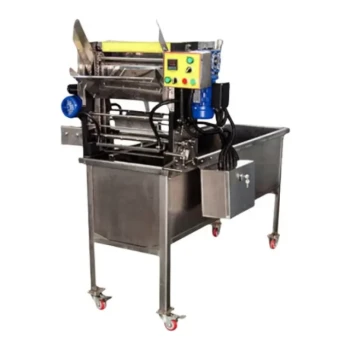
Integrating automatic honey filling machines marks the critical transition from raw material collection to professional manufacturing. These systems allow for the rapid transformation of raw honey into standardized commercial products by executing precise volume controls and drastically minimizing both material loss and the risks of secondary contamination inherent in manual handling.
The true value of automation lies in achieving full-chain standardization. When paired with upstream hardware like hive-making machines, automated filling lowers the comprehensive operating cost per kilogram, making large-scale commercial operations economically viable.
The Pillars of Commercial Standardization
Precision and Product Consistency
In large-scale operations, relying on manual filling creates variability that retailers and export markets will not tolerate. Automatic machines utilize high-precision quantitative filling valves to ensure every unit meets strict net weight requirements.
This eliminates the "overfill" waste common in manual operations. It guarantees that the final packaged product is uniform, giving your brand a professional appearance and ensuring compliance with labeling laws.
Minimizing Secondary Contamination
Hygiene is the primary barrier to entry for broad retail distribution. Manual bottling involves significant human contact, which increases the risk of introducing bacteria or foreign particles.
Automated systems creates a closed loop during the post-processing stage. By removing human hands from the filling and sealing process, you virtually eliminate secondary contamination, ensuring the product maintains the strict hygiene standards required for modern commercial success.
Achieving Full-Chain Operational Efficiency
The Synergy with Hive-Making Hardware
To understand the full impact, you must view the filling machine as part of a larger hardware ecosystem. The primary reference highlights the importance of combining filling automation with hive-making machines.
While hive machines ensure the breeding environment is standardized (interchangeable frames and supers), the filling machine standardizes the output. This creates "full-chain standardization."
Reducing Comprehensive Operating Costs
The ultimate metric for a large-scale apiary is the operating cost per kilogram of honey produced. Automation addresses this by increasing throughput capacity to meet export-level demands.
Simultaneously, it reduces the material loss associated with spills and manual errors. By optimizing speed and minimizing waste, the cost per unit drops significantly compared to traditional family-scale production methods.
Understanding the Trade-offs
Specificity of Equipment
Honey is a viscous fluid with unique flow characteristics that change with temperature. Generic liquid fillers often fail in this context.
You must invest in machines specifically built to handle high-viscosity fluids to avoid blockages or inconsistent fills. Using general-purpose equipment often leads to operational downtime.
Maintenance and Technical Skill
Transitioning to automation shifts your labor requirements. You rely less on general manual labor and more on skilled operators who can maintain and calibrate machinery.
If your operation lacks personnel with the technical ability to troubleshoot synchronized capping processes or filling valves, the efficiency gains can be lost to machine downtime.
Making the Right Choice for Your Goal
To determine if this integration is right for your current stage of growth, consider your immediate objectives:
- If your primary focus is entering retail or export markets: Prioritize automation for its hygiene benefits and ability to meet strict net weight labeling compliance.
- If your primary focus is lowering unit economics: Focus on the reduction of material loss and labor costs to drive down the comprehensive operating cost per kilogram.
- If your primary focus is scaling total production volume: Implement filling machines in conjunction with hive-making hardware to achieve full-chain standardization.
Automation is not just a convenience; it is the fundamental hardware requirement for modernizing the economics of honey production.
Summary Table:
| Feature | Manual Filling | Automated Filling | Impact on Operation |
|---|---|---|---|
| Filling Precision | High variability/Overfill waste | High-precision quantitative valves | Ensures legal compliance & reduces loss |
| Hygiene Control | High risk of human contact | Closed-loop system | Eliminates secondary contamination |
| Output Speed | Limited by labor | High-speed throughput | Meets export & retail demand scales |
| Operating Cost | High per-unit labor cost | Lower cost per kilogram | Enhances long-term economic viability |
| Consistency | Inconsistent product look | Uniform professional packaging | Strengthens brand trust & retail readiness |
Elevate Your Apiary to Industrial Standards with HONESTBEE
Transitioning from raw collection to professional manufacturing requires more than just tools—it requires a specialized hardware ecosystem. HONESTBEE empowers commercial apiaries and distributors worldwide with a comprehensive suite of professional equipment designed for scale.
How we add value to your business:
- Precision Machinery: From high-viscosity honey-filling machines to industrial-grade hive-making and honey-processing hardware.
- Full-Chain Standardization: We supply the complete spectrum of beekeeping tools and essential consumables to ensure your operation runs seamlessly.
- Commercial Growth: Whether you are expanding your honey-themed cultural merchandise or scaling for export, our wholesale solutions reduce your comprehensive operating costs.
Ready to modernize your production? Contact HONESTBEE today to consult with our experts on the right machinery for your commercial goals.
References
- Ahmed Alghamdi, Yilma Tadesse. New approach for determination of an optimum honeybee colony’s carrying capacity based on productivity and nectar secretion potential of bee forage species. DOI: 10.1016/j.sjbs.2014.09.020
This article is also based on technical information from HonestBee Knowledge Base .
Related Products
- Fully Automatic Honey Filling Packaging Machine for Processing Line
- Automatic Honey Filling and Filtering Machine for Beekeeping Bottle Filling
- Precision Durable Efficient HONESTBEE Rotary Honey Filling Machine
- Semi Automatic Small Honey Bottle Filling Machine Honey Filler
- Automatic Single-Dose Snap & Squeeze Honey Sachets Packing Machine
People Also Ask
- Why are fully automatic honey filling and packaging lines essential? Boost Your Honey's Market Value and Quality
- What is a fully-automatic honey filler? Streamline Your Production with High-Precision Automation
- How do automated honey filling and packaging machines affect profitability? Boost Margins with HONESTBEE Technology
- How do automated honey filling and packaging machines contribute to the market value of honey products? Maximize Your ROI
- How do industrial-grade automated honey filling and packaging machines mitigate the risk of physical contamination?