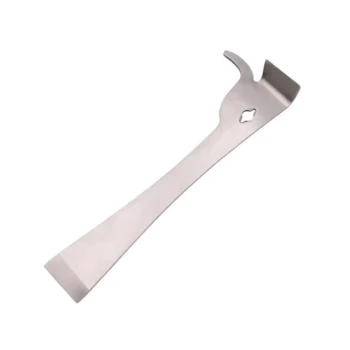
Increasing the number of frame bars from 10 to 15 is a strategic hardware modification that significantly expands the hive's internal surface area. This adjustment directly addresses the spatial bottlenecks inherent in standard designs, allowing strong colonies to maximize both brood production and resource accumulation without facing immediate physical constraints.
By overcoming the spatial limitations of standard 10-frame Langstroth hives, the 15-frame configuration aligns hardware capacity with the biological requirements of a strong colony, directly enhancing overall productivity.
Solving the Space Bottleneck
Overcoming Standard Limitations
Standard 10-frame Langstroth hives often impose an artificial ceiling on a colony's growth potential.
When a colony becomes strong, the standard hardware can restrict its natural expansion.
Moving to a 15-frame setup removes this barrier, ensuring the hive structure supports rather than hinders population growth.
Expanding Internal Surface Area
The primary technical significance of this change is the massive increase in usable surface area.
Bees do not just need empty volume; they require physical substrate (comb surface) to perform work.
Five additional frames provide the necessary infrastructure for simultaneous biological activities.
Enhancing Biological Function
Supporting Larger Brood Areas
A prolific queen requires significant comb space to lay eggs continuously.
The 15-frame high-capacity configuration ensures there is ample room dedicated to egg-laying.
This prevents the brood nest from becoming "honey-bound," allowing for sustained population replacement and growth.
Maximizing Resource Storage
Beyond reproduction, a strong colony functions as a resource acquisition engine.
The additional frames provide critical "warehousing" space for nectar and pollen.
This ensures that honey storage does not compete with the brood nest for space during heavy nectar flows.
Operational Considerations
Management Adjustments
While the biological benefits are clear, this configuration alters the physical footprint of the hive.
The increased width changes the center of gravity and the weight of individual boxes.
Operators must account for the non-standard dimensions when planning hive stands and inspection routines.
Determining the Right Configuration for Your Apiary
To decide if this hardware modification suits your operation, consider your specific goals:
- If your primary focus is maximizing colony productivity: The 15-frame design is the superior choice, as it accommodates the extensive brood and storage needs of high-performing colonies.
- If your primary focus is equipment standardization: Acknowledge that maintaining standard 10-frame hives may require more frequent active management to prevent congestion.
Ultimately, shifting to 15 frames is an effective method for scaling your hardware to match the high-output potential of your strongest colonies.
Summary Table:
| Feature | 10-Frame Standard Hive | 15-Frame High-Capacity Hive |
|---|---|---|
| Colony Growth | May impose artificial ceilings | Supports unrestricted population expansion |
| Brood Potential | Risk of becoming honey-bound | Dedicated space for continuous egg-laying |
| Storage Area | Limited pollen/nectar warehousing | Expanded substrate for resource accumulation |
| Management | Higher frequency of congestion checks | Accommodates high-output biological needs |
| Hardware Focus | Equipment standardization | Maximizing individual colony productivity |
Scale Your Apiary Output with HONESTBEE
Transitioning to high-capacity hardware requires precision-engineered equipment that can handle the increased weight and biological demands of a prolific colony. HONESTBEE specializes in supporting commercial apiaries and distributors with a comprehensive range of professional-grade tools.
From heavy-duty hive-making machinery to advanced honey-filling systems and essential consumables, we provide the infrastructure necessary to turn your high-output potential into profit. Whether you are expanding your colony footprint or optimizing your honey processing line, our wholesale offerings are tailored to your growth.
Ready to upgrade your commercial beekeeping operation? Contact us today to explore our full spectrum of equipment and machinery!
References
- Dr. A. A. Ahmed, Mai Monir Fawzy Al- Nabawy El- Zanaty. Studies on modern rearing methods in honeybee colonies. DOI: 10.21608/mjapam.2023.317573
This article is also based on technical information from HonestBee Knowledge Base .
Related Products
- 5 Frame Wooden Nuc Box for Beekeeping
- Durable Plastic Frame Spacer
- Plastic Bee Frame Beekeeping Hive Frames for Wholesale
- Wooden Bee Hive Frames for Beekeeping and Wholesale
- Multi-Function Plier-Style Frame Grip Hive Tool
People Also Ask
- What are the options for adding frames to a nuc after taking two frames from the parent colony?
- What frames should be moved into the queenless hive when requeening with a nuc? Ensure a Successful Queen Introduction
- What roles do five-frame nucleus boxes and ten-frame Langstroth hive boxes play in colony standardization?
- What is the primary function of five-frame nuclei boxes? Master Early Colony Establishment for Stronger Hives
- What is the typical composition of frames in a nuc? A 5-Frame Blueprint for a Thriving Hive