The decisive difference is not simply bee size—it is colony scale and honey throughput. Apis mellifera workers carry larger nectar and pollen loads, queens lay more eggs, and colonies reach approximately 40,000–60,000 bees versus 25,000–30,000 for Apis cerana. Under the reference’s standard conditions, A. mellifera produces roughly 25–30 kg of honey per colony, compared with 4–5 kg for A. cerana, requiring larger hive capacity and higher-throughput extraction equipment.
Commercial equipment should be sized around colony population, usable comb area, frame format, and expected harvest volume. A. mellifera generally requires larger modular hive systems, more supers, and extractors capable of processing substantially more honey per colony; A. cerana can use smaller, lighter systems but demands greater flexibility because of its stronger swarming and absconding behavior.
The Biological Differences That Drive Hardware Selection
Worker load capacity affects colony throughput
An A. mellifera worker typically carries approximately 40–80 mg of nectar, compared with 30–40 mg for A. cerana. Its pollen load is also higher, at approximately 12–29 mg versus 7–14 mg.
These are per-bee differences, but their commercial effect is multiplied by colony size. More productive workers operating in larger colonies can fill combs and supers faster during strong nectar flows.
Foraging range changes apiary planning
The reported foraging range is approximately 2–5 km for A. mellifera and 0.8–2 km for A. cerana. This gives A. mellifera a broader operating radius where suitable forage is dispersed.
The implication is not that a longer range eliminates the need for good forage. Rather, it can make large-scale operations more viable in open plains, irrigated agricultural regions, and concentrated orchards where colonies can exploit extensive nectar sources.
Queen productivity expands colony size
A. mellifera queens may lay approximately 800–1,800 eggs per day, compared with 300–800 eggs per day for A. cerana. This supports a larger workforce during peak nectar flows.
Peak colony populations are commonly described as 40,000–60,000 bees for A. mellifera and 25,000–30,000 for A. cerana. Hive volume, ventilation, brood-space management, and the number of available frames must accommodate that difference.
Comb-building capacity is important, but not a simple species constant
The reference gives approximately 5–8 combs for A. mellifera and 3–8 combs for A. cerana. Because these ranges overlap, comb count alone does not establish a universal hive size.
The more reliable equipment distinction is the combination of colony population, frame dimensions, comb depth, management method, and expected honey flow. A. mellifera operations generally use larger modular hive configurations and additional honey supers, while A. cerana systems are often smaller or more locally adapted.
How Yield Differences Translate into Hive Design
Apis mellifera needs scalable hive volume
Under the primary reference’s standard conditions, an A. mellifera colony produces approximately 25–30 kg of honey, compared with 4–5 kg for A. cerana. That is roughly five to seven and a half times more honey per colony in that comparison.
The higher output requires enough brood space for the larger workforce and enough super capacity to prevent congestion during nectar flows. Commercial systems therefore favor modular wooden boxes, movable frames, and expandable honey supers.
Standardized movable-frame hives support commercial handling
Both species build parallel combs inside enclosed cavities and can be managed with movable-frame systems. However, A. mellifera is especially well suited to standardized commercial configurations such as Langstroth-type hives, where supers, frames, queen excluders, and replacement parts can be handled consistently.
The critical design feature is accurate bee-space control, commonly associated with approximately 8 mm spacing in standard hive construction. Correct spacing allows frames to be lifted without crushing bees or encouraging excessive cross-combing.
Apis cerana often benefits from smaller, adaptable systems
A. cerana is traditionally kept in smaller box systems, locally adapted wooden hives, or log hives. These arrangements can suit smaller colonies, rugged terrain, and operations where lightweight equipment is more important than maximum throughput.
For commercial use, movable frames can still improve inspection and harvesting. The equipment should be selected for the colony’s actual frame format rather than assuming that A. mellifera and A. cerana components are automatically interchangeable.
How Yield Determines Extraction Equipment Capacity
Extractor sizing should follow frames and harvest volume
A honey extractor is sized primarily by frame count, frame dimensions, cycle time, and daily harvest volume. Species identity is a useful planning indicator, but it is not a substitute for calculating the number of colonies, supers, and frames that will be processed.
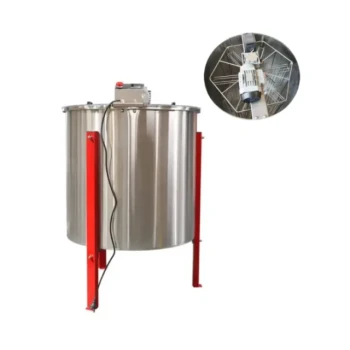
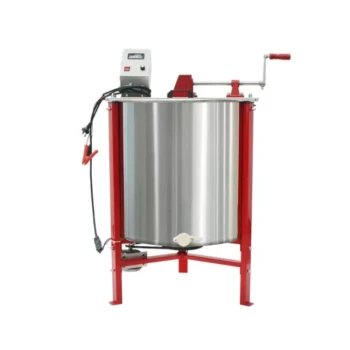
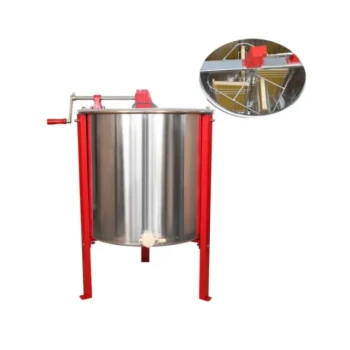
Because A. mellifera colonies produce far more honey under comparable conditions, commercial operations generally need larger radial or tangential extractors, more holding capacity, and faster transfer from uncapping to filtration and storage.
Apis mellifera may justify mechanized uncapping
Higher production increases the bottleneck risk at the uncapping stage. If a commercial apiary harvests many A. mellifera frames in a short nectar window, manual uncapping can limit the entire line even when the extractor itself has sufficient capacity.
Distributors should therefore evaluate the complete workflow: uncapping equipment, extractor, honey pump, filters, settling tanks, storage tanks, and filling machinery. Increasing only extractor size may move the bottleneck elsewhere.
Apis cerana generally needs lower-volume equipment
The lower per-colony yield of A. cerana usually supports smaller extractors and less extensive processing infrastructure. Lightweight, transportable equipment may be more valuable than maximum hourly throughput, particularly in forested, mountainous, or dispersed apiaries.
However, a low-output colony does not necessarily mean a low-output business. A large number of A. cerana colonies can still create substantial aggregate processing demand, so equipment should be sized for the total apiary harvest, not yield per colony alone.
Management Behavior Also Affects Hive Design
Swarming and absconding favor adaptable equipment
The supplementary references identify A. cerana as having stronger tendencies toward swarming, absconding, and robbing. Absconding is especially important because a colony that abandons its hive reduces the return on installed hardware and complicates production planning.
Equipment for A. cerana should therefore support rapid inspection, easy relocation, secure closure, and straightforward colony recovery. Modular components are useful, but overly complex systems may be counterproductive in remote or frequently moved apiaries.
Apis mellifera is more compatible with standardized workflows
A. mellifera is described as having lower absconding tendencies and remaining comparatively manageable on frames during inspections. This makes standardized hive bodies, queen excluders, frame handling, and mechanized harvesting more commercially practical.
The advantage is operational consistency. A distributor serving large A. mellifera apiaries can provide repeatable components across colonies, simplifying inventory, maintenance, transport, and replacement.
Hive sealing requirements differ
A. mellifera actively uses propolis to seal gaps, while A. cerana is described as not relying on propolis in the same way to close hive cracks. This makes physical hive maintenance particularly important for A. cerana systems.
Poorly sealed equipment can increase stress, encourage robbing, and contribute to absconding risk. Durable boxes, accurate joints, secure lids, and replacement parts are therefore not minor accessories; they are part of species-appropriate hive design.
Understanding the Trade-offs
Do not treat yield figures as universal guarantees
The primary reference gives a standard comparison of 25–30 kg versus 4–5 kg per colony. Supplementary figures report different annual ranges, including approximately 30–40 kg for A. mellifera and 10–25 kg for A. cerana depending on region, while another source gives a much lower A. cerana figure.
These differences reflect variation in forage, climate, management, colony strength, and whether the measurement is a peak-flow or annual average. Equipment decisions should use local production records and a design margin rather than a single published yield number.
Larger equipment does not automatically improve productivity
An oversized extractor or excessive hive volume can increase capital cost, storage requirements, labor, and transport difficulty. Equipment should be large enough to prevent harvest bottlenecks, but not so large that it remains underused for most of the season.
For A. cerana, lightweight and modular equipment may deliver better operational value than heavy industrial machinery. For A. mellifera, under-capacity is usually the greater risk during peak harvest.
Species should not be confused with frame standard
The fact that both species can use movable-frame hives does not mean their local hive formats, frame sizes, or colony-management practices are identical. Mixing components without checking dimensions can create poor bee space, unusable combs, or extraction incompatibility.
For resellers, the correct product strategy is to offer species-specific and standard-compatible options, with clearly documented frame dimensions and hive-body specifications.
Higher yield carries higher operating requirements
A. mellifera offers greater commercial output but may require higher investment in hive equipment, feeding, disease control, transport, and pest management. The higher revenue potential must be evaluated against those operating costs.
A. cerana may require less capital and can perform well in varied terrain, but lower yield and higher absconding risk can make production less predictable. The most economical species depends on forage, geography, labor, and market access.
Making the Right Choice for Your Goal
Select equipment by combining species biology with local harvest data, colony count, frame format, and the required processing window.
- If your primary focus is high-volume commercial production: Prioritize standardized A. mellifera hive bodies, expandable supers, compatible frames and queen excluders, plus extractor and uncapping capacity matched to peak harvest volume.
- If your primary focus is low-capital or rugged-terrain beekeeping: Favor lightweight, durable, adaptable A. cerana hive systems and smaller processing equipment that can be moved and maintained easily.
- If your primary focus is equipment distribution: Build a product portfolio covering standardized Langstroth-compatible components, species-appropriate smaller hive systems, extraction machinery, replacement parts, and clearly verified dimensions.
- If your primary focus is reliable order fulfillment: Stock the complete workflow—from hive boxes and frames through uncapping, extraction, filtration, storage, and filling—so customers do not encounter capacity mismatches between equipment stages.
- If your primary focus is accurate capacity planning: Size machinery from total frames and expected harvest-day volume, using conservative local yield data rather than relying on a single species-wide average.
The right commercial system is the one that matches colony scale, local conditions, frame standards, and peak processing demand—not merely the bee species name.
Summary Table:
| Feature | Apis mellifera | Apis cerana |
|---|---|---|
| Worker nectar load | 40–80 mg | 30–40 mg |
| Worker pollen load | 12–29 mg | 7–14 mg |
| Queen egg-laying rate | 800–1,800/day | 300–800/day |
| Peak colony population | 40,000–60,000 bees | 25,000–30,000 bees |
| Foraging range | 2–5 km | 0.8–2 km |
| Honey yield per colony (standard) | 25–30 kg | 4–5 kg |
| Comb count | 5–8 combs | 3–8 combs |
| Swarming/absconding tendency | Moderate | High |
Equipment implications: Larger modular hives, more supers, and high-capacity extractors for A. mellifera; smaller, adaptable hives and lower-volume extraction equipment for A. cerana.
Ready to equip your apiary with the right hive and extraction systems? At HONESTBEE, we understand that every bee species and operation has unique needs. Our comprehensive wholesale portfolio includes everything from hive-making machinery and honey extraction equipment to essential consumables, all sized for optimal performance. Whether you're a distributor looking for profit margins and OEM/ODM support, or a beekeeper needing rapid, reliable supply, our dedicated team ensures you get the right equipment with efficient order fulfillment. Contact us today to discuss your requirements and discover how our one-stop sourcing can maximize your efficiency and yield.
Related Products
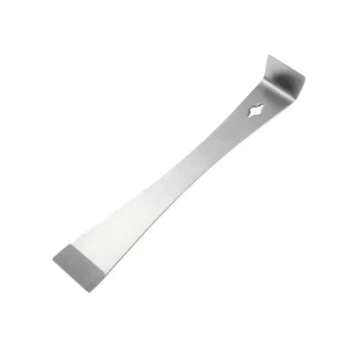
- Professional Stainless Steel Pry-Bar Hive Tool
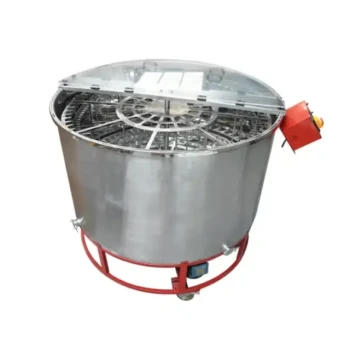
- Stainless Steel Manual 8 Frame Radial Honey Extractor Machine for Beehives
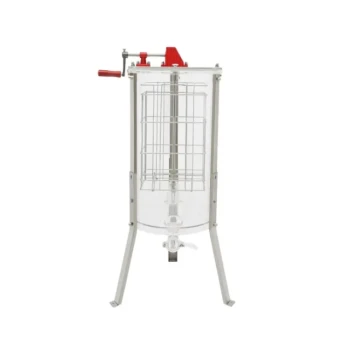
- Plastic Hand Crank 2 Frame Honey Extractor Low Price
- Electric 8 Frame Honey Spinner Extractor Equipment for Beekeeping
- HONESTBEE 2 Frame Manual Acrylic Honey Extractor Beekeeping Equipment
People Also Ask
- What is the function of a professional stainless steel hive tool in IFB? Optimize Your Colony Strength Assessment
- Which technical challenges in hive maintenance are addressed by using a professional stainless steel hive tool?
- What are the primary functions of a stainless steel hive tool? Essential Tips for Efficient Apiary Maintenance
- What are the primary functions of a stainless steel hive tool? Essential Equipment for Professional Beekeeping
- What is the role of professional hive tools in routine apiary maintenance? Expert Tips for Hive Health and Longevity