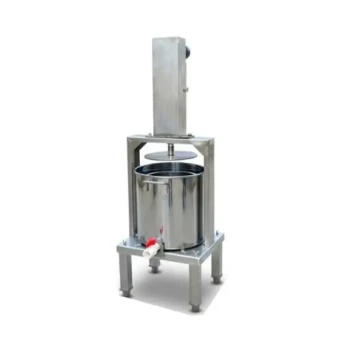
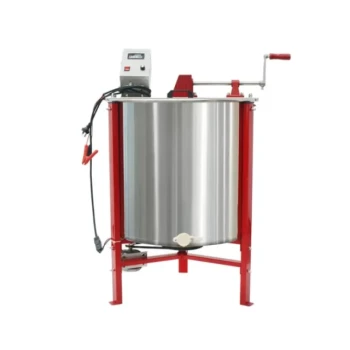
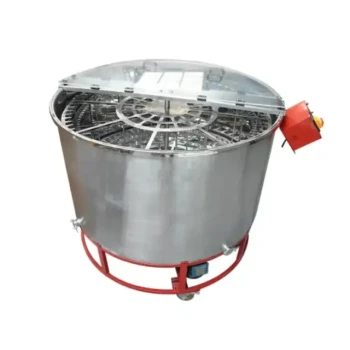
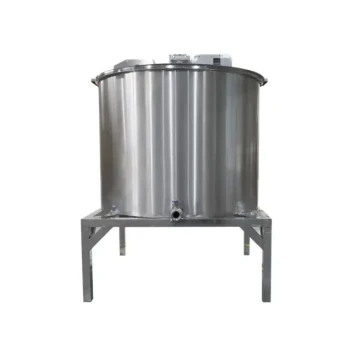
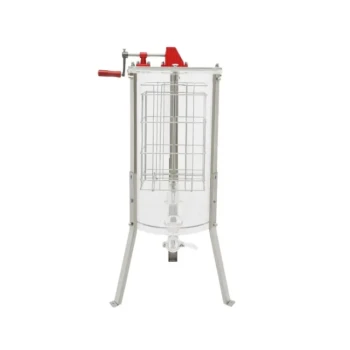
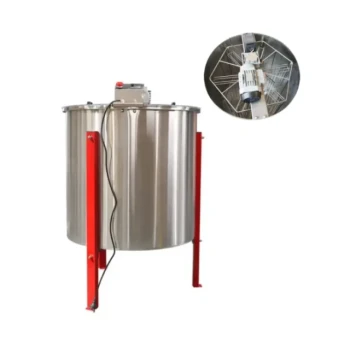
For commercial apiaries, centrifugal honey extraction machinery delivers faster, repeatable, and less wasteful harvesting than traditional pressing. It removes honey while keeping the wax comb intact, allowing frames to return directly to the hive. This reduces manual labor, shortens extraction cycles, lowers the colony’s wax-rebuilding workload, and supports higher seasonal output across large operations.
The central operational advantage is comb preservation. Unlike pressing, which typically destroys the comb and requires replacement or rebuilding, centrifugal extraction lets commercial beekeepers reuse frames immediately—turning each harvest into a faster, more scalable production cycle.
Why Centrifugal Extraction Improves Commercial Operations
It preserves reusable wax comb
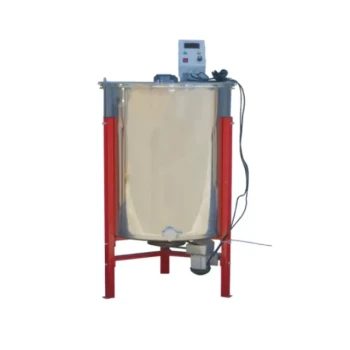
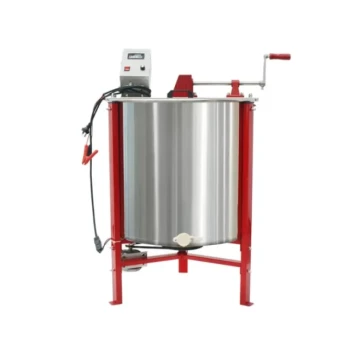
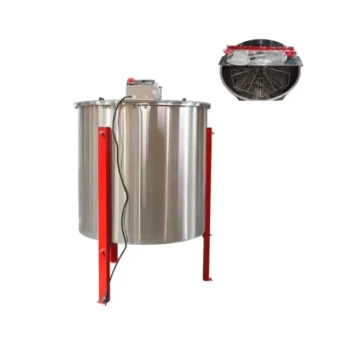
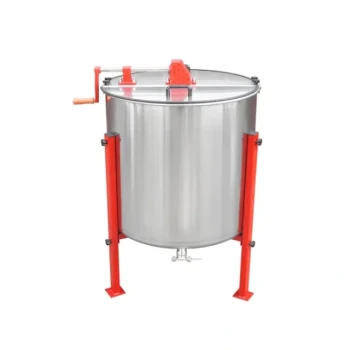
A centrifugal extractor spins harvested frames inside a drum, using rotational force to expel honey from the cells. Because the comb structure remains intact, the empty frames can be returned to hive supers after extraction.
Traditional pressing generally crushes the comb to release the honey. The resulting wax must then be processed, replaced, or rebuilt before the frames can support another full production cycle.
It reduces the bees’ rebuilding workload
Bees spend substantial energy secreting wax and constructing new cells. Reusing intact comb allows that energy to be redirected toward foraging, brood care, and honey production.
For commercial apiaries, this can improve the productivity of each hive over the flowering season. The benefit is not only biological; it also reduces the need to manage replacement comb at scale.
It increases harvesting throughput
Centrifugal machines are designed for repeatable extraction cycles. Operators can load multiple frames, run the extractor, drain the collected honey, and process the next batch with less manual handling than crushing and pressing individual combs.
This creates a more predictable workflow during peak harvest periods, when delays can increase labor costs and complicate processing schedules.
It lowers harvesting labor
Traditional pressing requires more hands-on work, including comb cutting, crushing, pressing, and cleanup. Centrifugal extraction shifts much of the separation process to a mechanized system.
Operators still need to uncap, load, inspect, and clean frames, but the core extraction step becomes faster and less physically demanding. That matters when labor availability is limited or harvest volumes are high.
How the Equipment Supports Higher Output
More honey from the same hive resources
When intact combs return to the hive, colonies do not need to rebuild their working cell structures after every extraction. This allows the existing comb infrastructure to be used repeatedly.
Over a full season, that can increase the amount of honey produced from the same hives, supers, and frames compared with a process that destroys the comb after each harvest.
Faster turnaround between harvests
Reusable frames can be placed back into service without waiting for complete comb reconstruction. This shortens the interval between extraction and the next productive cycle.
For commercial producers, faster turnaround can be especially valuable during strong nectar flows, when unused hive capacity represents missed production.
More consistent process performance
A properly configured extractor provides a repeatable method for separating honey from frames. Consistent loading, rotation, drainage, and cleaning procedures make production easier to standardize across teams and locations.
That repeatability supports better planning for labor, equipment utilization, packaging, and order fulfillment.
Operational Benefits for Commercial Buyers and Distributors
Equipment scales with production requirements
Centrifugal extractors are available in configurations suited to different apiary sizes and processing volumes. This gives distributors and resellers an opportunity to match equipment capacity to the customer’s frame count, harvest frequency, and labor model.
The correct selection should consider not only drum capacity, but also frame compatibility, drive system, operator access, cleaning requirements, and expected daily throughput.
It strengthens the value proposition for professional users
For beekeepers, the purchase is not simply about replacing a manual tool. It is an investment in labor reduction, comb reuse, production continuity, and seasonal capacity.
For B2B sellers, these operational benefits provide a stronger basis for product recommendations than price alone. Customers are typically evaluating how quickly the machine can recover its cost through improved workflow and output.
It simplifies repeat purchasing and service support
Commercial apiaries may require additional extractors, replacement parts, accessories, or equipment upgrades as their production expands. A supplier that can provide a broad product portfolio, fast responses, technical guidance, and reliable fulfillment becomes more valuable than a source offering a single machine.
This is particularly important during harvest windows, when delayed delivery or unavailable components can interrupt production.
Understanding the Trade-offs
The equipment requires upfront investment
Centrifugal extraction machinery costs more than basic pressing equipment. The financial case depends on harvest volume, labor rates, expected equipment life, and the value of preserving reusable comb.
Small operations with limited production may not achieve the same payback speed as commercial apiaries processing large numbers of frames.
Operators need correct setup and handling
Frames must be loaded securely and balanced correctly. Excessive speed, poor frame placement, or unsuitable equipment settings can damage frames even though the centrifugal method is fundamentally non-destructive.
Training and operating procedures are therefore important parts of the equipment investment.
Cleaning and maintenance remain essential
Honey extraction equipment must be cleaned thoroughly and maintained consistently. Drums, baskets, valves, gears, seals, and drive components all affect reliable operation.
A supplier should provide clear maintenance guidance and ensure that replacement parts and technical support are available when required.
Pressing may still have niche applications
Traditional pressing can remain useful for small-scale operations, damaged comb, or wax recovery. It is not automatically inferior in every situation; its main limitation is that it is poorly suited to high-volume operations that depend on rapid comb reuse and standardized throughput.
Making the Right Choice for Your Goal
Centrifugal extraction is generally the stronger choice when an apiary prioritizes scalable production and efficient use of existing hive assets.
- If your primary focus is higher seasonal yield: Choose centrifugal extraction so intact combs can return to the hive and support faster colony production cycles.
- If your primary focus is labor reduction: Use a mechanized extractor to replace much of the manual crushing and pressing work.
- If your primary focus is high-volume processing: Select equipment with sufficient frame capacity, reliable drainage, and repeatable operating performance.
- If your primary focus is equipment resale or distribution: Offer capacity-matched solutions backed by technical expertise, rapid response, dependable service, and fast order fulfillment.
- If your primary focus is low initial cost: Compare the purchase price with expected labor savings, comb replacement costs, and the value of faster harvest turnaround.
For commercial apiaries, centrifugal extraction is best understood as a production-system upgrade that converts comb preservation into measurable gains in speed, labor efficiency, and long-term output.
Summary Table:
| Operational Benefit | Centrifugal Extraction | Traditional Pressing |
|---|---|---|
| Comb Preservation | Intact comb reused immediately | Comb destroyed, requires rebuilding |
| Bee Rebuilding Workload | Reduced, bees focus on foraging | Increased, energy spent on comb reconstruction |
| Harvesting Throughput | High, repeatable cycles with multiple frames | Low, labor-intensive batch processing |
| Labor Requirements | Lower manual handling, mechanized | High manual effort, time-consuming |
| Seasonal Output | Higher, faster turnaround | Lower, delays between harvests |
| Equipment Cost | Higher initial investment | Lower initial cost |
| Suitability | Ideal for commercial, high-volume operations | Limited to small-scale or niche use |
Ready to upgrade your commercial apiary's efficiency? HONESTBEE offers a comprehensive range of centrifugal extractors and beekeeping equipment designed for high-volume operations. From extractors to uncapping tools and full processing lines, we provide everything you need to increase throughput, reduce labor, and maximize seasonal yields. Our dedicated B2B support ensures fast delivery, OEM/ODM customization, and reliable after-sales service. For distributors and beekeepers, we deliver competitive wholesale prices and professional expertise to help you expand your business. Contact us today for a tailored solution that boosts your honey production and profitability!
Related Products
- electric honey extractor honey centrifuge 3 frame honey extractor stainless steel honey frame extractor
- Manual Hand Crank 4 Frame Honey Extractor Centrifuge for Beekeeping
- Professional 4 Frame Self Reversing Electric Honey Extractor for Beekeeping
- 24 Frame Honey Extractor Commercial Radial Honey Frame Extraction Machine
- Stainless Steel Manual 8 Frame Radial Honey Extractor Machine for Beehives
People Also Ask
- What are the characteristics of electric honey extractors? Boost Your Apiary Efficiency with Automated Technology
- What are the disadvantages of using an electric honey extractor? Weighing Cost, Power, and Comb Safety
- What are the advantages of an electric honey extractor? Boost Efficiency and Scale Your Honey Production
- What are the technical advantages of electric honey extractors? Maximize Yield and Protect Your Bee Colony
- How does an electric honey extractor affect the quality of honey? Preserve Flavor & Purity with Precision Extraction