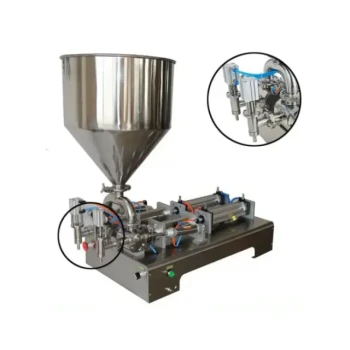
Honey filling machines act as the critical infrastructure that transforms raw, bulk harvest into standardized, retail-ready commodities. They primarily address the challenges of inconsistent dosing, hygienic safety, and the inefficiency of manual labor during the transition from apiary to marketplace. By automating this stage, producers bridge the gap between home production and the rigorous demands of commercial distribution.
Core Insight: The primary value of a honey filling machine is not just speed, but standardization. It eliminates the variability of manual handling to ensure that every unit meets the strict hygienic, preservation, and quantitative standards required for modern retail shelves and international export.
Solving Physical Processing Hurdles
Mastering High Viscosity
Honey is a complex fluid that changes behavior based on temperature and composition. Manual filling struggles with these fluctuations.
High-precision filling machines offer accurate metering control regardless of the product's thickness. They facilitate the consistent packaging of diverse products, including pure honey, honey with nuts, or honey containing honeycomb.
Eliminating Waste and Dripping
One of the most immediate challenges in honey processing is the "drip," which leads to product loss and messy packaging.
Automated machines address this through high-precision dispensing nozzles designed for viscous materials. This technology ensures a clean break after filling, preventing residue on the bottle exterior which improves aesthetic appeal for direct retail sales.
Ensuring Accurate Net Weight
Commercial markets require strict adherence to labeled weights. Manual filling often results in overfilling (loss of profit) or underfilling (regulatory violation).
Industrial-grade machines utilize automated control systems to guarantee the precise net weight of every container. This consistency is essential for meeting the standardized requirements of supermarkets and avoiding consumer complaints.
Guaranteeing Hygiene and Preservation
The Closed-Loop Advantage
Contamination is a significant risk when moving honey from bulk storage to individual jars.
Honey filling machines operate within a closed environment, minimizing the risk of secondary contamination from dust or human contact. This system preserves the natural flavor and physicochemical properties of the honey, which is vital for maintaining product quality.
Protecting Product Authenticity
Adulteration—the unauthorized addition of syrups or sweeteners—is a major concern in the global honey market.
By creating a closed production cycle from the hive to the final packaging, these machines minimize the opportunity for the introduction of adulterants like cane sugar syrup. This hardware foundation ensures the pollen fingerprint of the bottled product remains consistent with the original apiary samples, supporting reliable traceability systems.
Extending Shelf Life via Sealing
Exposure to air and moisture accelerates spoilage and unwanted crystallization.
Advanced filling units often integrate vacuum or nitrogen-flush sealing technologies. This prevents oxygen and moisture ingress, significantly slowing the crystallization process and ensuring quality stability during long-term retail storage.
Operational Considerations and Trade-offs
Calibration Complexity
While automation improves consistency, it introduces a need for technical expertise. Operators must precisely calibrate machines when switching between different honey types or container sizes to maintain accuracy.
Maintenance vs. Manual Labor
The shift from manual to machine reduces labor costs but increases maintenance responsibility. To prevent cross-contamination or clogging, the high-precision dosing systems require rigorous cleaning protocols, particularly when processing honey with additives like nuts.
Aligning Equipment with Market Strategy
To maximize the value of your processing line, select equipment based on your specific commercial end-game.
- If your primary focus is Mass Retail or Export: Prioritize machines with closed-loop systems and nitrogen flushing to ensure strict regulatory compliance, traceability, and maximum shelf-life stability.
- If your primary focus is Specialty or Artisan Products: Prioritize machines with versatile viscosity handling to accurately package complex products like honeycomb-infused jars without clogging or damaging the texture.
Ultimately, the right filling technology turns honey from a raw agricultural ingredient into a trusted, competitive consumer brand.
Summary Table:
| Challenge Category | Key Problem Addressed | Mechanical Solution |
|---|---|---|
| Physical Processing | High viscosity & dripping | High-precision nozzles & metering control |
| Regulatory Compliance | Inconsistent net weights | Automated dosing & weight-sensor systems |
| Hygiene & Safety | Secondary contamination | Closed-loop systems & touchless automation |
| Product Preservation | Oxidation & short shelf life | Vacuum sealing & nitrogen-flush technology |
| Market Integrity | Risk of adulteration | Secure, traceable closed-cycle production |
Elevate Your Beekeeping Business with HONESTBEE
Ready to transition from raw harvest to a competitive retail brand? HONESTBEE is the dedicated partner for commercial apiaries and distributors worldwide. We provide the essential hardware needed to scale your operations, including industrial-grade honey-filling machines, hive-making equipment, and a full spectrum of specialized beekeeping tools.
Our solutions ensure your products meet the highest standards of hygiene and standardization required for international export. Whether you need heavy machinery or essential consumables, we offer comprehensive wholesale packages tailored to your growth goals.
Maximize your production efficiency today.
References
- Tarekegn Deresse Beyene, Tariku Bachano Batayo. Review on Diversity and Socio-Economic Contribution of Home Garden Agroforestryin Ethiopia. DOI: 10.7176/jnsr/12-7-04
This article is also based on technical information from HonestBee Knowledge Base .
Related Products
- Precision Durable Efficient HONESTBEE Rotary Honey Filling Machine
- Economy Small Honey Filling Machine Honey Bottle Filler Packaging Machine
- Semi Automatic Small Honey Bottle Filling Machine Honey Filler
- Fully Automatic Honey Filling Packaging Machine for Processing Line
- Commercial Rotary Honey Filling Machine for Production
People Also Ask
- What is a key feature of the new generation of the honey filling machine? The Advanced Electronic Control Unit
- How do high-precision honey filling machines ensure quality? Optimize Your Commercial Production with HONESTBEE
- What quality control role does professional honey filling equipment perform? Ensure Consistency and Product Stability
- What are the common types of bottling machines used for honey? Choosing the Right Solution for Your Apiary
- How do honey filling machines work? Achieve Precision & Speed for Your Apiary