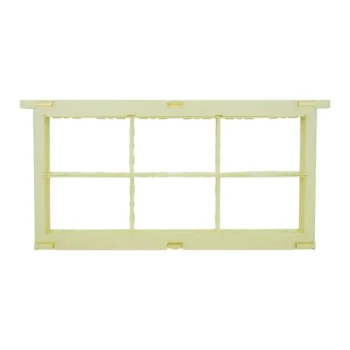
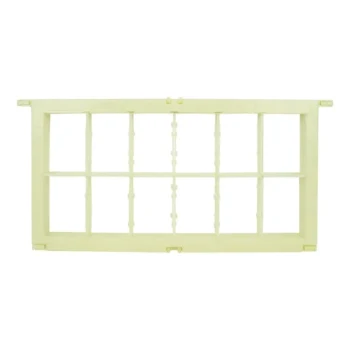
Standardized bee frames are the foundational unit of measurement and control required to establish a uniform baseline across honey bee colonies. By providing a fixed physical dimension and cell count, these frames allow professional apiarists and researchers to eliminate statistical bias, ensuring that any observed changes in colony growth are the result of specific environmental factors or management strategies rather than initial size discrepancies.
Core Takeaway: Standardized frames serve as the essential benchmark for colony strength normalization, converting complex biological mass into quantifiable units that enable precise commercial valuation and scientific accuracy.
The Foundation of Colony Normalization
Eliminating Statistical Bias in Operations
Standardized hardware configurations, typically involving a specific number of worker and brood frames, ensure consistency of initial conditions. This hardware-driven normalization allows operators to accurately attribute colony development to landscape characteristics or protective measures.
Precision Measurement of Hive Biomass
Frames serve as a physical metric to quantify adult bee populations, with a standard frame typically representing approximately 3,000 adult bees. This conversion from "bees on a comb" to a numerical count is the only way to objectively compare the efficacy of different feeding strategies across large-scale operations.
Standardizing Reproductive Vitality
Using a standardized frame-grid—often featuring 5x5 cm squares—technicians can calculate the area of capped larvae with surgical precision. This allows for the normalization of the queen’s daily egg-laying rate, providing a reliable data point for assessing the reproductive health of the entire apiary.
Enhancing Commercial Viability and Service Standards
Meeting Pollination Service Qualifications
For B2B resellers and service providers, standardized frames are the "currency" of the pollination industry. They provide the objective classification—weak, medium, or strong—required to meet technical qualifications for high-value services, such as almond pollination contracts.
Evaluating Nutritional and Chemical Impact
Normalization through standardized frames is the core tool for monitoring how colonies react to different artificial bee bread formulas or environmental stressors like herbicides. Without this spatial reference benchmark, it is impossible to quantitatively assess the contribution of nutritional supplements to colony expansion.
Optimizing the Hive Microenvironment
Standardized frames within a modern hive body create a controllable physical space that stabilizes internal temperature and humidity. This structural optimization reduces pathogen accumulation, providing the fundamental production stability needed for high honey yields and long-term colony survival.
Understanding the Trade-offs and Pitfalls
The Risk of Non-Standardized Inventory
Utilizing non-standardized or "custom" frames within a large-scale operation creates a data silo where colony strength cannot be accurately compared. This lack of interoperability can lead to inefficient resource allocation and the inability to fulfill strict pollination contract requirements.
Dependency on Manufacturing Precision
The benefits of normalization are entirely dependent on the dimensional accuracy of the frames. Slight deviations in frame size or cell density can skew population estimates by thousands of bees, potentially compromising research integrity or commercial grading.
Environmental Limitations
While standardized frames normalize the measurement of the colony, they do not insulate the bees from external environmental stressors. Operators must recognize that standardized hardware is a tool for assessment and management, not a standalone solution for colony health in adverse climates.
Making the Right Choice for Your Goal
As a professional distributor or wholesaler, selecting the right standardized hardware is critical for ensuring your clients can achieve accurate normalization and maximize their operational efficiency.
- If your primary focus is research and data accuracy: Prioritize frames that support the use of 5x5 cm grid tools to ensure precise calculation of brood-rearing capacity and egg-laying rates.
- If your primary focus is high-value pollination services: Source standardized frames that align with industry-standard "frames of bees" metrics to ensure your clients' colonies meet contract-specific strength categories.
- If your primary focus is maximizing honey yield and hive health: Invest in a full-spectrum portfolio of standardized modern beehives that optimize internal microenvironments and reduce pathogen accumulation.
Standardized frames are the essential infrastructure that transforms beekeeping from an art into a precise, scalable, and commercially viable science.
Summary Table:
| Key Function | Practical Application | Impact on Commercial Operations |
|---|---|---|
| Biomass Quantification | Standard frame = ~3,000 adult bees | Objective valuation and contract compliance |
| Bias Elimination | Consistent hardware dimensions | Reliable comparison of different management strategies |
| Vitality Assessment | 5x5 cm grid-based brood counting | Precise monitoring of queen reproductive health |
| Micro-climate Control | Optimized internal spacing | Reduced pathogen accumulation and higher honey yields |
| Standardized Grading | Weak, Medium, and Strong categories | Mandatory qualification for high-value pollination services |
Elevate Your Inventory with HONESTBEE’s Professional Solutions
As a premier one-stop sourcing partner, HONESTBEE empowers distributors and B2B resellers with a comprehensive, full-spectrum product portfolio. From precision-engineered standardized frames to advanced honey-filling machines and essential consumables, we provide the reliable hardware your clients need to achieve colony normalization and maximize yields.
Why Partner with HONESTBEE?
- Deep Industry Expertise: Professional-grade tools designed for large-scale commercial apiaries.
- Rapid Response & Fulfillment: Ultra-fast delivery and efficient order processing to keep your supply chain moving.
- Wholesale Advantage: Competitive margins on everything from specialized machinery to honey-themed merchandise.
- OEM/ODM Support: Tailored solutions to meet specific market demands.
Ready to enhance your commercial offering and ensure supply reliability? Contact our expert team today to explore our wholesale catalog and see how we can grow your business together.
References
- Patrycja Pluta, Robert J. Paxton. Organic farming and annual flower strips reduce parasite prevalence in honeybees and boost colony growth in agricultural landscapes. DOI: 10.1111/1365-2664.14723
This article is also based on technical information from HonestBee Knowledge Base .
Related Products
- Assembled Wooden Bee Frames with Plastic Foundation for Durability and Convenience by HONESTBEE
- Assembled Wooden Bee Frames with Beeswax Foundation Ready to Use by HONESTBEE
- HONESTBEE Wired and Assembled Wooden Bee Frames Foundation for a Thriving Hive
- Wooden Bee Hive Frames for Beekeeping and Wholesale
- Plastic Bee Frame Beekeeping Hive Frames for Wholesale
People Also Ask
- What are the technical advantages of using bee frames with plastic foundation? Boost Hive Efficiency and Durability
- When should frames with new foundation be given to colonies? Master Timing for a Thriving Hive
- Do you have to wire bee frames? Essential Guide to Frame Strength & Honey Harvesting
- What are bee frames and how are they sized? A Professional Guide to Standardization & Material Choice
- What types of bee frames can be cleaned and returned to service? A Guide to Safe Apiary Refurbishment