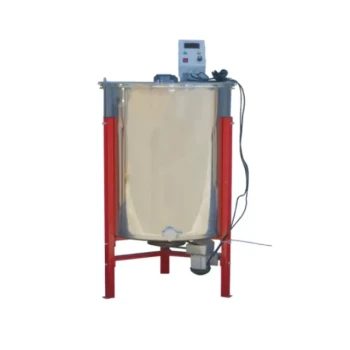
The centrifugal fan acts as the primary engine of a honey dehydration system, generating the necessary force to drive dry air through the moisture removal chamber. By delivering high-velocity airflow directly across the honey streams, it actively strips away evaporated water vapor. This continuous movement prevents the air surrounding the honey from becoming saturated, ensuring the system can reliably reduce moisture content to levels below 17%.
Ideally, efficient dehydration requires a constant disparity between the moisture in the honey and the moisture in the air. The centrifugal fan maintains this balance by rapidly displacing humid air with dry air, preserving the mass transfer efficiency required for the process.
The Mechanics of Air Movement
Generating System Pressure
The centrifugal fan serves as the power source for the entire pneumatic circuit.
It creates the pressure differential needed to force air through the resistance of the moisture removal chamber.
Interaction with Honey Streams
The system is designed so that air flows directly across the honey streams.
This targeted airflow ensures maximum contact area between the dry air and the liquid honey surface.
Maintaining Dehydration Efficiency
Scouring Water Vapor
As water evaporates from the honey surface, it immediately enters the surrounding air.
The high-velocity airflow provided by the fan physically removes this vapor before it can settle.
Preventing Local Saturation
Without constant air movement, a layer of stagnant, humid air would form around the honey.
The fan prevents this "local humidity saturation," which would otherwise halt the evaporation process.
Sustaining Mass Transfer
By constantly introducing fresh, dry air, the fan maintains high mass transfer efficiency.
This ensures the evaporation rate remains constant throughout the dehydration cycle.
Operational Considerations and Trade-offs
Velocity vs. Energy Consumption
The primary reference highlights the need for high-velocity airflow to ensure effective drying.
However, generating high velocity requires significant energy input to the fan motor.
The Necessity of Force
Relying on passive air movement or low-power fans is insufficient for this specific application.
To reach the strict target of under 17% moisture, the mechanical force of a centrifugal fan is non-negotiable to overcome vapor pressure resistance.
Making the Right Choice for Your Goal
To optimize your dehydration system, consider how the fan's performance aligns with your specific production targets:
- If your primary focus is Speed: Ensure the fan generates sufficient velocity to prevent any local humidity saturation, allowing for maximum evaporation rates.
- If your primary focus is Product Quality: Verify that the airflow creates a consistent drying environment to reliably reach the critical <17% moisture threshold without fluctuation.
A properly sized centrifugal fan is the difference between a stalled process and a highly efficient dehydration cycle.
Summary Table:
| Key Role | Impact on Dehydration Process | Primary Benefit |
|---|---|---|
| Pressure Generation | Drives dry air through the moisture removal chamber | Overcomes pneumatic resistance |
| Vapor Scouring | Physically removes evaporated water from honey surface | Prevents local humidity saturation |
| Mass Transfer | Constantly replaces humid air with fresh dry air | Maintains high evaporation rates |
| Velocity Control | Directs high-speed airflow across honey streams | Ensures consistent moisture reduction |
Scale Your Honey Production with HONESTBEE
Maximize your apiary's efficiency with professional-grade machinery and equipment from HONESTBEE. We cater specifically to commercial apiaries and distributors, offering a comprehensive wholesale portfolio designed for industrial success.
Our expertise extends across the entire beekeeping lifecycle, providing:
- Advanced Machinery: From high-efficiency honey dehydration systems and honey-filling machines to specialized hive-making hardware.
- Essential Tools & Consumables: A full spectrum of beekeeping tools and industry-standard consumables.
- Cultural Merchandise: Unique honey-themed retail products.
Ready to upgrade your operations with reliable, high-performance equipment? Contact our team today to discuss your wholesale needs and discover how HONESTBEE can support your growth.
References
- R. S. Gill, S. S. Dhaliwal. A small scale honey dehydrator. DOI: 10.1007/s13197-015-1760-0
This article is also based on technical information from HonestBee Knowledge Base .
Related Products
- electric honey extractor honey centrifuge 3 frame honey extractor stainless steel honey frame extractor
- Manual Hand Crank 4 Frame Honey Extractor Centrifuge for Beekeeping
- Honey Concentrating Vacuum Heating Thickening Machine Dehumidifier for Honey
- 0.5T Capacity Honey Dehumidifier Dryer with Vacuum Heating and Thickening Filtering Machine
- Honey Concentrating and Filtering Dehumidifier Machine 2T Capacity for Honey
People Also Ask
- What are the characteristics of electric honey extractors? Boost Your Apiary Efficiency with Automated Technology
- What are the disadvantages of using an electric honey extractor? Weighing Cost, Power, and Comb Safety
- What are the advantages of an electric honey extractor? Boost Efficiency and Scale Your Honey Production
- What are the technical advantages of electric honey extractors? Maximize Yield and Protect Your Bee Colony
- How does an electric honey extractor affect the quality of honey? Preserve Flavor & Purity with Precision Extraction