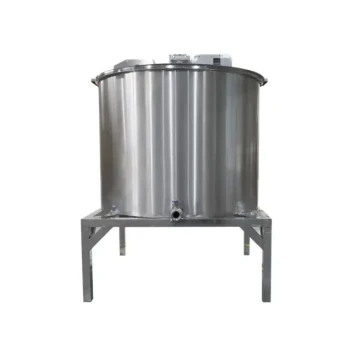
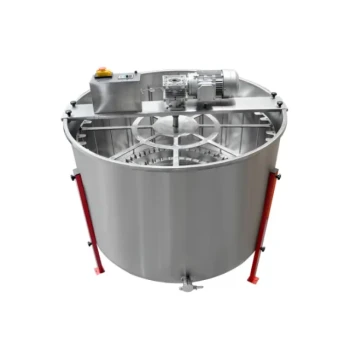
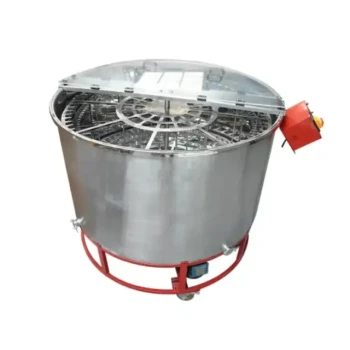
Commercial honey collection equipment serves as the primary instrument for quantifying nectar depletion in field experiments. When paired with standardized sampling techniques, this equipment allows researchers to measure nectar volume at precise distances from an apiary, providing the empirical data necessary to assess resource availability.
By enabling comparative sampling, this equipment validates the existence of intra-specific competition. It provides the hard evidence needed to optimize apiary spacing, revealing significant nectar reductions—averaging 41%—in areas surrounding commercial operations.
The Mechanics of Nectar Assessment
Standardized Distance Sampling
The core function of this equipment in an experimental setting is to establish control zones. Researchers use it to sample flowers both within and beyond specific radii, such as the critical 1.1km threshold from an apiary.
Quantifying Resource Depletion
This comparative process converts anecdotal observation into measurable data. By analyzing the samples collected, the equipment detects specific reductions in nectar volume, verifying that proximity to a commercial apiary directly correlates with resource scarcity.
Validating Ecological Hypotheses
Proving Intra-Specific Competition
The data gathered by this equipment moves the concept of competition from theory to fact. It empirically verifies "intra-specific competition hypotheses," demonstrating that high densities of honey bees deplete local forage faster than it can replenish.
Measuring the Impact
The equipment is sensitive enough to record substantial drops in availability. In reported studies, it has identified an average decrease of 41% in nectar availability, a figure that highlights the intensity of competition in commercial zones.
Understanding the Trade-offs
The Density vs. Availability Conflict
The use of this equipment highlights a critical operational trade-off: increasing apiary density inevitably reduces the resources available per colony.
Interpreting the Data
While the equipment provides precise volume measurements, it reveals that "more bees" does not equal "more honey" if the forage is over-saturated. Ignoring the depletion rates captured by this equipment leads to unsustainable resource use and potential colony stress.
Making the Right Choice for Your Goal
To ensure sustainable operations and accurate data collection, consider the following applications of these findings:
- If your primary focus is Apiary Management: Use the 1.1km radius as a baseline for spacing hives to avoid the 41% nectar reduction associated with overcrowding.
- If your primary focus is Ecological Research: Utilize standardized commercial equipment to empirically verify competition models before drawing conclusions about local carrying capacity.
This equipment transforms nectar availability from a variable guess into a manageable metric for sustainable beekeeping.
Summary Table:
| Feature | Experimental Role | Key Research Insight |
|---|---|---|
| Distance Sampling | Establishes control & test zones | Measures depletion beyond 1.1km radii |
| Volume Quantification | Converts samples to empirical data | Identifies average 41% nectar reduction |
| Hypothesis Testing | Proves intra-specific competition | Verifies density impacts on forage replenishment |
| Operational Scaling | Balances colony density vs. resources | Optimizes hive spacing for sustainable yield |
Maximize Your Yield with Data-Driven Beekeeping Solutions
Don't let intra-specific competition limit your apiary's potential. HONESTBEE provides commercial apiaries and distributors with the precision tools needed to manage resources effectively. From high-performance honey-filling machines to specialized hive-making equipment and essential industry consumables, our comprehensive wholesale offering empowers you to optimize every drop of nectar.
Whether you are scaling a commercial operation or supplying the next generation of beekeepers, our hardware and cultural merchandise ensure you stay ahead of the competition. Contact HONESTBEE today to explore our full spectrum of beekeeping machinery and tools designed for professional success.
References
- Mickaël Henry, Guy Rodet. The apiary influence range: A new paradigm for managing the cohabitation of honey bees and wild bee communities. DOI: 10.1016/j.actao.2020.103555
This article is also based on technical information from HonestBee Knowledge Base .
Related Products
- 32 Frame Commercial Electric Honey Extractor for Beekeeping and Honey Production
- 40 Frame Commercial Electric Honey Extractor for Beekeeping
- Commercial 48-Frame Stainless Steel Honey Extractor
- HONESTBEE 72 Frame Industrial Electric Honey Extractor for Beekeeping
- Professional Honey Filter with Tripod Support Stand
People Also Ask
- What are commercial honey extractors used for? Boost Your Apiary's Efficiency & Profitability
- What is a commercial honey extractor? The Essential High-Volume Solution for Large Apiaries
- Who are commercial honey extractors designed for? Scaling Your Industrial Beekeeping Success
- How is honey extracted commercially? Maximize Your Apiary's Efficiency and Honey Yield
- What are commercial honey extractors and for what scale of beekeeping are they intended? Scale Your 200+ Colony Apiary