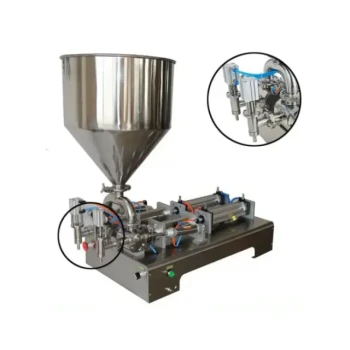
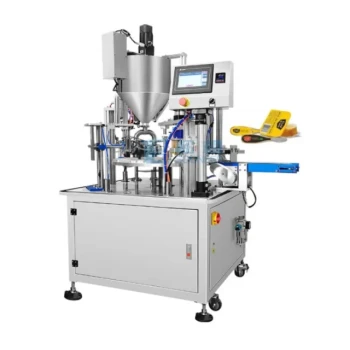
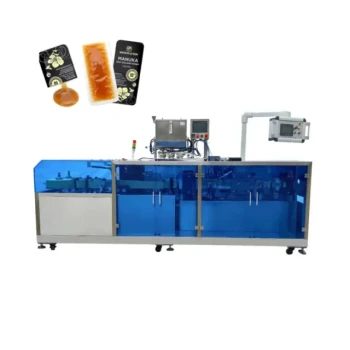
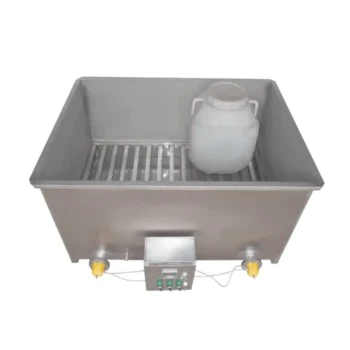
Honey filling machines typically rely on a volumetric piston filling system. Because honey is a highly viscous and sticky substance, a piston mechanism is required to forcefully measure and dispense a precise volume into containers. While other methods exist for specific conditions, the piston filler is the standard for handling the unique physical properties of honey.
Core Insight: The thickness of honey makes gravity-based filling slow and inaccurate for most operations. Therefore, the industry standard utilizes piston-driven volumetric displacement, which physically pushes a specific amount of product into the container to ensure consistent speed and weight accuracy.
The Challenge of Viscosity
Why Piston Systems dominate
Honey resists flow. A simple gravity-fed system often struggles to move thick honey efficiently.
Piston fillers overcome this by using a cylinder and a piston to draw product in and force it out. This "positive displacement" method handles the resistance of thick honey without sacrificing speed.
Volumetric Accuracy
Consistency is key in packaging. Piston systems are inherently volumetric, meaning they measure a specific amount of space the honey occupies.
This allows for a precise dosage in every cycle, whether filling a small sachet, a jar, or a squeeze bottle.
Modern Control Integration
The mechanical action of the piston is often managed by advanced electronics.
Modern machines utilize PLCs (Programmable Logic Controllers) to regulate the speed and timing of the piston stroke. This ensures that the filling rhythm matches the conveyor speed, integrating seamlessly into automated workflows.
Alternative Mechanisms and Trade-offs
Gravity Fillers (The Low-Viscosity Option)
You may encounter gravity filling machines, but they have distinct limitations.
These rely on the weight of the honey falling from an overhead tank. They are typically only suitable for low-viscosity liquids, such as honey that has been heated or naturally thin varieties.
Overflow Filling Machines
Overflow fillers are used when the visual appearance of the fill level is the top priority.
This system fills every bottle to the exact same height, regardless of minor variations in bottle interior volume. While aesthetically pleasing on the shelf, it is generally less efficient for thick, cold honey than a piston system.
Pump and Weighing Systems
For very large quantities or specific bulk applications, pump fillers or net-weight fillers are used.
Pump fillers are excellent for viscous liquids requiring precise movement, while weighing machines dispense based on mass rather than volume.
Making the Right Choice for Your Goal
Selecting the right machine depends on the viscosity of your specific honey product and your production scale.
- If your primary focus is handling thick, raw, or room-temperature honey: Choose a Piston Filling Machine, as it provides the force necessary to move viscous product accurately.
- If your primary focus is cosmetic consistency on clear glass bottles: Consider an Overflow Filler to ensure every jar looks filled to the exact same level.
- If your primary focus is high-speed automation: Opt for an Automatic Viscous Liquid Filling Machine equipped with PLCs to synchronize filling, capping, and labeling.
Match the resistance of your product to the force of the machine; for honey, that almost always means trusting the power of a piston.
Summary Table:
| Filling System Type | Best Use Case | Key Advantage |
|---|---|---|
| Piston Filling | Thick, raw, or room-temperature honey | High precision and force for viscous liquids |
| Gravity Filling | Heated or naturally low-viscosity honey | Simple design, cost-effective for thin liquids |
| Overflow Filling | Retail glass jars requiring visual uniformity | Ensures identical fill levels regardless of bottle volume |
| Pump & Weighing | Large-scale bulk containers | Accuracy based on mass rather than volume |
Scale Your Honey Production with HONESTBEE
Are you a commercial apiary or honey distributor looking to streamline your packaging process? HONESTBEE provides the precision-engineered machinery you need to handle the toughest viscosity challenges.
Our comprehensive wholesale range includes:
- Advanced Honey-Filling Machines: Featuring PLC-controlled piston systems for unmatched volumetric accuracy.
- Integrated Solutions: Full-spectrum beekeeping tools, hive-making machinery, and automated labeling systems.
- Consumables & Merchandise: From essential industry hardware to honey-themed cultural goods.
Maximize your efficiency and product consistency today. Contact our expert team at HONESTBEE to find the perfect equipment tailored to your apiary’s specific needs.
Related Products
- Precision Durable Efficient HONESTBEE Rotary Honey Filling Machine
- Commercial Rotary Honey Filling Machine for Production
- Pneumatic Double Nozzle Honey Filling Bottling Packaging Machine
- Automatic Honey Filling and Filtering Machine for Beekeeping Bottle Filling
- Fully Automatic Honey Filling Packaging Machine for Processing Line
People Also Ask
- How do honey filling machines work? Achieve Precision & Speed for Your Apiary
- How do high-precision honey filling machines ensure quality? Optimize Your Commercial Production with HONESTBEE
- What quality control role does professional honey filling equipment perform? Ensure Consistency and Product Stability
- How do honey filling and processing machines aid native bee product conservation? Boost Value with HONESTBEE Technology
- What is a key feature of the new generation of the honey filling machine? The Advanced Electronic Control Unit