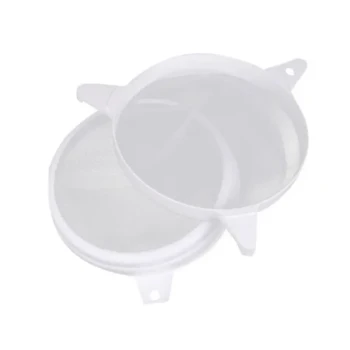
Large-scale honey infusion and filtration require a dedicated ecosystem of food-grade vessels and specialized separation systems. To effectively manage commercial production, operators need food-grade bulk containers capable of holding between 3 and 60 pounds for the infusion process, paired with a bottling bucket system featuring extra-fine filters to ensure the removal of all flavoring solids.
Core Takeaway While basic extraction focuses on removing wax, infusion requires precise filtration to separate flavoring agents from the finished product. Commercial success depends on utilizing food-grade bulk vessels for the infusion phase and transitioning to automated, hygienic systems for filtration and bottling to ensure consistency and prevent contamination.
Essential Equipment for the Infusion Phase
Food-Grade Bulk Containers
The foundation of commercial infusion lies in the vessel. You must use food-grade bulk containers designed to hold specific commercial volumes, typically ranging from 3 to 60 pounds.
These containers serve as the primary reaction vessel where the honey absorbs flavor profiles. Using non-food-grade materials here introduces a high risk of chemical leaching, which can compromise the purity of the honey.
Corrosion-Free Holding Tanks
For larger industrial setups, holding tanks are necessary for decanting and staging honey before and after infusion.
These tanks should be corrosion-free to withstand the acidity of honey and various flavoring agents. They often include features for liquefaction or heat exchange to maintain the honey at optimal viscosity for processing.
Filtration and Homogenization Systems
The Bottling Bucket System
Once infusion is complete, the honey must be separated from the solid flavoring ingredients. A bottling bucket system is the standard requirement for this stage.
This system must be equipped with reusable or extra-fine filters. These filters are critical for removing particulate matter and flavoring solids, ensuring the final liquid retains the clarity and texture of "liquid gold."
Industrial Mixers and Homogenizers
In large-scale operations, consistency across batches is paramount. Industrial-grade mixing and homogenization equipment allow processors to scientifically blend different honey batches.
This equipment adjusts physical properties and component concentrations. It is also used to ensure specific constituents, such as GM pollen, remain below legal thresholds (e.g., 0.9 percent) for compliance in target markets.
Critical Trade-offs in Large-Scale Processing
Automation vs. Manual Handling
There is a distinct trade-off between manual control and automated hygiene. Manual handling allows for close inspection but significantly increases the risk of secondary contamination.
Industrial automated filling equipment mitigates this risk. By utilizing precise quantitative control and hygienic sealing technologies, automation increases throughput while ensuring the product remains untouched and sanitary.
Sanitation Requirements
As equipment scale increases, so does the complexity of cleaning. You cannot rely on simple rinsing.
Operators must invest in specialized cleaning brushes to thoroughly scrub filters, strainers, and pumps. Furthermore, the use of food-safe sanitizing solutions is mandatory to prevent residue buildup and bacterial growth in the intricate parts of filtration and bottling machinery.
Final Packaging and Quality Control
Automated Filling Technology
The final stage requires machinery that can fill containers with absolute consistency. Automated bottling equipment ensures that every unit contains the exact specified volume.
Sealing and Preservation
Beyond filling, the equipment must seal the container correctly. Proper sealing is the only defense against air and moisture, the two primary enemies of honey quality.
A standardized sealing process prevents fermentation and spoilage, extending the shelf life of the infused product.
Making the Right Choice for Your Goal
To select the correct equipment profile, assess your primary operational objective:
- If your primary focus is Flavor Clarity: Prioritize extra-fine filtration systems and food-grade bulk containers to ensure no solid residue impacts the texture of your infusion.
- If your primary focus is Volume and Consistency: Invest in industrial homogenizers and automated filling lines to standardize batches and meet strict regulatory labeling requirements.
The transition to large-scale infusion is not just about bigger buckets; it is about adopting a system that guarantees hygiene, consistency, and stability in every bottle.
Summary Table:
| Equipment Category | Primary Purpose | Key Features |
|---|---|---|
| Bulk Containers | Infusion & Reaction Phase | Food-grade material, 3–60 lb capacity, leaching prevention |
| Holding Tanks | Decanting & Staging | Corrosion-free, heat exchange for viscosity control |
| Filtration Systems | Particle Removal | Extra-fine filters, bottling bucket systems, solids separation |
| Homogenizers | Batch Consistency | Industrial-grade mixing, concentration adjustment |
| Filling Machinery | Packaging & Sanitation | Automated quantitative control, hygienic sealing |
Elevate Your Commercial Honey Production with HONESTBEE
Transitioning to large-scale honey infusion requires more than just bigger containers—it demands a precision-engineered ecosystem. HONESTBEE specializes in serving commercial apiaries and distributors by providing a comprehensive wholesale range of professional-grade beekeeping tools and machinery.
From honey-filling machines and industrial-grade filtration systems to specialized hardware like hive-making equipment and honey-themed cultural merchandise, we provide the full spectrum of tools needed to ensure hygiene, consistency, and stability in every batch.
Ready to scale your operations? Contact us today to learn how our wholesale solutions can enhance your production efficiency and product quality.
Related Products
- Automatic Honey Filling and Filtering Machine for Beekeeping Bottle Filling
- Honey Concentrating and Filtering Dehumidifier Machine 2T Capacity for Honey
- Electric Double Wall Honey Filtering Machine Purifier Equipment for Honey Processing Plant
- Fully Automatic Honey Filling Packaging Machine for Processing Line
- Professional Stainless Steel Honey Filtering Machine with Water Bath Heating for Beekeeping
People Also Ask
- What process advantages do professional honey filtering and filling machines provide? Optimize Your Organic Honey Output
- How do honey filling and filtering machines increase product value? Turn Raw Honey into Premium Export-Grade Goods
- How do honey filtration and filling machinery contribute to industrialization? Scale Your Commercial Honey Production
- What specific issues do industrial filtration and automated filling machinery address? Ensure Honey Quality & Compliance
- How does the use of professional honey filtration and filling machinery facilitate international honey exports?