Precise temperature control is the fundamental requirement for accurate honey enzyme analysis. Determining diastase values requires constant-temperature incubation because enzymatic reactions are highly sensitive to thermal fluctuations. A strictly controlled environment—typically a water bath—standardizes the rate of starch hydrolysis, ensuring that the measured activity reflects the honey's true biological quality rather than a variable in the testing conditions.
Core Takeaway Diastase activity acts as a "biological thermometer" for honey quality, indicating maturity and heat exposure. Since enzymes catalyze reactions at rates dictated by temperature, maintaining a precise thermal environment during testing is the only way to scientifically validate the honey's naturalness and processing history.
The Biological Mechanism Behind the Requirement
The Sensitivity of Diastase
Diastase is a biological enzyme responsible for breaking down starch, and it is extremely sensitive to temperature changes. Even minor fluctuations in heat can significantly accelerate or decelerate the enzyme's activity level.
Standardizing the Reaction Rate
The test measures the speed at which the diastase in the honey degrades a starch solution. To calculate the Diastase Number (DN) or Goethe units accurately per gram of honey, the reaction rate must be measured against a fixed constant.
Creating a Controlled Baseline
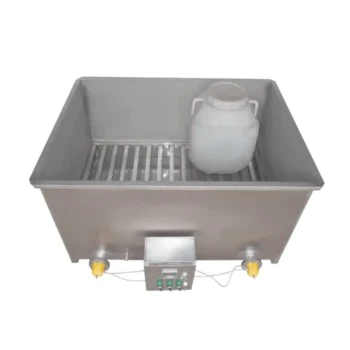
By using a high-precision thermostatic water bath (often set to 40°C), you create a standardized environment. This ensures that the degradation of starch is driven solely by the concentration of the enzyme, not by external temperature variables.
Implications for Quality Control
Measuring Naturalness and Maturity
The enzyme value is a core indicator used to evaluate the biological activity grade of the honey. A precise incubation process allows you to confirm that the honey is mature and retains the natural enzymatic properties found in raw honey.
Detecting Heat Damage
Diastase levels drop when honey is exposed to excessive heat during processing. Precision testing reveals if the honey has been "overcooked" during filtration or filling, serving as a critical check on the product's integrity.
Optimizing Processing Lines
Operators use these precise values to reverse-engineer their production methods. If the testing equipment is accurate, the data can be used to tune temperature compensation mechanisms in the factory, ensuring the processing line preserves the honey's biological value.
Understanding the Trade-offs
Equipment Cost vs. Data Integrity
High-precision constant-temperature water baths and spectrophotometry equipment represent a significant investment compared to basic lab gear. However, using lower-grade equipment introduces thermal variance that renders the Diastase Number scientifically useless.
Operational Complexity
Achieving this level of precision requires strict adherence to protocols. A slight deviation in the incubation temperature does not just skew the results slightly; it can lead to a complete misclassification of the honey's grade or freshness.
Making the Right Choice for Your Goal
Reliable enzyme analysis is the bridge between raw biological data and actionable quality control.
- If your primary focus is Laboratory Accuracy: Ensure your water bath is calibrated to maintain 40°C with negligible fluctuation to standardize the starch hydrolysis process.
- If your primary focus is Process Optimization: Use the diastase values to audit your heating intensity during filtration, ensuring you aren't inadvertently inactivating enzymes.
- If your primary focus is Product Certification: Rely on constant-temperature incubation to provide the definitive data needed to prove your honey's naturalness and maturity to regulators.
Precision in the lab guarantees the preservation of value in the product.
Summary Table:
| Feature | Requirement | Impact on Analysis |
|---|---|---|
| Temperature Target | Typically 40°C (Water Bath) | Standardizes the rate of starch hydrolysis |
| Equipment Precision | High-precision thermostatic control | Eliminates external thermal variance in results |
| Enzyme Sensitivity | High sensitivity to fluctuations | Prevents acceleration or deceleration of activity |
| Quality Indicator | Diastase Number (DN) | Validates honey maturity and detects heat damage |
Elevate Your Honey Quality Standards with HONESTBEE
Preserving the biological integrity of honey requires more than just testing—it requires the right industrial tools. HONESTBEE empowers commercial apiaries and distributors with a comprehensive range of professional beekeeping equipment, from high-precision honey-filling machines to specialized hive-making hardware and essential industry consumables.
Whether you are looking to optimize your processing line to protect delicate enzymes or seeking to expand your wholesale inventory with premium beekeeping machinery and cultural merchandise, we provide the expertise and tools you need to succeed.
Ready to scale your honey production? Contact us today to explore our full spectrum of wholesale solutions!
References
- Miras Nurbayevich Suraganov, Sharipov B.O.. DETERMINATION OF THE CONTENT OF TOXIC ELEMENTS IN THE TROPHIC CHAIN "SOIL - PLANT - BEE BODY - HONEY". DOI: 10.52578/2305-9397-2023-4-1-28-34
This article is also based on technical information from HonestBee Knowledge Base .
Related Products
- Precision Honey Refractometer Instrument for Quality Assessment
- Professional Thermostatic Conical Honey Melter
- Heavy Duty Stainless Steel Honey Processing Machine Decrystallizing Tank
- Digital Honey Refractometer for Precision Measurement of Optimal Honey Quality
- Professional Stainless Steel Honey Filtering Machine with Water Bath Heating for Beekeeping
People Also Ask
- How do professional scientific instruments contribute to honey quality testing? Ensure Purity and Market Compliance
- What is the function of a honey refractometer in beekeeping? Ensure Harvest Quality and Prevent Fermentation
- Why is a honey refractometer considered essential for harvesting honey? Guarantee Quality and Prevent Fermentation
- What are the main benefits of using a honey refractometer? Ensure Honey Quality & Market Compliance
- What is the working principle of a honey refractometer? Master Optical Precision for Pure Honey