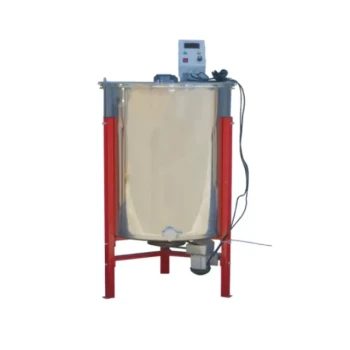
The industrial centrifuge is the engine of efficiency in bee pollen protein processing, providing the necessary force to separate solids from liquids far beyond what natural gravity can achieve. It serves two distinct critical functions: it is the primary method for harvesting precipitated proteins from solution after chemical treatment, and it is the standard tool for validating the protein's functional quality during laboratory testing.
The centrifuge translates chemical precipitation into physical recovery. It is the definitive tool for isolating high-purity protein solids from supernatants and is essential for removing unbound fluids to accurately measure functional parameters.
The Role of Centrifugation in Protein Extraction
Accelerating Solid-Liquid Separation
The core challenge in protein isolation is efficiently separating the valuable solid material from the liquid mixture.
An industrial centrifuge applies high gravitational acceleration to the mixture. This forces the denser solid particles to settle rapidly, achieving a level of separation speed and clarity that filtration or gravity settling cannot match.
Recovering Precipitated Proteins
In the preparation of concentrates or isolates, the process often involves adjusting the pH to cause proteins to precipitate (solidify) out of the solution.
Once precipitation occurs, the centrifuge is used to extract these precipitated bee pollen proteins from the supernatant. This step is vital for maximizing yield and ensuring the final product is not diluted by the processing liquid.
Validating Functional Properties
Measuring Water Holding Capacity (WHC)
To understand how the protein will behave in food products, you must measure its ability to retain water.
During WHC testing, the centrifuge is used to force out any unbound free water. This ensures that the remaining weight reflects only the water physically held within the protein structure, providing accurate data on texture and stability.
Assessing Oil Holding Capacity (OHC)
Similarly, determining how well the protein interacts with fats is crucial for formulation.
The centrifuge removes free, unabsorbed oil from the sample. This allows for a precise calculation of the Oil Holding Capacity, a key metric for applications involving emulsification or flavor retention.
Operational Considerations and Trade-offs
Balancing Speed with Integrity
While high gravitational force is efficient, it introduces mechanical stress.
Excessive speed or duration can generate heat or shear forces that may denature sensitive proteins. This can alter the very functional properties (like solubility or WHC) you are trying to preserve or measure.
Equipment Cost vs. Purity
Industrial centrifuges represent a higher capital investment compared to simple filtration systems.
However, the trade-off is often necessary. Filtration methods may clog or fail to capture fine precipitates, whereas centrifugation ensures the high-purity protein components required for commercial-grade isolates.
Making the Right Choice for Your Goal
To maximize the utility of an industrial centrifuge in your workflow, align your settings with your specific objective.
- If your primary focus is Production Yield: Prioritize optimizing gravitational acceleration and spin time to maximize the recovery of precipitated solids from the supernatant, reducing waste.
- If your primary focus is Quality Control (WHC/OHC): strictly standardize your centrifugation parameters (speed and time) to ensure that the removal of unbound water or oil is consistent across all distinct batches.
Mastering the use of the centrifuge ensures you not only capture the maximum amount of protein but also accurately verify its functional value.
Summary Table:
| Function | Key Role in Protein Processing | Key Outcome |
|---|---|---|
| Separation | Accelerates solid-liquid division via high G-force | Rapid harvest of precipitated proteins |
| Yield Recovery | Extracts solids from supernatants after pH adjustment | High-purity protein isolates with minimal waste |
| WHC Testing | Removes unbound free water from protein structure | Accurate measurement of Water Holding Capacity |
| OHC Testing | Eliminates unabsorbed oil from the sample | Precise validation of Oil Holding Capacity |
Elevate Your Beekeeping Operation with HONESTBEE
At HONESTBEE, we specialize in empowering commercial apiaries and distributors with the high-performance tools required for modern processing. Whether you are scaling up production with industrial honey-filling and hive-making machinery or refining your bee pollen concentrates, our comprehensive wholesale portfolio has you covered.
From essential consumables to specialized hardware, we provide the expertise and equipment needed to maximize your yield and product quality. Contact us today to discover how our tailored beekeeping solutions can drive your business growth!
References
- Zeynep BAKKALOĞLU. ARI POLENİ PROTEİNLERİ VE FONKSİYONEL ÖZELLİKLERİ. DOI: 10.31467/uluaricilik.984837
This article is also based on technical information from HonestBee Knowledge Base .
Related Products
- Manual Hand Crank 4 Frame Honey Extractor Centrifuge for Beekeeping
- electric honey extractor honey centrifuge 3 frame honey extractor stainless steel honey frame extractor
- Professional 4 Frame Self Reversing Electric Honey Extractor for Beekeeping
- Fully Automatic High Speed Centrifugal Bottle Unscrambler
People Also Ask
- What are some tips for achieving efficient honey extraction with a centrifuge extractor? Maximize Your Yield & Efficiency
- What is the proper procedure for maintaining a centrifuge honey extractor? Expert Tips for Longevity and Hygiene
- What are the advantages of using a centrifuge honey extractor? Maximize Yields and Protect Your Honeycombs
- Which type of honey extractor is generally more durable? Focus on Material & Build Quality for Longevity
- What is a manual honey extractor? The Essential Guide to Cost-Effective Beekeeping for Beginners