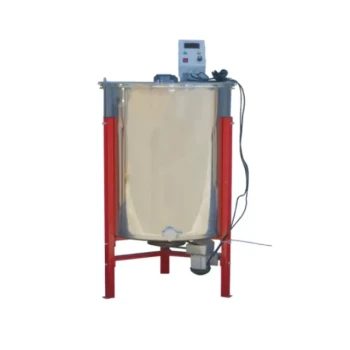
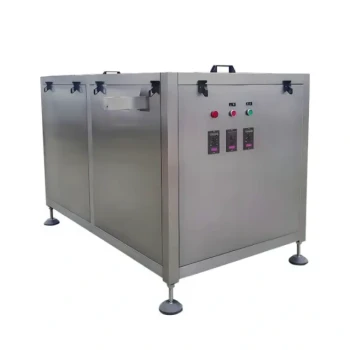
An industrial centrifuge is utilized primarily to achieve critical solid-liquid separation. In the specific context of extracting total carotenoids, the centrifuge processes a mixture of honey and 80% acetone. Its high-speed rotation generates powerful force to rapidly precipitate insoluble impurities, leaving behind a clear liquid (supernatant) that contains the dissolved pigments.
By effectively removing particulate matter that causes light-scattering interference, the centrifuge ensures the extracted solution is optically clear, which is a prerequisite for the accurate measurement and detection of carotenoid pigments.
The Mechanics of Extraction and Separation
Preparing the Sample
The process begins by mixing and homogenizing the honey sample with a solvent, specifically an 80% acetone solution. This solvent is chosen to dissolve the target carotenoid pigments effectively. However, this mixture inevitably contains insoluble impurities that must be removed before analysis can proceed.
Applying Centrifugal Force
The industrial centrifuge spins the homogenized mixture at high speeds. This rotation generates significant centrifugal force, which acts physically on the mixture's components based on their density.
Precipitating Impurities
Under this force, heavier insoluble particles are driven to the bottom of the container, forming a pellet. This rapid precipitation isolates the solid contaminants from the liquid phase.
Isolating the Supernatant
The result of this separation is a clear supernatant—the liquid floating above the solid pellet. This liquid retains the total carotenoids in solution but is now free of the physical debris that was present in the raw mixture.
Why Clarity is Critical for Detection
Eliminating Light Scattering
The primary reason for using such rigorous separation is to support optical detection. Any remaining solid particles in the solution would scatter light.
Ensuring Analytical Accuracy
Light scattering creates noise and interference during optical analysis. By producing a perfectly clear supernatant, the centrifuge ensures that the subsequent detection instruments read only the light absorption of the pigments, not the interference of impurities.
Understanding the Trade-offs
Equipment Complexity vs. Necessity
While gravity filtration could theoretically separate solids, it is often too slow and less effective for the fine particulates found in homogenized honey mixtures. The industrial centrifuge is a more complex and expensive piece of machinery, but it is necessary to achieve the speed and clarity required for accurate chemical analysis.
Potential for Thermal Impact
High-speed rotation can generate heat due to friction. If the centrifuge is not temperature-controlled, there is a theoretical risk of degrading heat-sensitive compounds. Operators must ensure the equipment settings do not exceed the thermal tolerance of the carotenoids being extracted.
Making the Right Choice for Your Process
If you are setting up a protocol for carotenoid quantification, understanding the role of the centrifuge is vital for data integrity.
- If your primary focus is analytical accuracy: Ensure the centrifuge speed and duration are sufficient to precipitate all insoluble matter to prevent optical interference.
- If your primary focus is process efficiency: Utilize the centrifuge to replace time-consuming gravity filtration methods, rapidly moving samples from homogenization to detection.
The centrifuge acts as the gatekeeper between crude extraction and precise measurement, ensuring your data reflects the true pigment content of the honey.
Summary Table:
| Process Phase | Action | Outcome |
|---|---|---|
| Homogenization | Mixing honey with 80% acetone solvent | Dissolves pigments while creating insoluble debris |
| Centrifugation | Applying high-speed centrifugal force | Rapidly precipitates solids into a dense pellet |
| Isolation | Separating the clear supernatant | Removes light-scattering particles for accurate analysis |
| Detection | Optical measurement of the liquid | Precise quantification of total carotenoid content |
Elevate Your Beekeeping Operation with HONESTBEE
At HONESTBEE, we specialize in empowering commercial apiaries and distributors with the professional tools and machinery needed for high-quality production. Whether you are scaling up with honey-filling machines or optimizing your yield with advanced honey processing equipment, our comprehensive wholesale offering ensures your business stays competitive.
From specialized hardware and hive-making machinery to essential industry consumables and honey-themed cultural merchandise, we provide the full spectrum of equipment to streamline your extraction and packaging workflows.
Ready to upgrade your commercial honey production? Contact our expert team today to discover how HONESTBEE can deliver the efficiency and reliability your apiary deserves.
References
- Vinutha R Bhatta, A Naresh Kumar. QUANTIFICATION OF SECONDARY METABOLITES IN CERANA HONEY AND ITS POTENTIAL ANTIOXIDANT PROPERTY. DOI: 10.7897/2230-8407.1009273
This article is also based on technical information from HonestBee Knowledge Base .
Related Products
- Manual Hand Crank 4 Frame Honey Extractor Centrifuge for Beekeeping
- electric honey extractor honey centrifuge 3 frame honey extractor stainless steel honey frame extractor
- Professional 4 Frame Self Reversing Electric Honey Extractor for Beekeeping
- Fully Automatic High Speed Centrifugal Bottle Unscrambler
People Also Ask
- What are some tips for achieving efficient honey extraction with a centrifuge extractor? Maximize Your Yield & Efficiency
- What is the proper procedure for maintaining a centrifuge honey extractor? Expert Tips for Longevity and Hygiene
- What are the advantages of using a centrifuge honey extractor? Maximize Yields and Protect Your Honeycombs
- Which type of honey extractor is generally more durable? Focus on Material & Build Quality for Longevity
- What is a manual honey extractor? The Essential Guide to Cost-Effective Beekeeping for Beginners