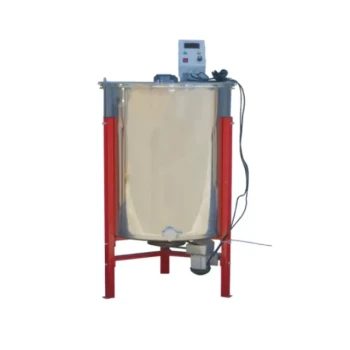
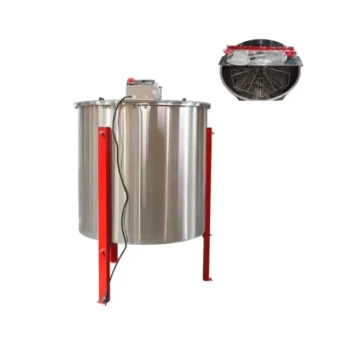
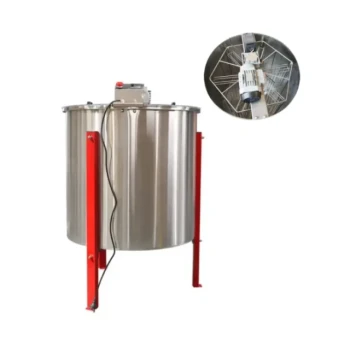
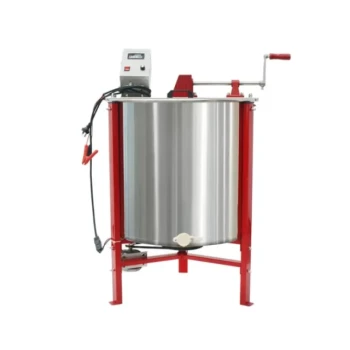
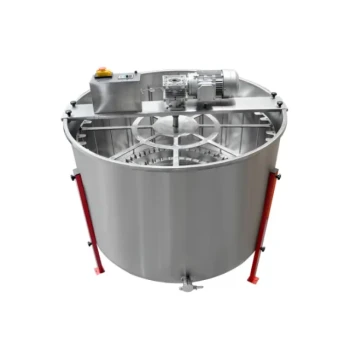
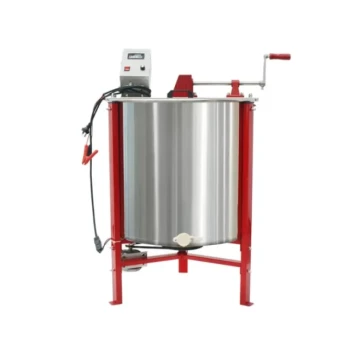
Industrial-grade centrifuges are the cornerstone of precision honey pollen extraction and commercial-scale efficiency. These machines generate the high rotational speeds—typically between 2,500 and 3,500 rpm—necessary to create the powerful centrifugal force required to separate microscopic pollen grains from a diluted honey solution. This physical separation process is the only reliable way to concentrate trace pollen samples from large liquid volumes, ensuring accurate quantitative analysis and high-quality precipitate recovery.
An industrial-grade centrifuge is indispensable because it leverages high-speed rotational force to achieve rapid phase separation based on density differences. This allows commercial operators to isolate and concentrate pollen grains efficiently while preserving the structural integrity of honeycombs and the nutritional profile of the honey.
The Technical Necessity of High-Speed Sedimentation
Overcoming the Density Challenge
Honey is a dense, viscous sugar matrix that naturally holds microscopic pollen grains in suspension. To isolate these grains for analysis or enrichment, an industrial centrifuge applies force that utilizes the density difference between the pollen and the liquid.
Precision at 3,500 RPM
While manual methods fail to capture trace amounts, an industrial-grade unit provides a stable, high-speed rotation (up to 3,500 rpm). This force drives the pollen to the bottom of the container, forming a dense sediment pellet that is easily recovered for microscopic observation.
Scalability for Commercial Quantities
Industrial units are designed to handle the large liquid matrices common in B2B honey processing. They provide the consistent force necessary to process bulk samples quickly, which is a critical requirement for quantitative pollen analysis (APC) and commercial grading.
Maximizing Operational Efficiency and Honey Integrity
Preserving Reusable Honeycomb Frames
Beyond pollen isolation, industrial centrifuges are used to eject honey from wax cells without damaging the physical structure of the honeycomb. This allows beekeepers to return intact frames to the hive, saving the bees the massive energy expenditure of rebuilding wax and allowing them to focus entirely on nectar collection.
Cold-Process Extraction for Quality Control
These centrifuges operate as a physical separation tool that does not require heat. By avoiding thermal processing, the equipment ensures that the honey’s natural active components, enzymes, and delicate flavor profiles remain completely intact.
Rapid Order Fulfillment and Throughput
For distributors and wholesalers, the speed of industrial centrifugation translates directly to efficient order fulfillment. Mechanized extraction is significantly faster than gravity-based methods, allowing for the high-volume throughput required in modern supply chains.
Understanding the Trade-offs
Capital Investment vs. Long-Term Yield
The primary trade-off is the initial cost of industrial-grade machinery compared to simpler gravity systems. However, the increased honey recovery rate and the ability to reuse frames provide a rapid return on investment for commercial-scale operations.
Maintenance and Technical Expertise
High-speed equipment requires regular maintenance and calibrated operation to ensure safety and precision. This necessitates a partnership with a supplier that offers deep professional industry expertise and dedicated customer service to handle technical support and part replacements.
Power Requirements and Portability
Unlike manual extractors, industrial centrifuges require a stable power source and a dedicated footprint. This makes them less portable but essential for centralized one-stop sourcing facilities where volume and speed are the primary drivers.
Selecting the Right Equipment for Your Business Model
Choosing the correct centrifuge is a balance between your processing volume and the specific analytical requirements of your target market.
- If your primary focus is high-precision pollen analysis: Invest in units capable of reaching 3,500 rpm to ensure the recovery of even the smallest trace specimens for APC testing.
- If your primary focus is maximize production throughput: Prioritize industrial models that emphasize frame preservation and high-capacity loading to speed up the harvesting cycle.
- If your primary focus is organic or premium honey markets: Select centrifuges that specialize in cold-extraction techniques to guarantee the integrity of the honey’s nutritional profile.
By integrating high-performance centrifugation into your workflow, you secure a competitive advantage through superior product purity and optimized resource management.
Summary Table:
| Key Feature | Commercial Benefit | Technical Specification |
|---|---|---|
| High-Speed Sedimentation | Captures trace pollen for accurate analysis | 2,500 - 3,500 RPM |
| Physical Separation | Cold-process extraction preserves enzymes | No thermal processing required |
| Frame Preservation | Protects honeycomb for reuse, saving bee energy | High rotational force vs. gravity |
| Industrial Throughput | Rapid fulfillment for high-volume B2B orders | Designed for large liquid matrices |
Scale Your Honey Production with HONESTBEE
Looking to optimize your commercial apiary or distribution network? HONESTBEE is your dedicated partner for one-stop sourcing of high-performance beekeeping machinery and consumables.
From high-speed industrial centrifuges to specialized honey-filling and hive-making machines, we empower distributors and wholesalers with:
- Comprehensive Portfolio: A full spectrum of specialized hardware, machinery, and industry consumables.
- Operational Excellence: Ultra-fast delivery, rapid response times, and efficient order fulfillment.
- Expert Partnership: Deep professional industry expertise and dedicated customer service tailored for B2B resellers.
Contact HONESTBEE Today to explore our wholesale offerings and enhance your supply chain with premium trading services!
References
- Ahter Fişne, Sevil Pehlivan. POLLEN ANALYSIS OF HONEYS FROM TRABZON (TÜRKİYE). DOI: 10.31467/uluaricilik.1641493
This article is also based on technical information from HonestBee Knowledge Base .
Related Products
- Manual Hand Crank 4 Frame Honey Extractor Centrifuge for Beekeeping
- electric honey extractor honey centrifuge 3 frame honey extractor stainless steel honey frame extractor
- Professional 4 Frame Self Reversing Electric Honey Extractor for Beekeeping
- HONESTBEE 72 Frame Industrial Electric Honey Extractor for Beekeeping
- Honey Concentrating and Filtering Dehumidifier Machine 2T Capacity for Honey
People Also Ask
- What are some tips for achieving efficient honey extraction with a centrifuge extractor? Maximize Your Yield & Efficiency
- What is the proper procedure for maintaining a centrifuge honey extractor? Expert Tips for Longevity and Hygiene
- What are the advantages of using a centrifuge honey extractor? Maximize Yields and Protect Your Honeycombs
- Which type of honey extractor is generally more durable? Focus on Material & Build Quality for Longevity
- What is a manual honey extractor? The Essential Guide to Cost-Effective Beekeeping for Beginners