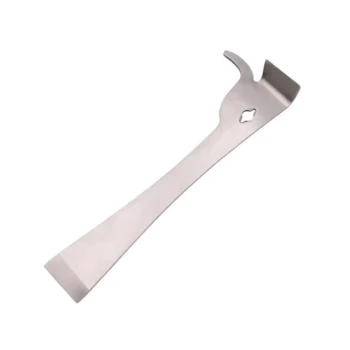
Owning multiple hive tools is a strategic necessity for beekeepers rather than a luxury, serving as insurance against work stoppages and enabling more precise hive manipulation. It provides the versatility to handle specific mechanical challenges, allows for techniques requiring simultaneous leverage, and guarantees that a misplaced tool does not halt a critical inspection.
Core Insight: Fieldwork in an apiary is time-sensitive and often messy; relying on a single tool creates a single point of failure. Maintaining a collection of tools ensures you can match the right mechanical advantage to the specific task while mitigating the common risk of losing equipment in the field.
The Functional Necessity of Variety
Matching the Tool to the Task
Different hive tool styles are engineered to solve specific physical problems within the hive.
While a standard tool might be generally useful, specialized designs are often required for unique situations, such as levering out a particularly stuck frame or scraping distinct surfaces.
Switching between tools allows you to apply force correctly without damaging woodenware or injuring bees.
The Requirement for Simultaneous Leverage
Occasionally, the propolis seal between hive boxes is too strong for a single leverage point.
In these instances, a beekeeper must use two tools at the same time to pry from opposing corners or angles.
This dual-tool approach distributes the pressure evenly, preventing the wood from cracking and reducing the physical strain on the beekeeper.
Continuity and Workflow Protection
The Reality of Misplaced Gear
Hive tools are small, often dark-colored, and easily lost during the activity of an inspection.
It is extremely common for tools to be misplaced in tall grass or inadvertently left on a nearby hive stand.
Without a backup, a beekeeper is forced to stop working to search for the tool, disrupting the rhythm of the inspection and leaving the hive open longer than necessary.
Eliminating Downtime
Having a spare tool immediately accessible ensures that work can proceed without interruption.
If a tool is dropped or lost, you simply reach for the backup and continue the inspection.
This redundancy protects the efficiency of your workflow, allowing you to finish the job and retrieve the lost tool later.
Understanding the Trade-offs
Versatility vs. Specialization
Multi-functional tools (referenced in supplementary materials) attempt to combine a flat blade, hook, and serrated edge into one unit.
While these offer convenience and reduce the number of tool switches, they can sometimes be bulkier or less ergonomic than dedicated single-purpose tools.
A "Swiss Army knife" approach is useful, but it rarely outperforms a specialized tool designed perfectly for a single function, like a J-hook for lifting frames.
Management of Equipment
Owning multiple tools requires a system for carrying and organizing them.
Carrying too many tools can become cumbersome, weighing down your suit pockets or tool belt.
The goal is strategic redundancy, not hoarding; carrying one active tool and one backup is usually sufficient for most inspections.
Making the Right Choice for Your Goal
To build an efficient toolkit, assess your current workflow and common frustrations.
- If your primary focus is reliability: Ensure you have at least two identical standard hive tools so a lost tool never stops your work.
- If your primary focus is precision: Acquire different styles (e.g., one J-hook and one flat blade) to handle both frame lifting and box separation effectively.
- If your primary focus is convenience: Consider a multi-functional tool as your primary carry, but keep a standard tool as a mandatory backup.
The professional approach is to view your hive tool not as a single object, but as a system of primary and backup instruments that guarantees success in the field.
Summary Table:
| Reason for Multiple Tools | Primary Benefit | Key Tool Types |
|---|---|---|
| Redundancy | Prevents work stoppage if a tool is lost in the grass. | Standard Flat Blade |
| Simultaneous Leverage | Evenly pries stuck boxes to prevent wood damage. | Two Matching Tools |
| Specialized Tasks | J-hooks lift frames easily; scrapers clean surfaces. | J-Hook, Scraper |
| Precision & Ergonomics | Reduces physical strain and protects bee colony. | Multi-functional Tools |
Scale Your Beekeeping Success with HONESTBEE
Maximize your apiary's productivity with high-quality, professional-grade equipment. At HONESTBEE, we specialize in supporting commercial apiaries and distributors with a comprehensive wholesale catalog.
Whether you need precision hive tools, advanced hive-making machinery, or honey-filling systems, we provide the full spectrum of hardware and industry consumables to keep your operations running smoothly. Partner with us to access reliable tools and unique honey-themed cultural merchandise tailored for your business growth.
Ready to upgrade your toolkit? Contact us today to explore our wholesale offerings!
Related Products
- Professional Multi-Function Stainless Steel Hive Tool
- Professional Stainless Steel Pry-Bar Hive Tool
- HONESTBEE Professional Long Handled Hive Tool with Precision Cutting Blade
- HONESTBEE Premium Italian Style Hive Tool with Hardwood Handle
- Ergonomic Plastic Frame Spacer Tool for Rapid Hive Management Beekeeping
People Also Ask
- Why are professional hive tools considered indispensable? Master Beekeeping Maintenance with Precision Leverage
- What is the role of professional hive tools in routine apiary maintenance? Expert Tips for Hive Health and Longevity
- What are the benefits of a multi-functional hive tool? Streamline Your Apiary Workflow with One Tool
- What advantages do multi-functional hive tools offer? Maximize Your Apiary Efficiency and Workflow
- What are the common construction features of hive tools? Key Insights for Superior Beekeeping Efficiency