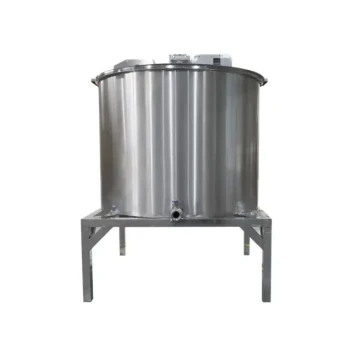
Professional Honey Harvesting and Processing Equipment acts as a multiplier for apiary profitability. By utilizing industrial-grade tools like centrifuges and filters, beekeepers can significantly reduce product loss and labor hours while maximizing extraction yields. This shift from manual to mechanized processing directly improves critical financial metrics, specifically raising the Net Present Value (NPV) and the Benefit-Cost Ratio (BCR) of the operation.
The transition to professional processing equipment is not merely an operational upgrade; it is a strategic financial move that lowers unit costs through efficiency and unlocks higher revenue tiers by enabling direct-to-consumer retail production.
The Economics of Extraction Efficiency
Maximizing Yield and Minimizing Waste
The primary driver for investing in professional equipment is the reduction of physical waste. Industrial-grade centrifuges and advanced filtration systems are designed to extract the maximum amount of honey from the comb.
Unlike manual methods, which leave significant residue behind, these machines ensure deep removal of impurities while capturing nearly all available product. This efficiency directly increases the honey yield per bee colony, providing a higher return on the biological investment already made in the hive.
Preserving Product Quality
Profitability is also a function of product value. Professional equipment maximizes the retention of active nutrients in the honey during the extraction process.
By maintaining high purity and nutrient integrity, producers can position their honey in premium market segments. This technical safeguard ensures that the output meets high commercial standards, protecting the operation against low efficiency and poor quality control.
Scaling Operations and Labor Dynamics
Overcoming Labor Constraints
In an environment of rising wages, labor is often the single highest variable cost in beekeeping. Automated processing equipment, such as high-performance extraction lines, significantly enhances labor productivity.
These systems allow a smaller workforce to process larger volumes of honey rapidly. By reducing the labor hours required per kilogram of honey produced, the operation lowers its marginal cost of production, improving the overall Benefit-Cost Ratio.
Managing Larger Volumes
To achieve high profitability, operations often need to scale up. Professional equipment allows beekeepers to manage larger production volumes without a linear increase in management complexity.
This scalability is essential for improving the commercialization rate of honey. It enables beekeepers to balance the costs of other activities, such as pollination services, ensuring overall profitability even if pollination fees are insufficient.
Vertical Integration and Market Access
Capturing Retail Value
Perhaps the most significant leap in profitability comes from changing how the honey is sold. Automated honey-filling and capping machines enable beekeepers to transition from selling bulk raw materials to offering retail-ready products.
By integrating precise metering, bottling, and sealing, producers can bypass intermediate traders. This allows the beekeeper to capture the retail value-add at the end of the supply chain, dramatically increasing the revenue per unit.
Ensuring Consistency and Hygiene
Retail markets demand consistency. Automated filling machines provide high-precision quantitative filling and hygienic sealing.
This level of standardization reduces unit packaging costs and builds consumer trust. It supports the development of independent brand lines, reducing dependency on volatile bulk market prices.
Diversification Through Byproducts
Monetizing Wax and Residues
Profitability is not limited to honey alone. Professional wax processing equipment allows beekeepers to transform harvest byproducts into high-value goods.
By refining beeswax into candles, soaps, or skin balms, operations can establish a secondary revenue stream. This diversification increases the economic output per hive without necessarily increasing the number of colonies or operational footprint.
Understanding the Trade-offs
Capital Intensity vs. Long-Term Gain
While the Benefit-Cost Ratio improves over time, professional equipment requires a significant upfront capital injection.
Beekeepers must calculate the Net Present Value (NPV) carefully. The equipment acts as a fixed cost that reduces long-term depreciation and variable costs, but it requires sufficient production volume to justify the initial expense.
The Necessity of Standardization
To fully leverage this equipment, the entire apiary often needs to standardize. For example, high-quality standardized beehives are required to ensure components are interchangeable and compatible with processing machinery.
While this reduces long-term depreciation and aids logistics, it may require a costly overhaul of existing non-standard hive inventory.
Making the Right Choice for Your Goal
To maximize your return on investment, align your equipment choices with your specific business model:
- If your primary focus is Volume Production: Prioritize industrial centrifuges and filtration systems to maximize yield per colony and reduce product loss.
- If your primary focus is Vertical Integration: Invest in automated filling and capping machines to bypass middlemen and capture the full retail price of your honey.
- If your primary focus is Risk Management: Acquire wax processing equipment to diversify revenue streams, ensuring income stability even during lower honey yield seasons.
Ultimately, professional equipment transforms beekeeping from a labor-intensive agricultural activity into a scalable, efficient, and vertically integrated business.
Summary Table:
| Equipment Category | Key Function | Financial Benefit |
|---|---|---|
| Centrifuges & Filters | Maximized honey extraction | Increases yield per colony; reduces product waste |
| Extraction Lines | High-volume automation | Lowers labor costs and marginal production costs |
| Filling & Capping | Retail-ready packaging | Captures retail value-add by bypassing middlemen |
| Wax Processing | Byproduct refinement | Creates secondary revenue streams from wax sales |
| Standardized Hives | Logistics compatibility | Reduces depreciation and simplifies colony management |
Scale Your Commercial Apiary with HONESTBEE
Maximize your operation's profitability with HONESTBEE, the leading provider of comprehensive wholesale solutions for commercial apiaries and distributors. We supply the full spectrum of beekeeping tools, from industrial honey-filling and capping machines to high-precision hive-making hardware.
Our extensive portfolio covers everything from heavy machinery to essential industry consumables and honey-themed cultural merchandise. Whether you are looking to reduce labor costs or vertically integrate your production for higher retail margins, our expert team is here to support your growth.
Ready to modernize your production? Contact us today to discuss our wholesale machinery and equipment offerings.
References
- Willickister R. Kadigi, Reuben M. J. Kadigi. Economic Viability of Smallholder Agroforestry and Beekeeping Projects in Uluguru Mountains, Tanzania: A Cost Benefit Analysis. DOI: 10.4236/ojf.2021.112007
This article is also based on technical information from HonestBee Knowledge Base .
Related Products
- Professional Wide Blade Honey Scraper for Beekeeping and Honey Processing
- Honey Concentrating and Filtering Dehumidifier Machine 2T Capacity for Honey
- All-Stainless Steel Pivoting Honey Uncapping Fork for Beekeeping
- Double Wall Honey Heating Stirring Homogenizer Mixing Machine with Various Capacity
- 0.5T Capacity Honey Dehumidifier Dryer with Vacuum Heating and Thickening Filtering Machine
People Also Ask
- What tools and machinery are essential to resolve common operational constraints such as equipment shortages and improper honey harvesting? Discover the complete honey-harvesting equipment lineup for commercial apiaries and distributors.
- How does environmental temperature control influence the efficiency of honey scraping equipment? Optimize Your Flow
- What operational considerations are critical during honey harvesting, and how do specialized honey processing tools add value to the final product? Optimize Quality and Yield
- What are the core functions of a honey processor? Master Moisture Control and Purification for Quality Honey
- What are the technical requirements for beekeeping equipment used in the production of comb honey compared to filtered honey?