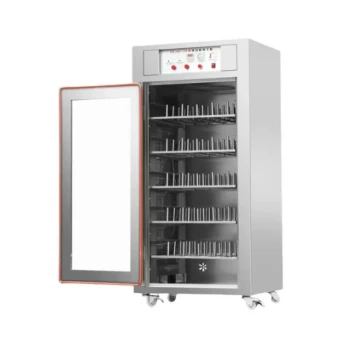
Specialized drying equipment is strictly required to manage the delicate balance between moisture removal and nutrient preservation in post-harvest bee-bread. Freshly harvested bee-bread contains a volatile moisture content of 24–28%, making it highly prone to immediate spoilage. Dedicated systems are engineered to reduce this to a stable 10–14% while ensuring processing temperatures never exceed 45°C.
The necessity of specialized equipment lies in its ability to decouple drying power from excessive heat. It provides the precise environmental control required to stabilize the product for long-term storage without destroying the heat-sensitive bioactive compounds that give bee-bread its economic and nutritional value.
The Biological Challenge: Moisture vs. Stability
To understand the equipment requirement, one must first understand the inherent instability of the raw material.
The Spoilage Threshold
Fresh bee-bread is biologically active and wet. With a moisture level of 24–28%, it provides an ideal environment for microbial growth and fermentation.
The Target for Stability
To render the product suitable for packaging and long-term storage, moisture must be aggressively reduced. The industry standard for safety and stability requires reaching a target range of 10–14%.
The Failure of Natural Drying
Simple air drying is insufficient for this task. Natural drying relies on inconsistent environmental conditions, which often fail to remove moisture quickly enough to prevent spoilage or maintain the uniformity required for commercial quality.
Preserving Economic and Nutritional Value
The primary reason for using specialized machinery rather than standard industrial dryers is the extreme heat sensitivity of the product.
The Thermal Limit
Bee-bread loses its value if "cooked." Specialized dryers are calibrated to maintain a strict temperature ceiling, typically below 45°C.
Optimal Operating Ranges
To further minimize risk, many advanced systems utilize a constant flow of circulating air maintained specifically below 40°C. This continuous dehydration process ensures moisture is removed efficiently without thermal spikes.
Protecting Bioactive Integrity
The economic value of bee-bread is directly tied to its nutritional profile. High temperatures destroy vital components such as antioxidants, phenolic compounds, and flavonoids.
Ensuring Functional Nutrition
Specialized equipment ensures that the final product retains the functional health benefits consumers expect. Without this precise control, thermal degradation renders the bee-bread nutritionally inferior, effectively destroying its market value.
Understanding the Trade-offs
While specialized equipment is necessary for quality, it introduces specific operational constraints that must be managed.
Speed vs. Quality
There is an inverse relationship between drying speed and product quality. Specialized low-temperature dryers take longer to reach the 10–14% moisture target compared to high-heat methods, creating a bottleneck in processing speed that must be accounted for in production planning.
Complexity of Extraction
Drying is often just one part of a complex mechanical chain. The equipment must work in tandem with specialized harvesting tools designed to separate bee-bread from honeycomb cells, requiring a seamless integration of cleaning, drying, and packaging machinery.
Making the Right Choice for Your Processing Line
When selecting drying solutions, your equipment configuration should be dictated by your specific end-product goals.
- If your primary focus is Nutrient Density: Prioritize equipment capable of strictly maintaining circulating air temperatures below 40°C to maximize the retention of phenolics and flavonoids.
- If your primary focus is Shelf Stability: Ensure the equipment has precise humidity sensors to guarantee the product reaches the 10–12% moisture baseline before packaging to prevent mold growth.
Ultimately, the investment in specialized drying technology is not just about removing water; it is about locking in value.
Summary Table:
| Feature | Requirement | Reason for Specialization |
|---|---|---|
| Moisture Content | Reduce 24-28% to 10-14% | Prevents microbial growth, fermentation, and spoilage. |
| Temperature Limit | Max 45°C (Ideal <40°C) | Prevents the destruction of heat-sensitive bioactive compounds. |
| Nutrient Preservation | High Retention | Protects antioxidants, phenolics, and flavonoids for market value. |
| Airflow Control | Continuous Circulation | Ensures uniform drying without thermal spikes or quality loss. |
Maximize Your Harvest's Value with HONESTBEE
Don't let poor processing compromise your product's quality. HONESTBEE specializes in professional solutions for commercial apiaries and distributors. From specialized bee-bread drying and harvesting machinery to honey-filling systems and essential beekeeping tools, we provide the full spectrum of equipment needed to maintain nutritional integrity and market value.
Ready to elevate your production standards? Contact us today to explore our comprehensive wholesale offerings and find the perfect equipment for your beekeeping enterprise.
References
- Sergei Oskin, Dmitry Tsokur. Improving the efficiency of the bee-bread drying process. DOI: 10.1088/1755-1315/1052/1/012104
This article is also based on technical information from HonestBee Knowledge Base .
Related Products
- High Quality Honey Dehumidifier Dryer Thickening Machine for Beekeeping
- Professional Bee Frame Machine for Side Bar Shaping
- Fully Automatic Beeswax Embossing Machine Foundation Mill
- Mini Desktop Bee Hive Frame Forming Making Machine
- 0.5T Capacity Honey Dehumidifier Dryer with Vacuum Heating and Thickening Filtering Machine
People Also Ask
- Can you dehumidify honey? A Beekeeper's Guide to Preventing Fermentation
- How to dry up honey? The Safe Guide to Stabilizing Honey and Preventing Fermentation
- How can the moisture content of honey be reduced? A Guide to Safe, Effective Drying Methods
- How to remove humidity from honey? Protect Your Harvest from Fermentation
- How to decrease moisture in honey? Prevent Fermentation and Ensure Long-Term Quality