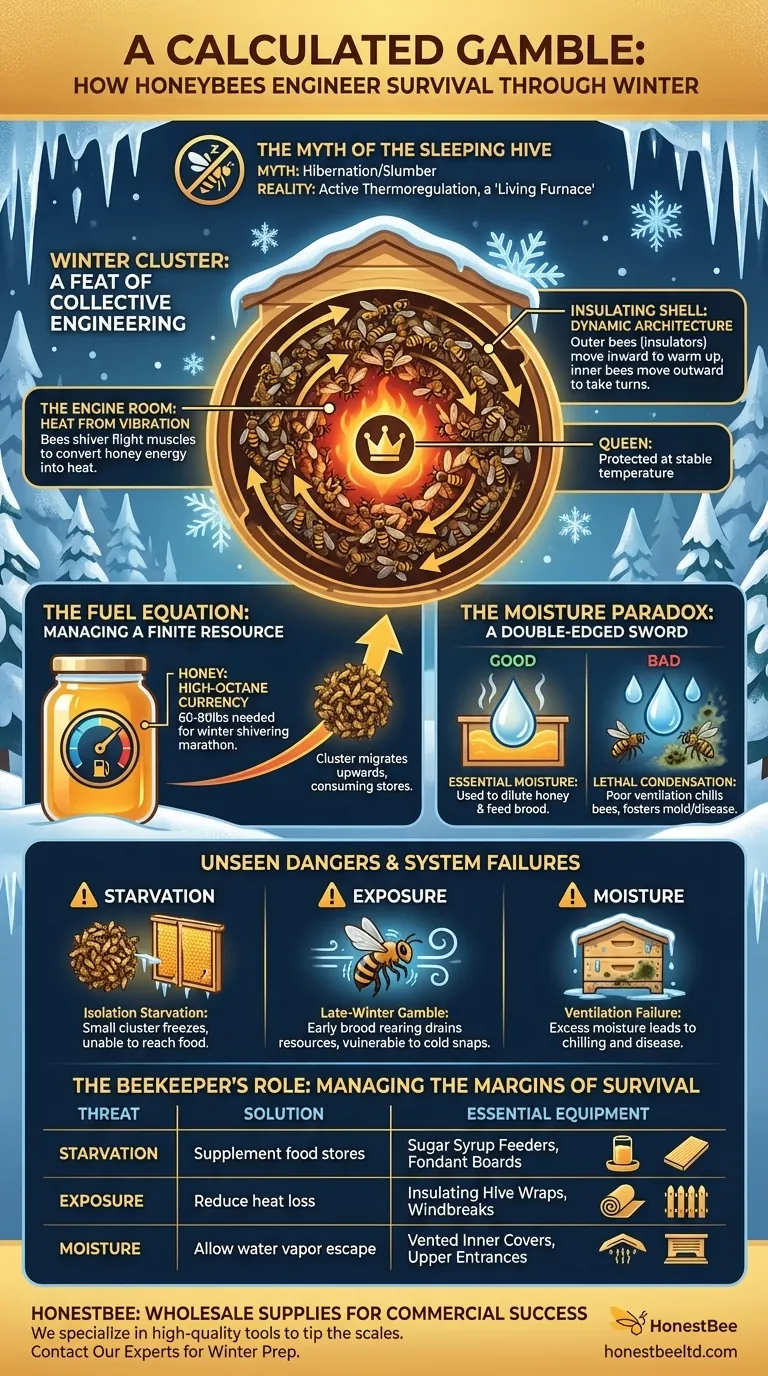
The Myth of the Sleeping Hive
Winter settles, and we imagine the honeybee hive in a state of deep slumber, a quiet suspension until spring. This is a comforting, but incorrect, assumption.
A honeybee colony does not hibernate. Instead, it engages in one of nature's most demanding feats of engineering: it becomes a living, breathing furnace. Surviving winter is not an act of dormancy but a months-long marathon of active, collective thermoregulation, fraught with calculated risks.
The Winter Cluster: A Feat of Collective Engineering
The core of this strategy is the "winter cluster." This isn't a simple huddle for warmth; it's a highly organized, self-regulating biological machine.
The Engine Room: Heat from Vibration
To generate heat, bees anchor their wings and engage in isometric contractions of their flight muscles. They shiver, intensely and continuously.
This coordinated vibration converts the chemical energy stored in honey directly into thermal energy. It's a brute-force method of heat production, turning the cluster's core into a stable, warm environment, even as temperatures outside plummet.
The Insulating Shell: A Dynamic Architecture
The cluster organizes itself into a sphere. Bees on the outer edge pack themselves tightly together, their bodies forming a dense, insulating mantle that dramatically reduces heat loss.
This isn't a static structure. The bees are in constant, slow rotation. Colder individuals from the outer shell move inward to warm up and feed, while warmer bees from the core cycle outward to take their turn as insulators. It is a system designed for endurance, ensuring no single group bears the brunt of the cold.
At the very center, protected and kept at a stable temperature, is the queen—the sole purpose of this entire endeavor.
The Fuel Equation: Managing a Finite Resource
A furnace is useless without fuel. The colony's survival hinges on the food stores it meticulously gathered during the warmer months.
Honey as a High-Octane Currency
Honey is pure, concentrated energy. A strong colony needs 60 to 80 pounds of it to fuel its winter-long shivering marathon. This is not a pantry; it is a finite energy budget that must be managed with ruthless efficiency.
As winter progresses, the entire cluster slowly migrates upwards through the hive, staying in direct contact with their honey stores, consuming their way to spring.
The Moisture Paradox: A Double-Edged Sword
The bees' metabolic process of converting honey into heat produces two things: warmth and water vapor. This creates a fascinating and dangerous paradox.
Some of this warm, humid air rises and condenses on the cool inner surfaces of the hive. This collected water is essential. The bees use it to dilute thick, crystallized honey and to produce the brood food needed to feed the first new generation of bees.
But if ventilation is poor, this life-giving moisture becomes a killer. Excess condensation can drip back down onto the cluster, chilling the bees, fostering mold, and spreading disease. What is essential in small doses becomes lethal in large ones.
Unseen Dangers and System Failures
Success is not guaranteed. The colony's strategy involves trade-offs where the solution to one problem can create another.
The Tragedy of Isolation Starvation
A cluster that is too small lacks the collective mass to generate enough heat and move effectively. It can become stranded, literally freezing in place. In a cruel twist of fate, a small colony can starve to death just inches away from frames full of honey, unable to break its huddle to reach them.
The Late-Winter Gamble: Betting on an Early Spring
Remarkably, the queen often begins laying eggs as early as January. This is a high-stakes bet. Rearing brood gives the colony a critical head start for the first spring pollen flows.
However, raising larvae dramatically increases the cluster's energy and food consumption at the precise moment their resources are at their lowest. An unexpected, late-season cold snap can exhaust their remaining fuel, leading to catastrophe.
The Beekeeper's Role: Managing the Margins of Survival
For a commercial apiary, where the health of hundreds of colonies represents a significant investment, relying on the bees' gamble alone isn't enough. The professional beekeeper's job is to manage the margins—to provide insurance against the worst-case scenarios.
Your role is to mitigate the three primary threats to the system.
| Threat | Beekeeper's Solution | Essential Equipment |
|---|---|---|
| Starvation | Supplement food stores in fall and winter. | Sugar Syrup Feeders, Fondant Boards |
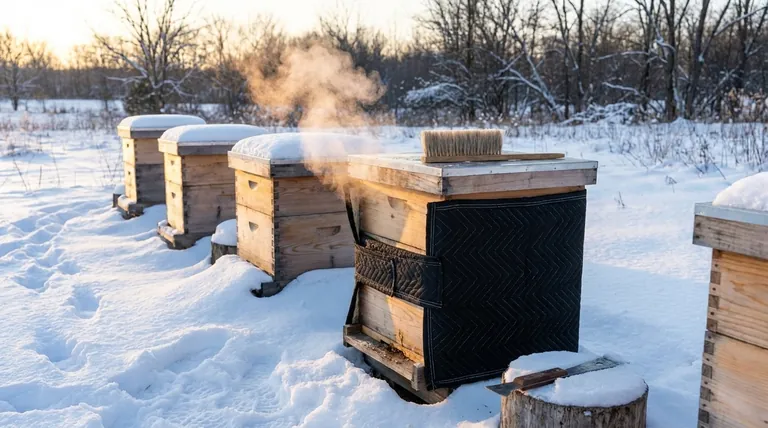
| Exposure | Reduce heat loss and protect from wind. | Insulating Hive Wraps, Windbreaks |
| Moisture | Allow excess water vapor to escape. | Vented Inner Covers, Upper Entrances |
Managing these risks at scale requires durable, reliable, and intelligently designed equipment. For commercial operations and distributors, ensuring every hive is properly fed, insulated, and ventilated is paramount to protecting your investment through the winter. This is where having a dependable supply chain is non-negotiable.
HONESTBEE specializes in providing high-quality, wholesale beekeeping supplies that empower commercial apiaries to effectively manage these winter risks. From robust feeders and fondant boards to professional-grade hive wraps, we provide the tools you need to tip the scales in your colonies' favor.
Winter survival is a testament to the honeybee's incredible collective resilience. By understanding the intricate engineering behind it, you can provide the support they need to emerge strong and ready for the season ahead. To discuss your apiary's winter preparation strategy and equipment needs, Contact Our Experts.
Visual Guide