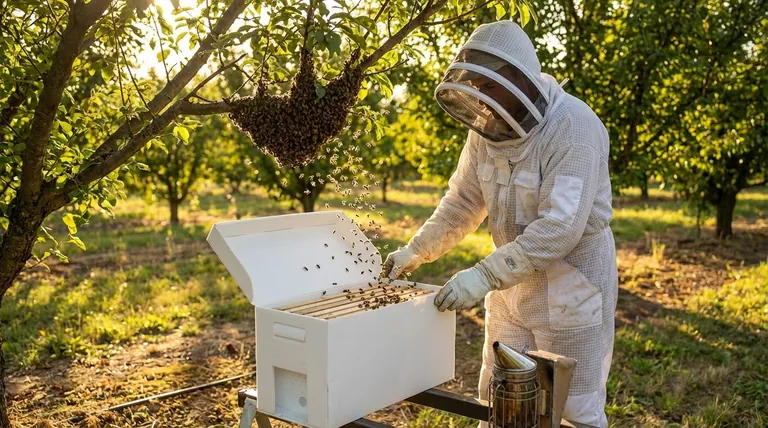
A Negotiation, Not a Capture
Imagine a pulsating, living mass of thousands of bees clinging to a tree branch. For the uninitiated, it’s a scene of primal fear. For a beekeeper, it’s a moment of profound opportunity.
The common term is "catching bees," but this is a misnomer. You don't catch a swarm like you'd trap an animal. You persuade a homeless colony that the box in your hands is the best real estate on the market. It's a negotiation, and to succeed, you must understand the other party's state of mind.
The Swarm's State of Mind
A swarm is not an angry mob. It is a colony in a unique, vulnerable, and surprisingly docile state of transition.
A Colony in Transit, Not an Army
Swarming is a sign of success. A healthy colony has outgrown its home, and the old queen leaves with half the workforce to found a new dynasty. They are not looking for a fight; they are looking for a future.
The Honey-Fueled Calm
Before leaving, every bee gorges on honey, packing as much fuel as possible for the journey. This has a powerful tranquilizing effect. Full of honey and with no home, brood, or food stores to defend, they are at their most placid. This psychological state is the beekeeper's greatest advantage.
The Mechanics of Relocation
The physical act of moving the bees is often the simplest part of the process. The entire operation is built around a single, unwavering principle: secure the queen. Where she goes, the colony inevitably follows.
The Principle of Queen-Centricity
Worker bees are constantly attuned to the queen's pheromones. If she is safely inside the hive box, they will receive her "come hither" signal and begin to march inside willingly. Her presence turns a simple wooden box into a home.
A Toolkit of Techniques
Depending on the swarm's location, the beekeeper chooses the most efficient and gentle method of relocation:
- The Shake & Drop: For swarms on an accessible branch, a sharp shake dislodges the cluster directly into an open hive box below. It's abrupt but effective.
- The Cut & Place: If the branch is expendable, the entire limb is snipped and gently placed inside the hive. Minimal disruption.
- The Scoop & Brush: For swarms on solid surfaces like walls, bees are gently brushed or scooped into the box. It is a patient, methodical process.
The Art of Persuasion: Making a House a Home
Getting the bees into the box is just the opening offer. Now, you must convince them to sign the lease. This is done not with force, but by speaking their biological language.
Speaking the Language of Nectar
A captured swarm has finite energy reserves. By providing a 1:1 sugar-syrup solution, a beekeeper mimics a strong natural nectar flow. This is a powerful signal of resource abundance. It tells the bees, "This location is rich. You have the fuel to build."
The Architecture of Acceptance
The syrup triggers their instinct to create wax and build comb. This act of creation is the ultimate investment in a new location. It solidifies their decision to stay. If the hive is well-ventilated, properly oriented, and secure, the bees’ cost-benefit analysis will almost always favor staying over starting their search anew.
Managing Risk and Reality
Even with perfect technique, swarm capture is a dance with nature's unpredictability. A professional prepares for failure points, turning potential chaos into a controlled process.
The Specter of Absconding
Sometimes, the bees leave. They may find the hive unsuitable for reasons beyond our perception. This isn't a failure of capture, but a rejection of the offer. The colony has decided to take its chances elsewhere.
A Dangerous Case of Mistaken Identity
Not every buzzing cluster is a honeybee swarm. Misidentifying aggressive yellow jackets or hornets can be a painful, even dangerous, mistake. Correct identification is the first step in any safe encounter.
The Confidence of Professional Equipment
A docile swarm can still sting. Professional gear—a proper veil, gloves, and a full suit—is not about bravery; it's about control. It grants the beekeeper the calm confidence required to move with gentle, deliberate motions. For commercial apiaries and distributors, the durability and reliability of this equipment are non-negotiable. Sourcing high-quality supplies from a trusted partner like HONESTBEE ensures that every capture is performed with maximum safety and efficiency.
The process can be summarized in a few key phases:
| Phase | Core Tactic | Key Objective |
|---|---|---|
| 1. Assessment | Identify the swarm and its state. | Confirm species and assess docility. |
| 2. Relocation | Use Shake, Cut, or Scoop method. | Move the queen and the cluster into the hive box. |
| 3. Persuasion | Provide sugar syrup and a quality hive. | Incentivize comb-building and colony investment. |
| 4. Observation | Monitor bee behavior for 24-48 hours. | Confirm the queen is accepted and the colony stays. |
Ultimately, swarm capture is a beautiful microcosm of beekeeping itself—a delicate interplay of biological understanding, precise engineering, and empathetic management.
For those dedicated to mastering this blend of science and art, ensuring your equipment is as reliable as your technique is paramount. Contact Our Experts
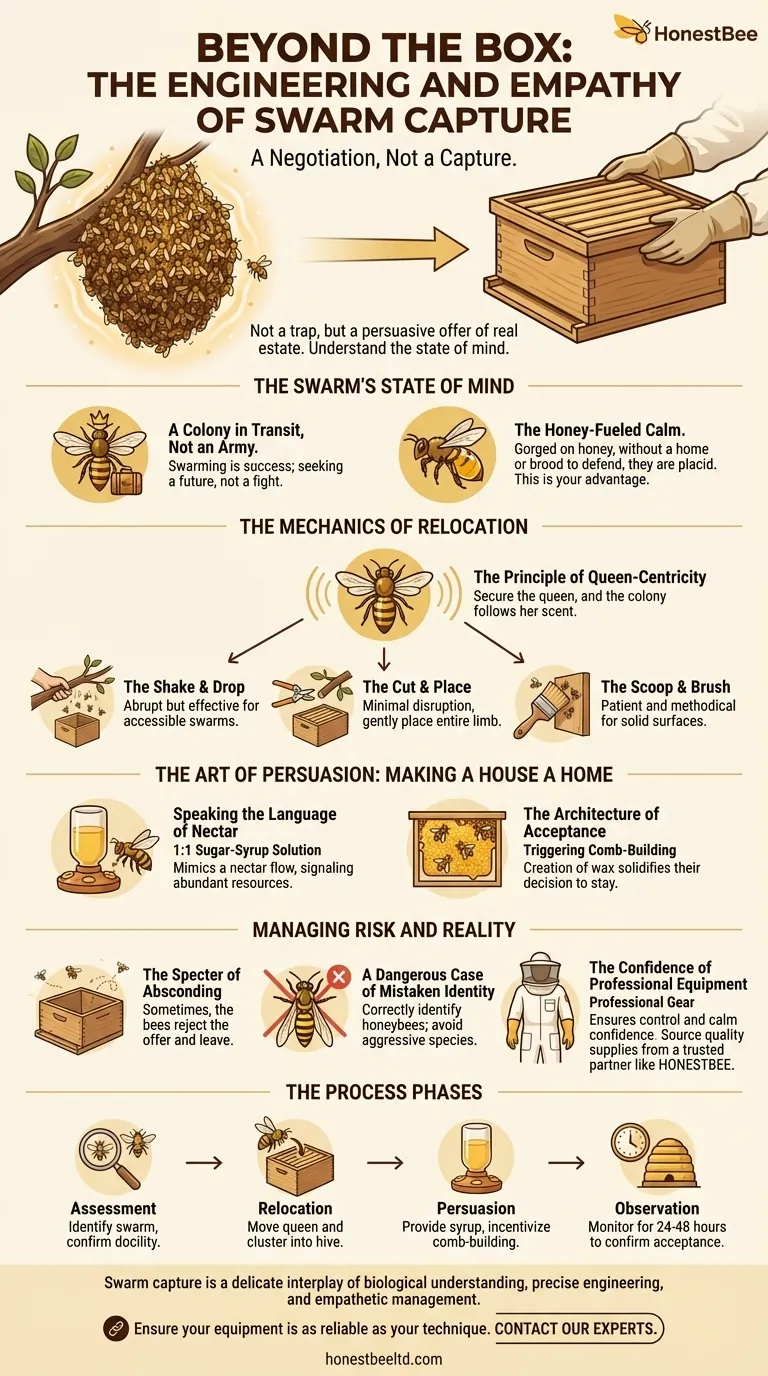
Visual Guide
Related Products
- HONESTBEE Professional Telescopic Pole Bee Swarm Catcher
- HONESTBEE Collapsible Tiered Bee Swarm Catcher for Beekeeping
- Reusable Clear Small Hive Beetle Traps for Beehives Beetle Trapping Tools
- Black Plastic Beetle Barn Hive Beetle Trap for Beehives
- Plastic Beetle Blaster Trap Beekeeping Tools and Supplies
Related Articles
- Swarm Catching for New Beekeepers: A Step-by-Step Safety Guide to Your First Successful Capture
- The Scent Plume Protocol: A Strategic Guide to Swarm Capture
- Beyond the Extra Box: The Calculus of Bee Swarm Prevention
- The Queen's Prison: How a Pollen Trap Can Create a Single Point of Failure in Your Apiary
- The Art of Gentle Intervention: A Guide to Pollen Trap Mechanics and Bee Psychology







