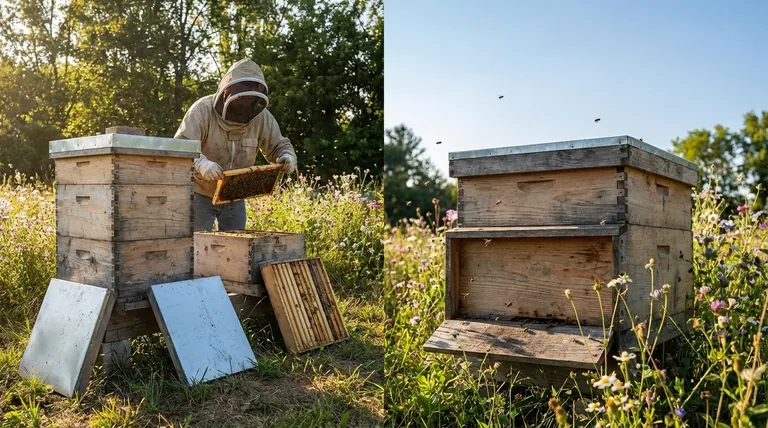
The Choice Is Not the Hive, But the Philosophy
In beekeeping, we often get lost in the details of equipment. We debate frame counts and box dimensions as if we're choosing components off a shelf. But the decision between a Langstroth and a Dadant hive is something deeper.
It's not a choice between two boxes. It's the adoption of an entire operating system.
You are choosing a philosophy of management, a workflow for your labor, and a bet on how a colony best thrives. This choice dictates how you interact with your bees, how you manage energy (both yours and the hive's), and ultimately, how your operation scales.
Two Blueprints for a Bee Colony
At a glance, the hives look similar. Both are vertical, modular systems with removable frames—a revolutionary concept in itself. But a single design decision, the depth of the brood chamber, creates two fundamentally different universes for the bees and the beekeeper.
The Langstroth: A System of Modular Control
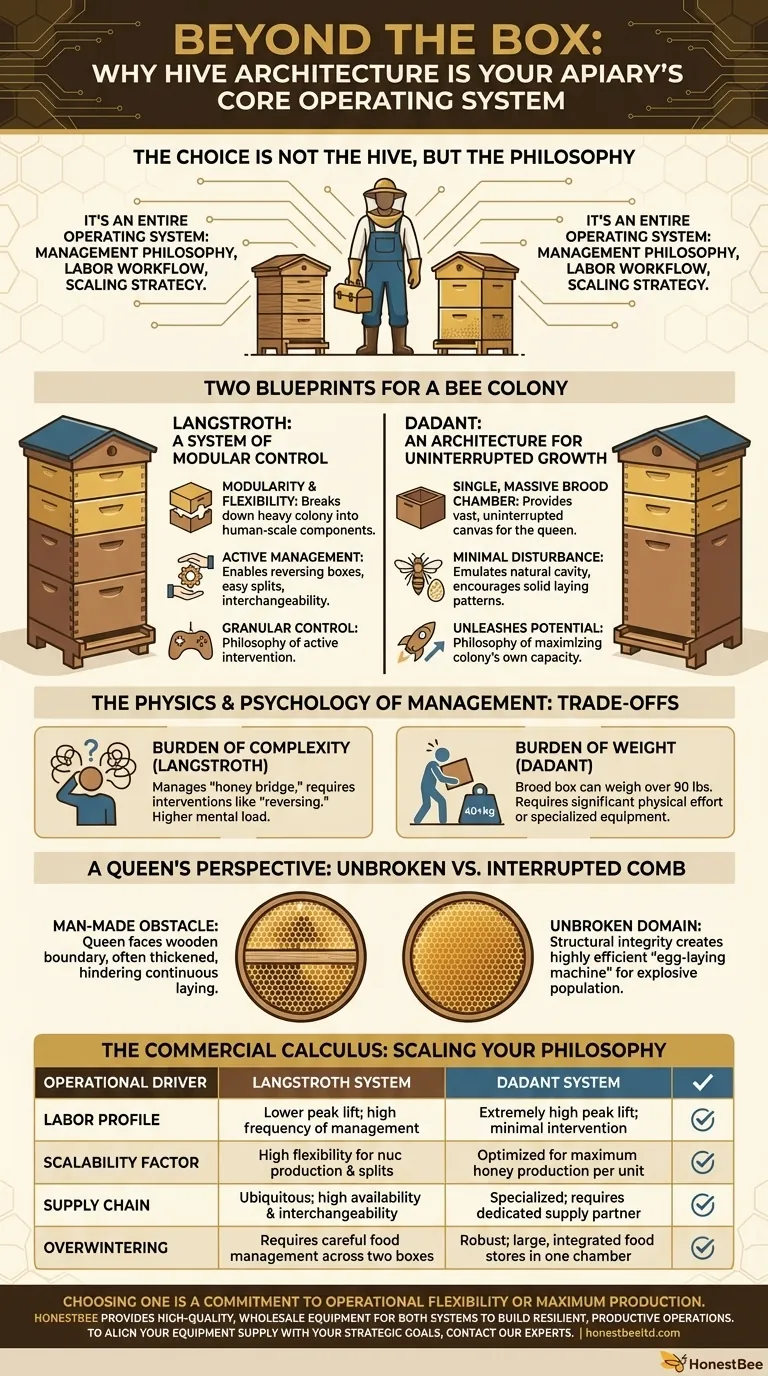
The Langstroth is the global standard for a reason. Its genius lies in its modularity. By using two stacked boxes for the brood nest, the system breaks down an impossibly heavy colony into manageable, human-scale components.
This is a system built for the beekeeper who values flexibility and intervention. You can reverse the boxes to stimulate expansion, easily make splits using a single box, and interchange equipment universally. The philosophy here is one of active management and granular control. The hive is a set of building blocks.
The Dadant: An Architecture for Uninterrupted Growth
The Dadant hive was born from a different observation. Its creator, Charles Dadant, believed the split brood chamber of the Langstroth was an artificial barrier to the queen's potential.
The Dadant hive is built around a single, massive brood chamber. The philosophy is to provide the queen a vast, uninterrupted canvas of comb. This design seeks to emulate a more natural cavity, encouraging her to lay in large, solid patterns and build a colossal workforce with minimal disturbance from the beekeeper. The hive is an architecture designed to unleash the colony's own potential.
The Physics and Psychology of Management
Every design decision imposes a trade-off. In beekeeping, these trade-offs are felt not just in spreadsheets, but in the physical strain on your back and the mental load of managing a living system.
The Burden of Weight vs. The Burden of Complexity
This is the central psychological trade-off.
A full Dadant brood box can weigh over 90 pounds (40+ kg). Its burden is one of pure physics. It often requires two people or specialized equipment to lift, making hive inspections a significant physical event.
The Langstroth system's burden is one of complexity. The beekeeper must manage the "honey bridge" that can form between the two brood boxes, discouraging the queen from moving freely. This leads to interventions like "reversing," a management task created entirely by the architecture of the hive itself.
A Queen's Perspective: The Unbroken vs. The Interrupted Comb
Imagine the world from the queen's perspective. Her biological imperative is to lay eggs in a continuous, expanding pattern.
In a dual-box Langstroth, she eventually reaches the wooden boundary of the top bars of the bottom box, often thickened with honey and pollen. It's a man-made obstacle in the heart of her nest.
In a Dadant, her domain is a deep, unbroken sheet of comb. This structural integrity allows her to build momentum, creating a highly efficient "egg-laying machine" that can produce an explosive population for the main nectar flow.
The Commercial Calculus: Scaling Your Philosophy
For a commercial apiary or distributor, this choice transcends a single hive and becomes the foundation of your entire business model. It's about standardizing a process that can be repeated hundreds or thousands of times efficiently.
| Operational Driver | Langstroth System | Dadant System |
|---|---|---|
| Labor Profile | Lower peak lift weight; higher frequency of management | Extremely high peak lift weight; minimal brood nest intervention |
| Scalability Factor | High flexibility for nuc production and splits | Optimized for maximum honey production per unit |
| Supply Chain | Ubiquitous; high availability and interchangeability | More specialized; requires a dedicated supply partner |
| Overwintering | Requires careful food management across two boxes | Robust; large, integrated food stores in one chamber |
Standardization vs. Specialization
The Langstroth ecosystem is built on standardization. For large-scale operations and distributors, this is a massive logistical advantage. Components are readily available and interchangeable, simplifying procurement and inventory management.
The Dadant is a specialized tool. It's an investment in a philosophy of maximizing the output of a single, massive colony. This model demands a robust supply chain for non-standard equipment and a labor plan that can accommodate its physical demands.
Choosing one is a commitment. It reflects whether your business model prioritizes operational flexibility or maximum per-hive production.
Whether your operation scales with the adaptable Langstroth or the powerful Dadant, having a dependable supply partner is non-negotiable. HONESTBEE provides the high-quality, wholesale equipment that commercial apiaries and distributors rely on to build resilient and productive operations. To align your equipment supply with your strategic goals, Contact Our Experts.
Visual Guide
Related Products
- Stainless Steel Round Beehive Air Vents for Ventilation
- Wholesales Dadant Size Wooden Bee Hives for Beekeeping
- Metal Hive Feet Bee Hive Stand for Ant Protection
- Metal Bee Hive Stand Bee Box Stand for Beekeeping
- Wooden Bee Hive Frames for Beekeeping and Wholesale
Related Articles
- How to Optimize Beehive Ventilation: Prevent Disease and Boost Colony Health
- The Silent Killer in the Hive: Why Moisture, Not Cold, Is Winter's Greatest Threat
- Beyond the Bee Box: Why Your First Apiary Investment Determines Your Success
- The Precision of Chaos: Navigating the Biological Risks of Commercial Beehive Transportation
- The Art of Intervention: A Systems Approach to Beehive Maintenance













