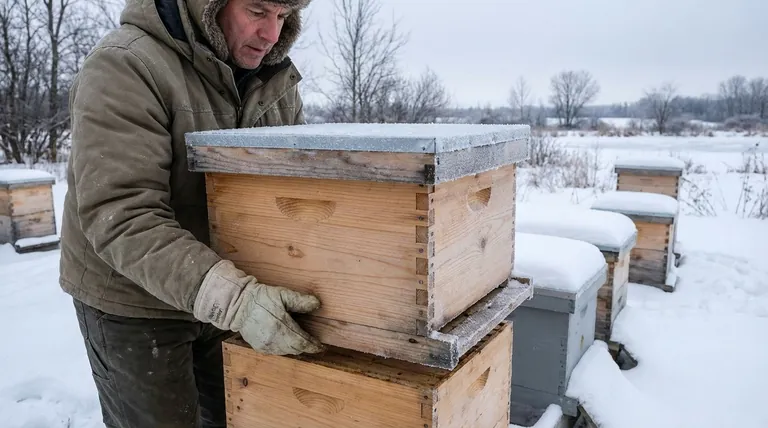
The Surgeon’s Dilemma
In medicine, a surgeon’s hardest decision is often when not to operate. An intervention, however well-intentioned, carries its own risks. The desire to open up the patient and "just take a look" can be catastrophic if the system is too fragile to handle the disruption.
A winter bee colony is that fragile system.
For beekeepers, especially those managing hundreds of nucs, the instinct to check on their bees during the cold months is powerful. We are conditioned to solve problems by observing them directly. Yet in winter, this instinct is a liability. The single most destructive act you can perform is to follow your curiosity.
The Lethal Kindness of a "Quick Peek"
A honeybee colony survives winter by forming a tight cluster, meticulously sealing every crack in their hive with propolis, and generating heat by vibrating their wing muscles. They create a pocket of warmth in a cold world, fueled entirely by their honey reserves.
Opening the hive, even for 30 seconds, is like tearing a hole in an astronaut's spacesuit.
The propolis seal shatters. Precious heat rushes out, replaced by a blast of cold, damp air. The colony, shocked, must now burn through its finite supply of honey at an accelerated rate just to get back to a stable temperature. A "quick peek" can be a death sentence, delivered with the best of intentions.
Judging Survival by a Different Sense
If sight is forbidden, how do we assess the colony's health? We switch senses. We rely on weight.
The practice is called "hefting." It is the cornerstone of winter management and a profound exercise in trusting an indirect signal over a direct one.
Calibrating Your Hands
Trust begins with a baseline. In late fall, after your nucs are provisioned for winter, heft each one. Lift it gently from the back, feeling the dense, reassuring weight of a full pantry. This sensation is your control group. It’s the memory your hands must hold onto for the next four months.
This isn't just a chore; it's the act of calibrating your most important diagnostic tool.
The Monthly Ritual
Beginning the week after Christmas, and once a month thereafter, repeat the process. Approach the nuc, gently heft it, and compare the feeling to your memory from the fall. The entire diagnosis takes less than five seconds.
The question you are asking is simple: Is this hive still heavy? Or is it becoming dangerously light?
The Intervention: When Action is Unavoidable
If the heft reveals a light nuc, the risk of starvation now outweighs the risk of intervention. Action is required, but it must be executed with the speed and precision of a pit crew.
Your goal is to be in and out in under 30 seconds.
The Anatomy of an Emergency Feed
This is not routine feeding; it is emergency life support. The type of food is critical.
| Feed Type | Why It Works (or Fails) |
|---|---|
| Solid Feed (Recommended) | Fondant, sugar bricks, or winter patties provide pure carbohydrates without adding moisture. The bees can consume it as needed from above the cluster. |
| Liquid Syrup (Avoid) | Introduces excess moisture, which can condense and drip cold water onto the bees. It also increases the risk of dysentery. |
Providing the right feed is as crucial as the intervention itself. Using liquid syrup in winter is like giving a hypothermia patient a cold drink.
The 30-Second Procedure
On the calmest, mildest day possible (ideally above 40°F / 4.5°C), perform the following steps without hesitation:
- Have your solid feed ready at hand.
- Quickly pry open the outer lid and remove the inner cover.
- Place the feed directly on the top bars, right above the bee cluster.
- Immediately replace the inner cover and outer lid.
Do not look for the queen. Do not inspect frames. Your only mission is to deliver the calories and seal the hive.
The Psychology of Restraint
Knowing the right procedure is easy. The difficult part is mastering the psychology of doing less.
Resisting the Urge for Visual Confirmation
The feeling that a nuc is "light" is an abstract piece of data. The urge to confirm it with your eyes—to see the empty honeycomb—can be overwhelming. You must learn to trust your hands. The discipline of winter beekeeping is a battle between your brain's need for certainty and the colony's need for stability.
The Asymmetry of Risk
A beginner often struggles with judging weight. What if you're wrong?
Consider the two possible errors:
- You think a heavy hive is light and give it an unnecessary sugar patty. (Minor disturbance, wasted feed).
- You think a light hive is heavy and do nothing. (Colony starves).
The consequences are not symmetrical. When in genuine doubt, it is always safer to provide an insurance patty than it is to risk a colony's life.
This discipline is supported by having the right tools on hand before an emergency arises. A stock of durable nucs and high-quality winter feed isn't just inventory; it's a pre-planned response system that enables decisive, minimalist action. For commercial apiaries, ensuring every colony is equipped for this approach is a matter of scale and preparation.
If you're looking to standardize your winter protocols with reliable, wholesale equipment, Contact Our Experts.
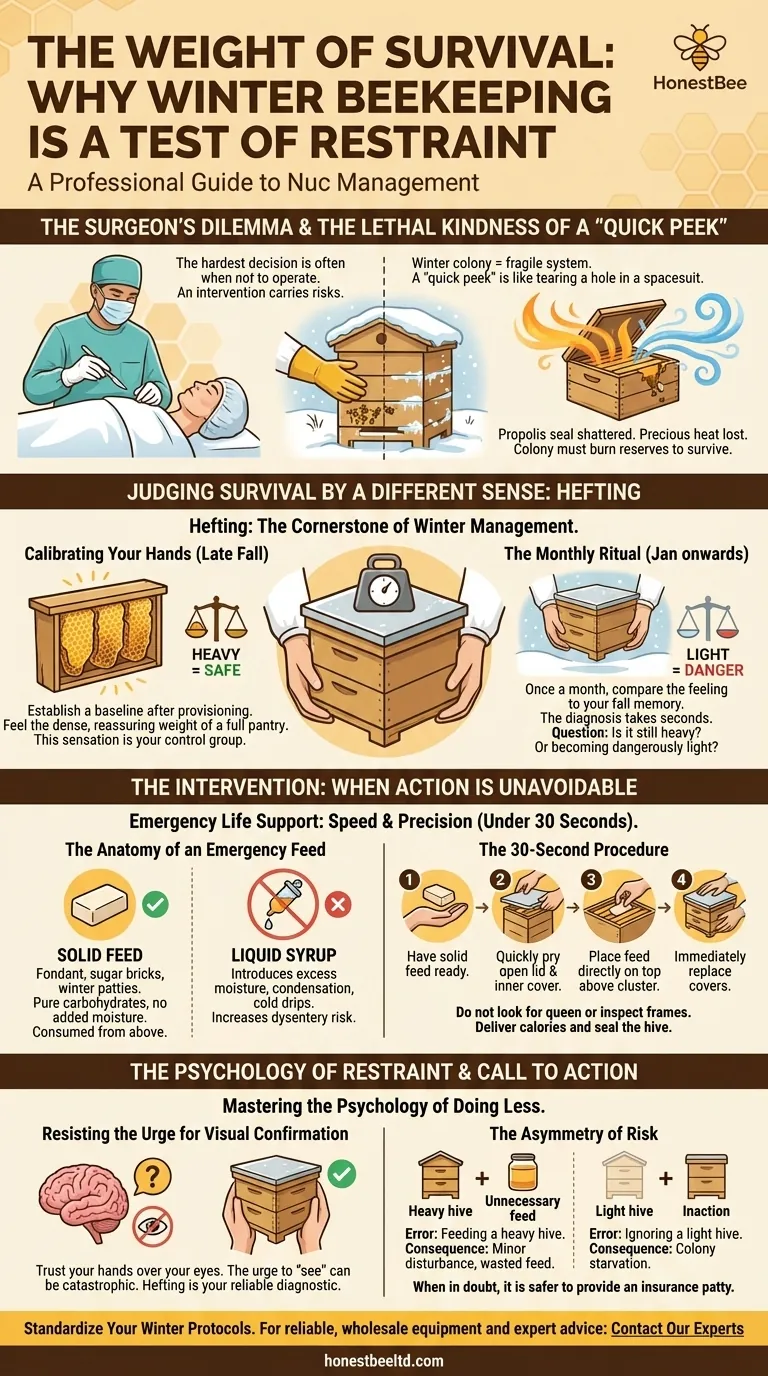
Visual Guide
Related Products
- Durable Plastic Hive Number Set for Beekeeping
- Stainless Steel Round Beehive Air Vents for Ventilation
- HONESTBEE Professional Hive Top Bee Feeder Feeding Solution
- Professional Large-Format Hive Number Set for Beekeeping
- HONESTBEE Professional Long Handled Hive Tool with Precision Cutting Blade
Related Articles
- Hive Thermodynamics: The Unseen Clock Governing Winter Survival
- How Beekeepers Can Diagnose Queen Issues and Prevent Colony Collapse
- The Material Calculus: A Beekeeper's Choice Between Nature and Durability
- Rethinking the Beehive: Why Material Choice is a Bet on Your Time and Sanity
- The Tipping Point: How the 7/10 Rule Prevents a Beehive's Silent Collapse


















