A Single Drop Holds the Fate of a Harvest
A commercial beekeeper stands before a stainless steel tank holding thousands of pounds of honey. The entire season's work—countless hours, the labor of millions of bees—is contained within.
The value of this harvest hinges on one question: is the moisture content low enough to prevent fermentation?
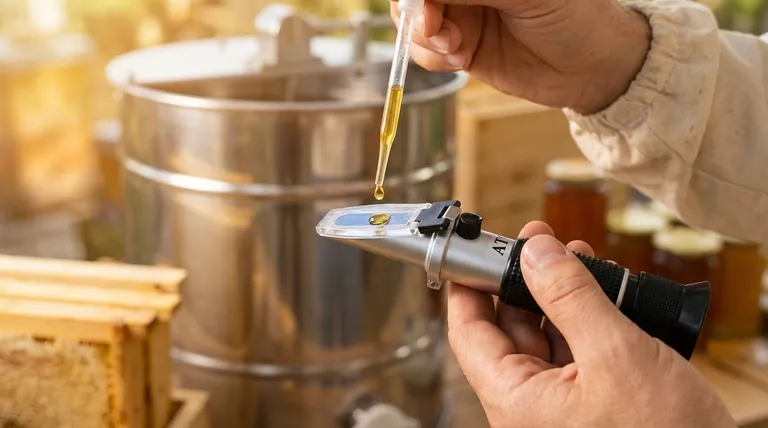
The answer comes from a single drop of honey placed on a small glass prism. The instrument used, a honey refractometer, provides a number. But that number is the end of a story that begins with physics and ends with psychology. Simply getting a reading gives you data; understanding the principles behind it gives you control.
What a Refractometer Truly Sees
A refractometer does not measure water. It measures a far more fundamental property of the universe: how light behaves when it enters a new medium.
The Principle of Refractive Index
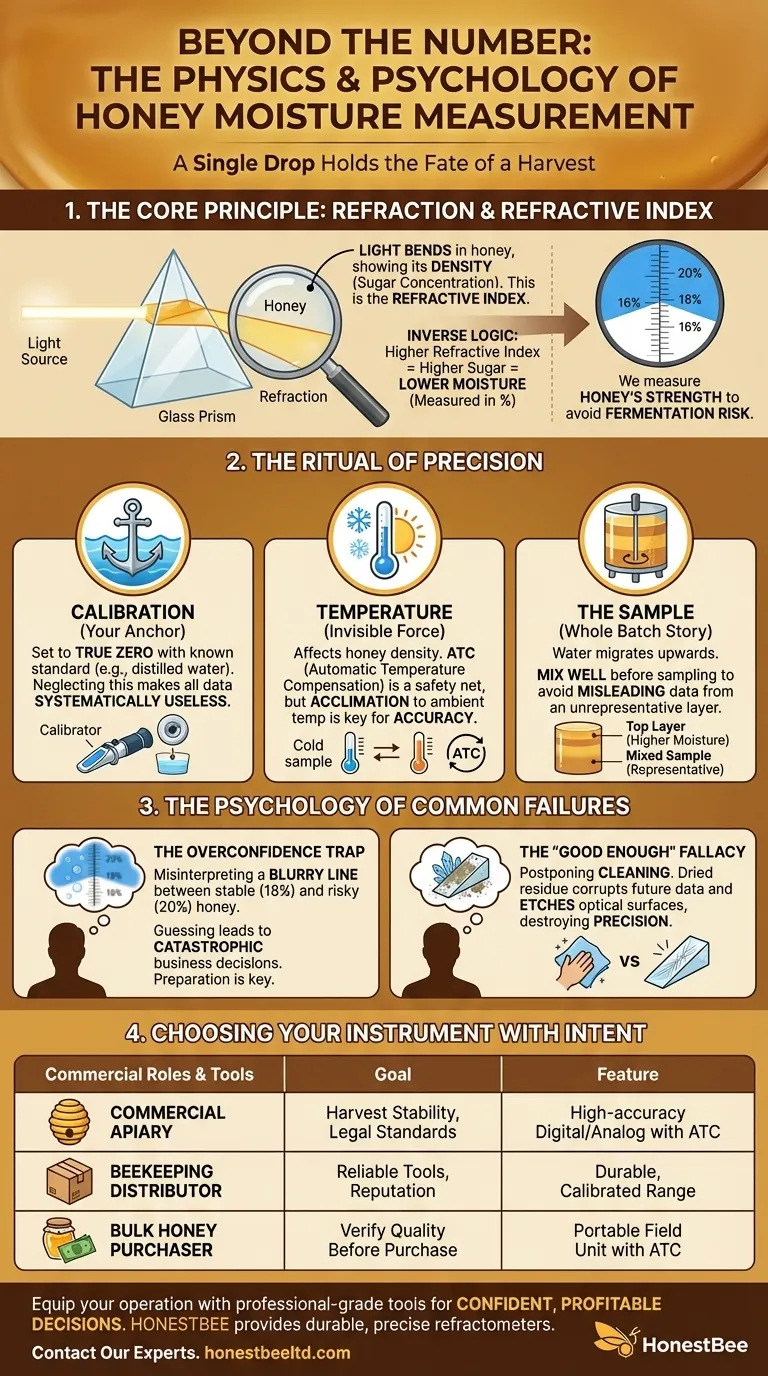
When light passes from the air into honey, it slows down and bends. This phenomenon is called refraction. The degree to which it bends is its refractive index.
The denser the honey—meaning, the higher the concentration of sugar—the more it bends the light. The instrument is, at its core, a device for quantifying this bend with extreme precision.
The Inverse Logic of Honey Quality
The scale on a honey refractometer is a brilliant piece of engineering. It translates the refractive index (a measure of sugar density) into its inverse: the percentage of water.
This is a crucial insight. A higher refractive index means higher sugar concentration, which corresponds to a lower moisture content. We are measuring the honey's strength to diagnose its primary vulnerability.
The Rituals of Precision
Getting an accurate reading is not a casual act. It's a deliberate process where each step is designed to eliminate a hidden variable that could corrupt the data and lead to a catastrophic business decision.
H3: Calibration: Your Anchor in Reality
Before every use, the refractometer must be calibrated against a known standard, like distilled water. This sets the instrument to a true zero point.
Skipping calibration is a cognitive trap. We assume the instrument is "probably fine." But it's like building a skyscraper on an unverified foundation. Every subsequent measurement inherits the initial error, rendering all data systematically useless. Calibration isn't a suggestion; it's a pact with reality.
H3: Temperature: The Invisible Force
Temperature is the silent collaborator in every measurement. It alters the density of honey, directly impacting its refractive index. A reading on cold honey will differ from warm honey, even if the moisture content is identical.
Modern refractometers with Automatic Temperature Compensation (ATC) are designed to correct for this. But relying on ATC without understanding the principle is risky. The best practice is always to allow both the sample and the instrument to acclimate to ambient temperature. This makes ATC a safety net, not a substitute for good procedure.
H3: The Sample: A Story of the Whole Batch
Taking a sample from the top layer of honey in a large tank is easy, but it can be misleading. Water is lighter than honey solids and can migrate upwards over time, creating layers.
An unrepresentative sample doesn't just give you a bad reading; it gives you a false sense of security. A truly professional operation ensures the batch is well-mixed before drawing a sample, ensuring the reading tells the story of the entire tank, not just its most convenient part.
The Psychology of Common Failures
Knowing the right steps is one thing. Understanding why we are tempted to skip them is another. Most failures with precision instruments are rooted in human psychology, not mechanical error.
The Overconfidence Trap: Misinterpreting the Scale
The line between stable, high-value honey (e.g., 18% moisture) and honey at risk of fermentation (20%) is razor-thin on the refractometer's scale. A blurry line caused by air bubbles or crystals tempts us to guess or round in our favor.
This requires intellectual honesty. A blurry reading is not a reading; it's a signal to prepare a better sample. Resisting the urge to "make it work" protects your reputation and your bottom line.
The "Good Enough" Fallacy: Improper Cleaning
After a reading, the prism must be cleaned immediately with a soft, damp cloth. It's easy to postpone this, especially at the end of a long day.
But dried honey residue is the ghost of a past measurement. It doesn't just make the next reading inaccurate; its crystalline structure can permanently etch the delicate optical surface, destroying the instrument's precision over time. Proper cleaning is not janitorial work; it's an investment in future accuracy.
Choosing Your Instrument with Intent
For commercial operations, the refractometer isn't just a tool; it's a critical piece of risk management infrastructure.
| Your Role | Primary Goal | Essential Tool Feature |
|---|---|---|
| Commercial Apiary | Ensure harvest stability, meet legal standards | High-accuracy digital or analog model with ATC |
| Beekeeping Distributor | Supply reliable tools, uphold your reputation | A range of durable, calibrated refractometers |
| Bulk Honey Purchaser | Verify quality of incoming supply before purchase | Portable, reliable field unit with ATC |
For commercial apiaries and distributors committed to this level of precision, having a reliable supply of professional-grade tools is non-negotiable. HONESTBEE provides the durable, precise refractometers necessary to turn data into confident, profitable decisions.
Contact Our Experts to equip your operation with the tools that safeguard your honey's quality and your business's reputation.
Visual Guide
Related Products
- Digital Honey Refractometer for Precision Measurement of Optimal Honey Quality
- Precision Honey Refractometer Instrument for Quality Assessment
- High Quality Honey Dehumidifier Dryer Thickening Machine for Beekeeping
- Modern Stainless Steel Honey Dipper Stirrer
- Honey Concentrating and Filtering Dehumidifier Machine 2T Capacity for Honey
Related Articles
- The Physics of Perfection: Why a Single Number Determines Your Honey's Fate
- How to Accurately Test Honey Readiness: Science-Backed Methods for Beekeepers
- How to Perfect Honey Moisture Levels: A Beekeeper’s Guide to Refractometer Mastery
- From Ambiguity to Certainty: The Practical Case for Digital Honey Refractometers
- Precision in a Drop: Why Your Honey Refractometer Might Be Lying to You