Beekeepers know honey supers are the backbone of efficient honey production—but are you using yours to their full potential? This guide unpacks practical strategies for selecting, maintaining, and harvesting supers to maximize yield while safeguarding colony health.
Honey Super Essentials for Modern Beekeeping
Anatomy of a Productive Super System
Honey supers are more than just storage boxes; they’re engineered ecosystems. The right system balances bee accessibility, comb stability, and beekeeper ergonomics. Research shows medium-depth supers strike this balance best, offering ample honey storage without the back strain of deeper models.
Selecting Your Super: Medium vs. Shallow Tradeoffs
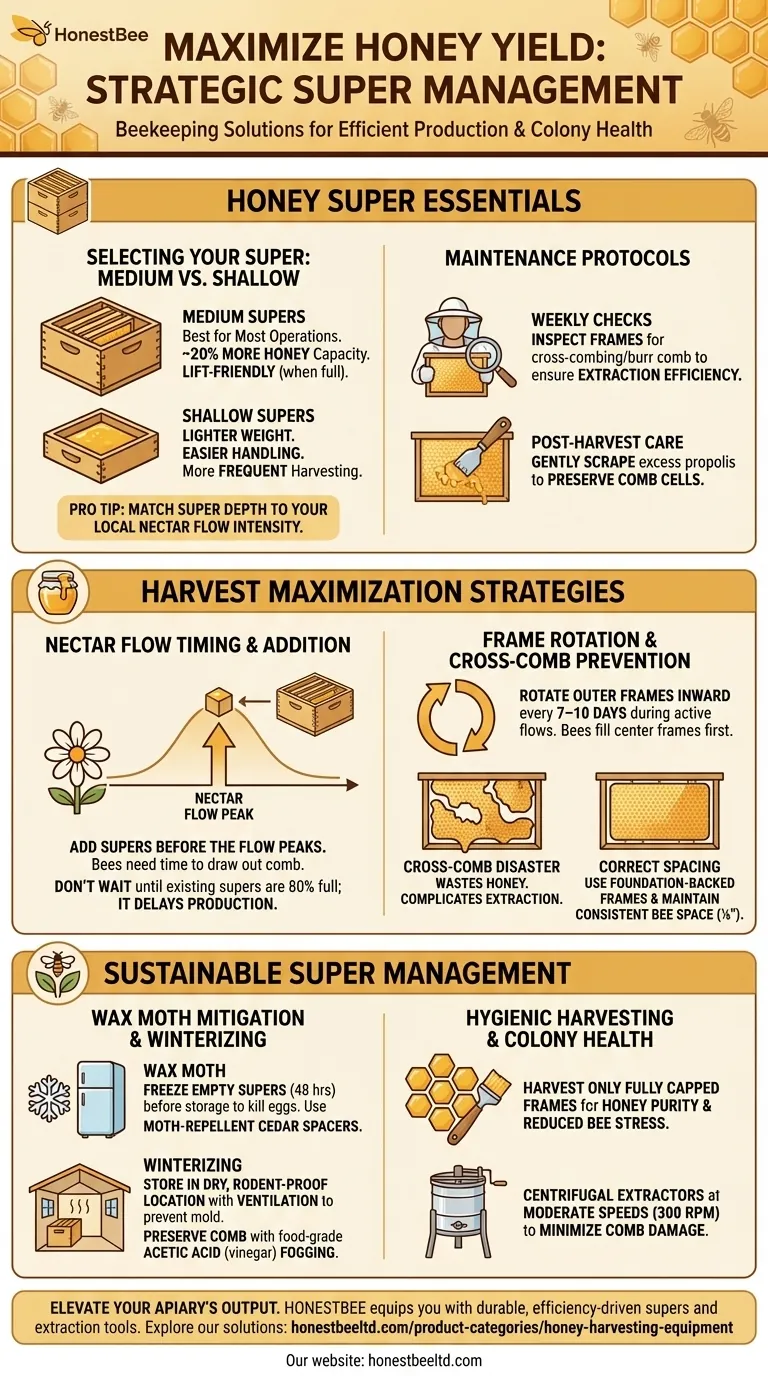
- Medium Supers: Ideal for most operations, holding ~20% more honey than shallow models while remaining liftable when full.
- Shallow Supers: Lighter and easier to handle but require more frequent harvesting during heavy nectar flows.
Pro Tip: Match super depth to your local nectar flow intensity. Areas with sporadic flows benefit from shallow supers’ flexibility.
Maintenance Protocols for Comb Preservation
- Weekly Checks: Inspect frames for cross-combing or burr comb, which reduce extraction efficiency.
- Post-Harvest Care: Scrape excess propolis gently to avoid damaging comb cells.
Harvest Maximization Strategies
Nectar Flow Timing and Super Addition
Add supers before the flow peaks—bees need time to draw out comb. A common mistake is waiting until existing supers are 80% full; this delays production.
Frame Rotation Techniques
Rotate outer frames inward every 7–10 days during active flows. Bees often fill center frames first, leaving outer combs underutilized.
Preventing Cross-Comb Disasters
Cross-combing wastes honey and complicates extraction. Use foundation-backed frames and maintain consistent bee space (⅛" between frames).
Sustainable Super Management
Wax Moth Mitigation in Stored Supers
- Freeze empty supers for 48 hours before storage to kill moth eggs.
- Stack supers with moth-repellent cedar spacers or para-dichlorobenzene crystals (follow local regulations).
Winterizing Supers for Multi-Season Use
- Store supers in a dry, rodent-proof location with ventilation to prevent mold.
- Preserve comb integrity by fogging with food-grade acetic acid (vinegar) to deter pests.
Hygienic Harvesting to Maintain Colony Health
- Harvest only fully capped frames to ensure honey purity and reduce stress on bees.
- Use centrifugal extractors at moderate speeds (300 RPM) to minimize comb damage.
Ready to Elevate Your Apiary’s Output?
HONESTBEE equips commercial beekeepers and distributors with durable, efficiency-driven supers and extraction tools—because your success hinges on equipment that works as hard as your bees. Explore our beekeeping solutions today.
Visual Guide
Related Products
- Professional Large-Format Hive Number Set for Beekeeping
- Precision Stainless Steel Frame Cleaner for Hive Grooves and Corners
- Durable Plastic Hive Number Set for Beekeeping
- Premium Traditional Copper Bee Smoker with Bellows
- HONESTBEE Premium Italian Style Hive Tool with Hardwood Handle
Related Articles
- Beyond the Bee Box: Why Your First Apiary Investment Determines Your Success
- The Silent Killer in the Hive: Why Moisture, Not Cold, Is Winter's Greatest Threat
- More Than a Number: Why the 8-Frame vs. 10-Frame Hive Debate Is About Psychology, Not Just Production
- How Bee Space Dictates Hive Success: Science-Backed Management Strategies
- Guide to Starting a Bee Hive in 7 Steps














